
 +62 895 001 924 667



Property taxes in Bali are not a single charge. They fall into several distinct categories, each arising at a different stage of ownership: buying, holding, earning rental income and eventually selling all trigger separate obligations — collected by different authorities, on different bases, at rates that vary by location and transaction structure.
The four most common obligations are: BPHTB, the acquisition duty payable when a buyer takes on qualifying land or building rights; PPh, the final income tax applied to sellers on a transfer and to rental or accommodation income under different rules depending on the transaction, taxpayer and classification; PBB-P2, the annual land and building tax charged during ownership; and VAT, which applies conditionally to qualifying new residential property from registered developers. Properties operated for short-stay tourist accommodation may also encounter a local levy known as PBJT.
Two points matter upfront. First, several of these taxes are set locally. PBB-P2 rates are determined by kabupaten or kota regulation, and the non-taxable thresholds within BPHTB calculations differ between regions. Applying a blanket rate to every property anywhere on the island produces an estimate, not an accurate figure. Second, the party who bears the legal obligation to pay a tax and the party who actually carries the cost under a contract are often different. Buyers and sellers regularly negotiate how transaction taxes are allocated — and any such allocation should be expressly documented in the written agreement.
How much you pay depends on the transaction structure, the type of land right involved, the property’s official assessed value, its location and your tax residency status. What follows covers each stage in order.
How Much Is Property Tax in Bali in 2026?
For a qualifying registered property-right purchase, buyers generally pay BPHTB of up to 5% on the taxable acquisition value after the applicable local allowance. Sellers generally pay 2.5% final income tax on the gross transfer value. Annual PBB-P2 has a statutory rate ceiling of 0.5%, but the actual bill depends on the local rate, taxable proportion, assessed NJOP and relief. Ordinary land and building rental income is generally subject to 10% final income tax on gross rent.
VAT and accommodation taxes depend on the transaction and activity. Contractual leaseholds, foreign ownership structures and short-stay accommodation require separate assessment.
Bali Property Taxes at a Glance
The table below summarises the main property taxes in Bali, the point at which each arises and who typically bears the obligation.
| Tax | When It Applies | Who Usually Pays | Rate or Basis |
|---|---|---|---|
| BPHTB (Acquisition Duty) | On acquisition of qualifying land and building rights | Buyer | Typically 5% of taxable value above the local non-taxable threshold (NPOPTKP); minimum threshold set by Law No. 1 of 2022 |
| PPh on Transfer (Final Income Tax) | On transfer of land and building rights | Seller | Typically 2.5% of gross transfer value; general regime under GR 34/2016 |
| PBB-P2 (Annual Land & Building Tax) | Annually, during ownership or control | Legal holder or person with effective control or benefit; often allocated by contract | Up to 0.5% of locally assessed taxable proportion of NJOP after applicable threshold; actual rate and proportion set by regional regulation |
| PPh on Rental Income | On rental or accommodation income, under different rules depending on the transaction, taxpayer and classification | Recipient of qualifying rental income | 10% of gross rental income as a final tax for ordinary land and building leases (PP 34/2017); accommodation income may follow a different regime |
| VAT / PPN | On qualifying new residential property from registered developers | Buyer | Statutory rate 12%; many non-luxury supplies carry an effective 11% charge under PMK 131/2024; government incentives available for eligible properties in 2026 |
| PBJT (Accommodation Tax) | On qualifying short-stay accommodation services | Consumption tax borne by customer, collected and remitted by the service provider | Rate set by applicable local regulation |
Three distinctions shape how this table should be read.
Local versus national taxation. PBB-P2 and PBJT are local taxes administered by the relevant kabupaten or kota. BPHTB is nationally framed under Law No. 1 of 2022 on Financial Relations between the Central Government and Regional Governments, but it is locally administered and the non-taxable threshold — NPOPTKP — can differ between regions.
Legal taxpayer versus contractual allocation. Indonesian law defines who is legally responsible for each tax. In practice, sale contracts regularly reassign the economic burden between parties. A seller may agree to cover BPHTB as a deal term; this does not change the legal structure, but it changes what each side nets. Any such arrangement must be explicitly stated in writing.
Transfer of registered rights versus an ordinary lease. BPHTB applies to the acquisition of a registered land right — Hak Pakai (Right of Use), HGB (Right to Build) or Hak Milik (Freehold). An ordinary contractual long-term leasehold arrangement that does not involve the acquisition of a qualifying land or building right generally does not trigger BPHTB merely by being signed. Transactions combining lease arrangements with transfers or grants of registered rights require separate review. This distinction affects both the acquisition costs and how ongoing tax obligations are structured for the duration of the arrangement.
Taxes When Buying Property
Purchasing property in Bali involves two main transaction-level taxes: an acquisition duty on the buyer’s side and a final income tax on the seller’s side. VAT may also apply to qualifying new-build properties.
BPHTB and Transfer Income Tax
BPHTB — Bea Perolehan Hak atas Tanah dan Bangunan — is the duty payable when a buyer acquires qualifying rights to land and buildings. Under the general framework, the rate is 5%, applied to the taxable value of the transaction. That taxable value is the difference between the applicable transaction price or the government’s assessed NJOP and the NPOPTKP, the local non-taxable threshold set by each kabupaten or kota.
For a sale and purchase, BPHTB generally uses the transaction price, but the applicable NJOP is used if the acquisition value is unknown or below NJOP. Other forms of acquisition follow different valuation rules under Law No. 1 of 2022. The NPOPTKP minimum is established by national law — for a first acquisition in a region, Law No. 1 of 2022 sets a minimum of IDR 80,000,000 — but the exact applicable threshold must be confirmed against local regulation for each transaction.
On the seller’s side, PPh on the transfer of land and building rights is a final income tax under Government Regulation No. 34 of 2016. The BPHTB framework is established by Law No. 1 of 2022 and the applicable local regulations. For general qualifying transactions, the rate is 2.5% of the gross transfer value — not of the profit. This means both buyer and seller carry separate tax obligations at the point of a registered right transfer, and the written sale agreement should confirm who bears each.
The timing of BPHTB is important when purchasing off-plan or under a binding sale and purchase agreement (PPJB). Under Government Regulation No. 35 of 2023, the tax may become due when the qualifying PPJB is signed, rather than only when the final land transfer deed is executed. Buyers should ask their PPAT to confirm the taxable event and payment deadline before signing either document.
Official guidance on income tax treatment of property ownership is published by the Directorate General of Taxes.
For buyers who need to understand the legal structures through which a foreigner can access Bali property, see “How a foreigner can buy property in Bali“.
Example: Taxes on an IDR 3 Billion Property Purchase
| Item | Illustrative calculation | Amount |
|---|---|---|
| Property acquisition value | Assumed price | IDR 3,000,000,000 |
| Buyer’s BPHTB | 5% × (3B − 80M) | IDR 146,000,000 |
| Seller’s transfer PPh | 2.5% × 3B | IDR 75,000,000 |
| Combined transaction taxes | BPHTB + PPh | IDR 221,000,000 |
| VAT | Depends on transaction | Not included |
| Notary, PPAT, registration | Quoted separately | Not included |
This example assumes a qualifying registered-right transfer, a 5% BPHTB rate, an applicable IDR 80 million allowance and the general 2.5% seller tax. It does not mean the buyer is legally liable for both taxes.
VAT and Purchase Fees
Indonesia’s statutory VAT rate is 12%, but under PMK 131/2024, many non-luxury taxable supplies use an adjusted tax base of 11/12 of the selling price, resulting in an effective 11% charge. The exact VAT treatment of a specific property sale must be confirmed from the developer’s tax invoice and the applicable regulatory category. VAT applies to qualifying supplies of new residential property by developers registered as PKP (taxable persons). Secondary market sales, contractual leasehold arrangements and sales by private non-registered individuals do not generally trigger it in the same way.
For 2026, PMK 90/2025 provides government-borne VAT on the eligible portion of qualifying ready-to-occupy houses or apartments priced at no more than IDR 5 billion, covering VAT attributable to the first IDR 2 billion. Eligibility requires the prescribed deed or fully paid binding sale agreement and handover within 2026, compliance with the advance-payment, invoicing, reporting and transfer restrictions, and satisfaction of buyer eligibility rules. Eligible foreign individuals must hold an Indonesian NPWP and meet the applicable foreign home-ownership requirements. This incentive is not automatic and not universal. The current regulation is available on the Directorate General of Taxes portal.
Example: VAT Incentive on a New IDR 3 Billion Home
| Item | Illustrative amount |
|---|---|
| Qualifying home price | IDR 3,000,000,000 |
| Assumed effective VAT rate | 11% |
| VAT before incentive | IDR 330,000,000 |
| Government-borne VAT on first IDR 2B | IDR 220,000,000 |
| Remaining VAT payable | IDR 110,000,000 |
This example assumes the property and buyer meet every requirement of PMK 90/2025 and that the relevant supply is subject to an effective 11% VAT calculation. The incentive is not a blanket exemption for every villa or apartment in Bali.
Before committing to any purchase, request the following from the seller, developer or appointed PPAT:
- Written confirmation of whether VAT applies and which party bears it
- The most recent SPPT PBB (annual tax notice) and proof of all payments to date
- The current NJOP stated in the PBB assessment
- The land certificate identifying the type of land right and its registration status
- A written breakdown of transaction costs, specifying notary fees, registration charges, BPHTB and any contractual cost-sharing
Notary fees, land registration charges, due diligence costs and property management fees are not government taxes. They are transaction costs and their allocation should be agreed separately.
Explore New Villas and Apartments in Bali





 Bali, Uluwatu
 from 85м²
 Bali,Sesehfrom 96м²

Annual Property Tax in Bali
PBB-P2 — Pajak Bumi dan Bangunan Pedesaan dan Perkotaan — is the annual land and building tax. It applies to most parcels of land and their associated buildings regardless of whether they generate income, and it is a recurring obligation for the duration of ownership or control.
The tax base is NJOP — Nilai Jual Objek Pajak, the government’s official assessed value of the property. NJOP is an administrative figure, not a market valuation. In high-demand areas across Bali — Seminyak, Canggu, Uluwatu, Ubud — the NJOP may differ materially from current transaction prices. A reassessment can affect PBB-P2, but the final annual bill also depends on the locally determined taxable proportion, the applicable tax rate and any available relief.

Each year the relevant local government issues an SPPT PBB — Surat Pemberitahuan Pajak Terutang, the annual tax assessment notice. Review the SPPT PBB and any supporting local assessment records for the NOP (Nomor Objek Pajak, the property’s tax identification number), the NJOP, the applicable relief, the tax due and the payment deadline. PBB-P2 payment deadlines are set locally; consult the current SPPT and the relevant local revenue office rather than assuming a uniform Bali-wide deadline.
Law No. 1 of 2022 sets the maximum PBB-P2 rate at 0.5%. Actual rates are established by local perda (regional regulation) and may be lower in a given regency. The 0.5% figure is the statutory ceiling for the tax rate, not a forecast of the effective burden — the locally determined taxable proportion and any applicable relief also affect the final amount. The actual figure for any specific property in Badung, Gianyar, Denpasar or elsewhere on Bali must be verified against the applicable local regulation.
Annual PBB-P2 rates differ between Bali’s regencies and municipalities. The national ceiling is not the amount every owner pays. Local regulations determine the applicable rate, non-taxable allowance and assessment methodology. Before relying on any published example, verify the current rules with the local revenue authority and compare them with the property’s latest SPPT PBB.
The purchase price is not your annual property tax base. Check the property’s official assessment and latest PBB notice before estimating the bill.
How to Calculate PBB
The PBB-P2 calculation incorporates a locally determined taxable proportion applied to the net assessed value, not simply the full NJOP. The simplified structure is:
PBB-P2 = local PBB-P2 rate × locally determined taxable proportion (20%–100%) × (NJOP − applicable NJOPTKP)
The local assessment rules, the applicable taxable proportion and any adjustments must be verified against the relevant kabupaten or kota regulation before producing a final figure.
Using illustrative assumptions: an NJOP of IDR 2,000,000,000, an NJOPTKP of IDR 12,000,000, a taxable proportion of 40% and a local rate of 0.3% produces:
0.003 × 40% × (2,000,000,000 − 12,000,000) = 0.003 × 0.4 × 1,988,000,000 = IDR 2,385,600 per year
These inputs are hypothetical, not confirmed Bali rates. The taxable proportion, NJOPTKP and applicable rate vary by location. To find the real annual PBB for a specific property, request the most recent SPPT PBB from the seller or the relevant local BPKPD office.
Paying Your Annual PBB
Once ownership or control of a property is established, the annual PBB process involves the following steps:
- Locate the SPPT PBB. The annual assessment notice is issued by the local authority. Ask any seller to provide copies for the last two to three years before the transaction closes.
- Verify the NOP details. Cross-check the property location, address, land area, buildings and tax-object details associated with the NOP against the land certificate and the physical property. Discrepancies can signal unregistered improvements or cadastral problems. Investigate any discrepancies with the relevant authorities before proceeding.
- Review the NJOP trend. Compare the NJOP in recent notices to check for reassessments that would affect future tax amounts.
- Note the payment deadline. Payment deadlines are set by the local authority. Confirm the current deadline from the SPPT or the relevant local revenue office. Late payment attracts administrative charges.
- Use approved payment channels. Accepted methods — designated banks, registered payment points or digital platforms — vary by kabupaten. Confirm what is accepted for the specific property location.
- Retain proof of payment. Keep payment evidence and ask the appointed PPAT which PBB records and receipts are required for the proposed transaction.
What If Your PBB Assessment Is Incorrect?
If your annual PBB-P2 bill appears incorrect, compare the SPPT PBB with the property’s actual land area, building details and local assessment records. An incorrect assessment may require an administrative correction or a formal tax objection, depending on the issue. Contact the relevant local revenue office (Bapenda or BPKPD) and confirm the applicable procedure, supporting documents and deadline. Do not assume that filing an objection automatically suspends payment or removes penalties.
Leasehold vs Freehold Taxes
In the Bali property market, “leasehold” typically describes a contractual long-term land lease — a personal agreement under which the buyer obtains agreed rights to occupy and use land for a fixed term. Any construction or development remains subject to the contract and applicable permits and land-use rules. Contractual lease terms and any extension rights are negotiated individually; do not assume a statutory duration or an automatic renewal right. This arrangement does not involve the transfer of a registered title. Indonesian “freehold” refers to Hak Milik, which only Indonesian citizens can hold directly. Foreign individuals may access Hak Pakai under certain conditions, while foreign investment companies (PT PMA) can hold HGB.
These legal differences produce direct tax consequences.
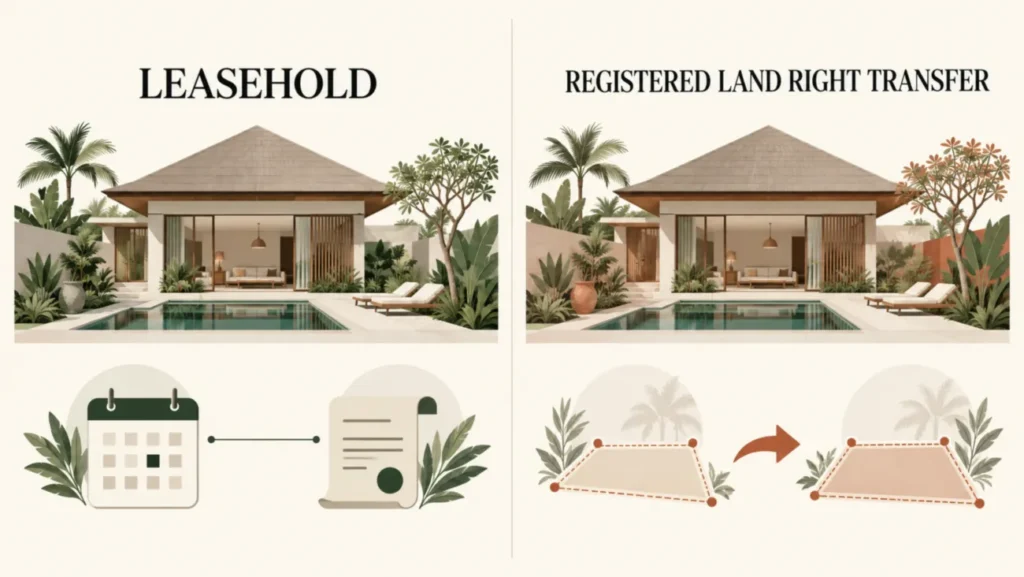
| Issue | Leasehold (Contractual) | Registered Land Right Transfer |
|---|---|---|
| Legal structure | Personal agreement; no registered title transfer | Transfer of Hak Pakai, HGB or Hak Milik between registered holders |
| Acquisition duty | An ordinary contractual lease not involving a qualifying registered right generally does not trigger BPHTB; arrangements combining a lease with a right transfer require separate review | Applies on acquisition; taxable base and NPOPTKP confirmed locally |
| Rental income tax | PPh applies to the landowner receiving the lease payment; the taxable gross amount and payment timing must be reviewed against actual terms | Not a rental transaction; acquisition tax treatment applies |
| Annual PBB responsibility | Under Law No. 1 of 2022, PBB-P2 liability can attach to a person or entity with effective control or benefit from the land or building, not only to the registered owner; the legally identified taxpayer must be checked against local tax records and the actual arrangement | PBB-P2 liability follows the person or entity meeting the statutory rights, control or benefit test; verify the locally recorded taxpayer |
| Contractual cost allocation | Must be stated clearly in the lease; not the same as the legal obligation | Should be stated explicitly in the transfer documentation |
| Due diligence priorities | Lessor’s title, PBB payment history, lease terms, identity of legally identified taxpayer, renewal rights | Land certificate status, NJOP, prior PBB payments, BPHTB history |
Browse Leasehold Villas in Bali
 Bali, Ubudfrom 175м²
 Bali, Ubudfrom 300м²

 Bali, Jimbaranfrom 152м²
A common situation in Bali: a foreign buyer signs a long-term leasehold agreement and the contract allocates annual PBB to the lessee. A lease may allocate the economic cost of PBB-P2 to the lessee, but that allocation does not by itself determine who is legally liable. Verify the taxpayer recorded for each relevant year and specify how current and historical liabilities will be settled. Request proof of payment for all recent years and verify which party is identified as the taxpayer in the local tax records.
It is also important to avoid treating all Indonesian land rights as interchangeable. Hak Milik, Hak Pakai and HGB carry different conditions for acquisition, duration, transferability and eligible holders. A PT PMA holding HGB does so as an Indonesian corporate entity with corporate, accounting and reporting obligations — this is not the equivalent of freehold ownership by a foreign individual.
For a fuller comparison of how these structures work beyond the tax dimension, see “Leasehold vs Freehold in Bali“.
Property Taxes for Foreigners
Tax outcomes for foreign buyers in Bali are not determined by nationality alone. The applicable rules depend on several variables, and the result can differ significantly between different types of buyer.
A foreign passport does not create a single Bali property tax rate. The transaction, tax residency and legal structure determine which rules apply.
The key distinctions are:
- Foreign individual vs Indonesian tax resident. Indonesian tax residency depends on statutory presence and intention criteria, including the more-than-183-days test in a 12-month period. This rule should not be treated as the sole criterion; additional factors apply. Tax residency affects which income tax rules govern rental income and other proceeds from the property.
- Non-resident taxpayer. A foreign buyer who is not an Indonesian tax resident faces different income tax treatment on rental proceeds. Applicable provisions of a tax treaty between Indonesia and the buyer’s home country may also affect the result.
- PT PMA. A foreign investment company structured as a PT PMA is an Indonesian legal entity subject to corporate income tax and ongoing reporting obligations. Whether a statutory financial audit is required depends on the company’s circumstances and applicable thresholds. A PT PMA is not simply a tax-reduction mechanism — it introduces compliance requirements that add ongoing cost.
- Legal title holder vs income recipient. In arrangements where the registered right is held by one entity and rental revenue flows through a management company to another, each party in the chain has distinct tax obligations. PBB-P2 follows the legally identified taxpayer; income-tax treatment depends on the party legally earning the income, the contractual agency or management arrangement and the applicable tax regime, not merely who collects the payment.
To illustrate: two foreign investors with comparable Bali villa arrangements — one through a contractual leasehold and one through a PT PMA holding HGB — face different annual tax costs, different income tax structures on rental revenue and different tax obligations on any eventual transfer. Neither arrangement is inherently simpler. Both require advice calibrated to the specific investor’s residency status, home country tax treaty position and intended use.
Find a Bali Property Within Your Total Budget
Tell ULU Homes your budget, preferred area and intended use. We’ll help you shortlist suitable properties and identify which transaction costs need separate confirmation.
Find a villa
Taxes on Rental Income
Rental income from Bali property is taxable in Indonesia, but the applicable rules depend on how the activity is classified. This distinction is frequently misunderstood, and applying the wrong assumption to a villa rental operation can lead to both underpayment and overpayment.
Long-Term Rental Income
When a property holder rents land and buildings under an ordinary lease — a residential or commercial arrangement where the tenant occupies and uses the property without the landlord providing material hospitality services — the income falls under PP No. 34 of 2017. This regulation establishes a final PPh of 10% on the gross rental amount, which may include ancillary charges connected to the lease and not only the base rent figure.
The final nature of this tax means it is calculated on the full taxable gross amount received, without first deducting the landlord’s operating costs or expenses. This differs from how income tax works in systems that allow deductions before applying a rate.
Example: a landowner receiving IDR 120,000,000 per year in qualifying gross rental income under an ordinary land and building lease owes:
10% × IDR 120,000,000 = IDR 12,000,000
This example assumes IDR 120,000,000 is the full taxable gross amount. When considering a long-term leasehold where the total consideration is paid upfront or in large instalments, the 10% final PPh should be analysed against the actual gross lease consideration, invoicing and payment terms rather than automatically assumed to arise in equal annual instalments.
When the tenant is an Indonesian corporate entity or a body with statutory withholding obligations, they typically withhold and remit this PPh on the landlord’s behalf. When the tenant is an individual, the landlord may be responsible for self-declaration. The applicable mechanism should be confirmed for each specific arrangement.
The regulation governing this tax is published on the Directorate General of Taxes website.
Short-Term Villa Rentals
Short-stay tourist accommodation — villas listed on booking platforms for nightly or weekly stays — does not automatically fall under the 10% PPh rule that applies to ordinary land and building leases. The key difference is the nature of the activity: providing accommodation services with associated hospitality is treated separately from a plain property rental.
Long-term property rental and short-stay accommodation are not automatically taxed under the same rules.
Where the operation meets the legal definition of taxable hotel accommodation services, it is generally outside national VAT under PMK 70/2022 and may instead fall within PBJT — the local accommodation tax on hotel services. PBJT is a local consumption tax generally borne by the customer and collected and remitted by the service provider to the relevant kabupaten or kota. The tax base, exclusions and rate are set by local regulation and must be confirmed in the relevant regency or city. Not every villa listed on a booking platform automatically qualifies as a hotel accommodation service; the classification depends on the actual activity and applicable permits. Other separately supplied or differently classified services may carry distinct VAT treatment. The operator’s income-tax obligations must be assessed separately.

The common Bali investment model — a foreign investor holds rights through a leasehold or PT PMA and contracts a management company to run short-stay rentals — creates a chain of revenue flows. The management company’s commission, the villa owner’s net proceeds, PBJT registration and the income tax on distributed amounts are each governed by separate rules. Routing revenue through a management company does not determine the tax treatment; it is necessary to trace who receives what income and which tax regime governs each recipient.
Taxes When Selling Property
When the holder of a registered land right transfers that right, a final income tax on the land and building rights transfer applies under GR 34/2016. In the general qualifying case, the seller pays this tax at 2.5% of the gross transfer value.
For an illustrative example: a registered right transfer completed at IDR 4,000,000,000 generates a seller’s tax of:
2.5% × IDR 4,000,000,000 = IDR 100,000,000
For transactions subject to the general 2.5% final transfer-tax regime, the tax is calculated on the gross transfer value rather than net gain, even where no profit is realised. Special provisions and different rates may apply in certain transaction types, and the applicable treatment should be confirmed before the transaction is structured.
For a contractual leasehold, the tax consequences on exit depend on what is being transferred. Assigning a lease contract from one party to another does not constitute a registered right transfer in the same sense, and the applicable tax analysis will differ. A sale of shares in a PT PMA is a separate transaction from a direct transfer of land rights. A share sale must be assessed separately, including the seller’s residence, applicable withholding rules and any anti-avoidance provisions; it must not be assumed to produce a single predetermined outcome.
Selling or assigning a contractual leasehold is not automatically taxed in the same way as transferring a registered land right. The tax treatment depends on whether the transaction is an assignment of contractual rights, a new lease, a transfer of another taxable asset or a corporate transaction. Before marketing the remaining lease term, obtain advice on the income-tax treatment of the proposed structure and identify any consent, registration or contractual costs.
Outstanding PBB should be verified and addressed before completion. PPATs and local authorities may require evidence of prior payments during transfer procedures; confirm the applicable documentary requirements locally.
Illustrative Bali Property Tax Scenarios
The table below illustrates how applicable taxes interact across three common Bali property scenarios, using illustrative round figures. It is designed to show which taxes apply in which situation — not to provide a template calculation that applies to all properties.
| Scenario | Relevant Taxes | Calculation Basis | What to Verify |
|---|---|---|---|
| Long-term leasehold villa (lease consideration IDR 1.5B over agreed term) | PPh on landowner’s gross lease income; PBB-P2 (often allocated to lessee by contract; verify legally identified taxpayer) | PPh: generally 10% of the taxable gross land-and-building lease consideration; confirm applicable withholding or self-payment timing against the agreement and tax rules; PBB: local rate × local taxable proportion × (NJOP − NJOPTKP) | Contract terms on tax allocation; proof of landowner’s PBB payments; landowner’s title status; identity of legally identified PBB taxpayer |
| Qualifying registered right transfer (IDR 3B transaction) | BPHTB (buyer); seller’s PPh on transfer; VAT if applicable | BPHTB: 5% × (IDR 3B − local NPOPTKP, minimum IDR 80M for first acquisition); Seller’s PPh: 2.5% × IDR 3B | Actual local NPOPTKP; NJOP vs transaction price; seller’s compliance; VAT applicability and effective rate |
| Villa generating rental revenue (IDR 200M annual accommodation bookings) | Annual PBB-P2; where the operation meets the legal definition of taxable hotel accommodation services, PBJT may apply; income tax on operator | PBB based on NJOP and local taxable proportion; PBJT calculated on the locally defined taxable consideration at the local rate; income tax per applicable regime | Operating structure; whether the activity qualifies as hotel accommodation services under applicable rules; PBJT registration; locally defined tax base, exclusions and rate; management company’s separate tax obligations |
Illustrative calculations only. Actual tax liabilities depend on the specific transaction, applicable local and national rules, and property assessments.
Two properties priced identically can carry meaningfully different tax profiles. A villa with a recently reassessed NJOP may incur a different annual PBB than an otherwise comparable property, but the final bill also depends on the local taxable proportion, tax rate and applicable relief — not the NJOP alone. A property in one kabupaten may face a different PBJT rate from an identical property elsewhere on the island. The listed price alone tells you very little about the ongoing tax obligations.
Find a Bali property that fits your plans. ULU Homes can help you explore villas and apartments based on your preferred location, budget and intended use. Start your property search.
Bali Property Tax Terms Explained
| Term | Meaning |
|---|---|
| PBB-P2 | Annual local land and building tax |
| BPHTB | Tax on acquiring qualifying land or building rights |
| PPh | Indonesian income tax |
| PPN / VAT | Value-added tax |
| PBJT | Local tax on specified goods and services, including qualifying hotel services |
| NJOP | Official assessed value used for property tax |
| NJOPTKP | Non-taxable portion of NJOP for PBB-P2 |
| NPOPTKP | Non-taxable acquisition value for BPHTB |
| SPPT PBB | Annual property tax assessment notice |
| NOP | Tax-object identification number |
| NPWP | Indonesian taxpayer identification number |
| PPAT | Official authorised to prepare specified land-right transfer deeds |
How to Avoid Tax Surprises
Some property-tax disputes can be reduced by checking available records before signing. Independent advice can help identify errors and compliance risks, but cannot eliminate them. A structured pre-purchase review addresses many common problems.
- Request the latest SPPT PBB. The annual tax notice contains the NOP, the NJOP, the applicable NJOPTKP, the calculated tax and the due date. Ask for the last two to three years to detect recent reassessments and to confirm the property’s tax classification.
- Verify proof of PBB payment. Receipts for recent tax years should be in the seller’s or landowner’s possession. Outstanding PBB should be verified and addressed before completion, and PPATs or local authorities may require evidence of prior payments during transfer procedures.
- Confirm the NOP and property description. The Nomor Objek Pajak on the SPPT must match the land parcel and buildings described in the title certificate and the draft contract. Discrepancies may indicate unresolved administrative issues or unregistered improvements.
- Review the land certificate and applicable right type. Confirm whether the right is Hak Milik, Hak Pakai, HGB or a contractual leasehold arrangement. The type of right determines which acquisition taxes apply, who is eligible to hold it and how any future transfer will be structured.
- Check applicable regional tax rules. Confirm the NPOPTKP for BPHTB, the local PBB-P2 rate and taxable proportion, and the PBJT rate for the relevant kabupaten or kota. These are set locally and may not match the figures cited in general online guides.
- Obtain a written breakdown of transaction taxes. The signed agreement should specify which party pays BPHTB, the seller’s PPh, any VAT, notary fees and registration charges. Verbal agreements on cost allocation have no practical weight once a dispute arises.
- Clarify the rental income structure. If you plan to earn income from the property, confirm at the outset whether the arrangement will be treated as an ordinary land and building lease or as an accommodation service operation. The applicable tax regime differs significantly, including the treatment of gross income and the role of PBJT.
- Commission an independent professional tax review. For transactions involving PT PMA structures, mixed-use properties or cross-border income flows, an independent review by a qualified Indonesian tax adviser may identify compliance issues before signing and reduce the risk of costly corrections after closing.
These checks apply whether you are buying locally or managing the process from a different country. For a detailed document checklist, see the “Bali Property Due Diligence Checklist“.
Before signing, ask for the latest PBB notice, proof of payment and a written breakdown of who bears each transaction tax.
Ready to Compare Bali Properties?
Share your preferred location, budget and property type. ULU Homes can help you compare available options and understand which transaction documents to request before committing.
Find a property in Bali
Final Thoughts
Property taxes in Bali operate across four distinct stages — acquisition, annual ownership, rental income and sale — and no single rate or calculation covers all of them. The total tax cost of holding a Bali property cannot be read from any one figure; it depends on the transaction structure, the type of land right, the property’s location and the tax status of the parties involved.
Legal structure and location both shape outcomes in ways that are easy to underestimate. PBB-P2 rates, taxable proportions and BPHTB thresholds differ between kabupaten. The gap between a contractual leasehold and a registered right transfer changes which acquisition duties apply and who the legally identified taxpayer is. The difference between an ordinary long-term lease and a short-stay accommodation operation changes how rental income is taxed and which levies apply. Each of these variables feeds into what the actual annual cost of ownership looks like.
The practical implication is straightforward: build the tax dimension into your planning before any commitment, not after. Request the SPPT PBB and recent payment receipts, confirm which party bears each transaction tax in writing, and understand how your rental income will be classified if you intend to generate returns from the property. ULU Homes can help you explore property options across Bali’s locations, budgets and use cases. For questions specific to your tax obligations, legal structure or residency position, consult a qualified Indonesian tax adviser or a licensed PPAT within their area of competence.
The information in this article is provided for general guidance only and does not constitute legal or tax advice. Tax rules, local rates and government incentive conditions are subject to change. Confirm the applicable obligations for your specific transaction and circumstances with a qualified professional.
 Real estate in Georgia
 Real estate in Cyprus
 Real estate in the UAE
 Real estate in Montenegro
 Real estate in Thailand
 Real estate in Spain
 Real estate in Saudi Arabia
 Real estate in Turkey
 Real estate in Zanzibar
 +62 895 001 924 667
 hello@ulu-homes.id
 Tibubeneng, Canggu, Kuta Utara, Badung Regency, Bali 80361, Indonesia




 Get catalogue of TOP-7 objects