
 +62 895 001 924 667



Jimbaran is a fishing bay south of Ngurah Rai International Airport, known for its seafood restaurants, sunsets, and relaxed walks along the shore. This guide features five places worth visiting: Jimbaran and Muaya Beach, Kedonganan Fish Market, Kelan Beach, Rock Bar at AYANA, and GWK Cultural Park. The last is in Ungasan rather than Jimbaran Bay itself, but makes a convenient addition to a day exploring southern Bali. The selection covers five different experiences: dinner on the sand, a morning at the fish market, a walk near the airport, cocktails overlooking the ocean, and a visit to a cultural park. Ticket prices and commercial conditions were reviewed against available operator information on November 1, 2026, while some market hours and local arrangements are based on published visitor reports. These details can change, so check the latest information before travelling.
How to Choose Where to Go
Jimbaran Bay lies south of the airport. According to Indonesia Travel, the journey from the international airport to the area takes around 15 minutes, while Legian, Seminyak, and Sanur are roughly 20 minutes away via the toll road. These are indicative journey times: actual travel depends on traffic and the time of day.
The shoreline is divided into several stretches. The Bali.com guide describes Jimbaran Beach as having three sections—northern, central, and southern—with cafés along the sandy shore. Kelan lies at the northern end, closer to the airport, while Muaya is in the south, where most of the beachfront restaurants are concentrated. These are different sections of the same bay, not two separate bays. Kedonganan Fish Market is in Kedonganan: TIMES Indonesia places it at the bay’s northern end on Jalan Pantai Kedonganan. GWK and Rock Bar are away from the beachfront: the former is in Ungasan, and the latter occupies an ocean-facing cliff within the AYANA resort.

Here, “top” means a selection for different kinds of visits, not an official ranking. Here’s how the five places compare:
| Place | Why Visit | Location | What to Check |
|---|---|---|---|
| Jimbaran and Muaya Beach | A shoreline walk and seafood dinner beside the water | Southern part of the bay, Jalan Four Seasons | The weight and total cost of your order, tax, and service charge |
| Kedonganan Fish Market | Fishing life, buying fresh seafood, and having it cooked nearby | Northern end of the bay, Jalan Pantai Kedonganan | Opening hours (sources differ), price by weight, and cooking charges |
| Kelan Beach | A beach walk with views of passing aircraft | Northern edge of the bay, near the airport | Noise, weather, and the terms at beachfront cafés |
| Rock Bar at AYANA | Cocktails and dinner on an ocean-facing clifftop terrace | Jalan Karang Mas Sejahtera, AYANA resort | Session, seating area, minimum spend, reservation, and dress code |
| GWK Cultural Park | Monumental statue, cultural programmes, and exploring the park | Jalan Raya Uluwatu, Ungasan | Ticket category, daily programme, heat, and weather |
1. Jimbaran and Muaya Beach

The southern part of the bay offers Jimbaran’s most recognisable scene. By day, it is a broad sandy beach where you can stroll beside the water and watch everyday local life. Towards evening, tables are brought closer to the shore, candles are lit, and the beach transforms into an open-air dining destination. Indonesia Travel describes much the same experience: diners select the day’s catch, enjoy their meal with sand beneath their feet, and may hear live music or see traditional dances at certain restaurants after sunset. Muaya works particularly well for couples and families looking for a simple evening: arrive, take a walk, have dinner, and head back.
Among the named restaurants, Indonesia Travel highlights Menega Cafe and Bawang Merah Beachfront Restaurant. The Hotels.com guide also lists Intan Sari Cafe, Pandan Sari, Nyoman Cafe, and Bela Seafood Cafe & Bar, identifying Menega and Intan Sari as particularly popular. According to the same source, Menega Cafe is on Jalan Four Seasons at Muaya Beach and usually opens daily from approximately 3:00 pm to 11:00 pm, although hours can change. These are examples, not endorsements: menus, prices, and quality differ between restaurants, and it is best to compare them in person.
Aim to arrive 60–90 minutes before sunset. That gives you time to walk along the beach, compare menus at two or three restaurants, and order without rushing before the evening crowds arrive. Sunset time varies by date, so check the forecast for the day you visit. A waterfront table is never guaranteed, which makes booking ahead sensible for an important dinner.
One point about access: walking along the shoreline does not normally require placing an order, but tables, sun loungers, and umbrellas belong to individual businesses, which generally expect customers to purchase something. Check the conditions before sitting down. Choose a restaurant for its menu and terms rather than simply for the front row of tables: the best view can also come with different pricing.
Before ordering seafood, check:
- The pricing unit: is the price per 100 grams, per kilogram, or per serving?
- The weight of the fish, crab, or prawns you choose: have it stated in front of you and note it down.
- Cooking method and side dishes: are rice, vegetables, and sauces included or charged separately?
- Tax and service charge: Ask whether the displayed prices already include any applicable taxes and service charges or whether additional amounts will be added to the bill. Request the final total before ordering.
- Minimum spend, table charges, and paid extras, such as entertainment.
- The full amount before the meal is prepared: ask for the total or a provisional bill.
Agree on the weight and total cost before your seafood goes onto the grill. That way, the final bill should not come as a surprise.
2. Kedonganan Fish Market

According to TIMES Indonesia, Pasar Ikan Kedonganan is located at the northern end of Jimbaran Bay. It is a working fish market where locally landed catches are sold alongside seafood supplied by traders from other areas. The publication describes fishermen unloading small fish, including lemuru, a type of sardine, directly from their boats. However, not every fish sold here is caught in Jimbaran’s coastal waters: some seafood is brought in from regions such as Banyuwangi and Lombok. If you specifically want to purchase a locally landed morning catch, ask the seller about its origin rather than assuming that everything on display comes from nearby boats.
You can visit simply to observe the fishing trade or buy seafood and arrange for a nearby restaurant to cook it. Those two experiences take different amounts of time and money. Around 30 minutes is enough for an introductory visit: walk through the rows, inspect the fish displayed on ice, and listen to the bargaining. Buying seafood to have cooked takes longer, as preparation happens at nearby establishments rather than at the market itself, and each business sets its own conditions. Not every warung will agree to cook whatever you buy, so arrange this before making a purchase.
Published opening hours vary: some guides suggest mornings until midday, while others give approximately 7:00 am to 7:00 pm. I could not find an official page confirming the schedule, so morning is the more dependable time to aim for, with hours checked locally.
How to buy seafood and have it cooked:
- Walk through the market and compare several sellers rather than buying from the first stall.
- Confirm the pricing unit: per kilogram, per 100 grams, or per item.
- Ask the vendor to weigh the seafood in front of you, and note the weight.
- Ask a nearby restaurant whether it will cook your market purchase, how much preparation costs, and which sides are included.
- Request the total: seafood, cooking, sides, drinks, tax, and service charge.
- Only then hand your purchase over to the kitchen.
There are a few practical things to know beforehand. Market floors are wet, so wear closed-toe shoes or sandals you do not mind getting dirty. Smells can be strong, particularly in the heat. This is a working market: vendors are busy and aisles are narrow, so avoid obstructing walkways or interrupting transactions. Ask permission before photographing people; not everyone appreciates a camera being pointed at them without warning.
An early-morning visit is the usual choice if you want to see fishing activity, but unloading times depend on the weather and the fishermen themselves, so there is no guarantee you will witness boats bringing in their catch. The market combines easily with breakfast nearby or a walk along Kelan Beach.
3. Kelan Beach

Pantai Kelan lies at the northern end of the bay, closer to the airport. Indonesia Travel notes that Jimbaran’s coastline offers views of aircraft taking off and coming in to land. Some visitors find this entertaining; others see it as background noise. It helps to decide which experience appeals to you before choosing where to spend your time.
Kelan is worth considering as a destination in its own right. A different coastal perspective, a walk along the sand, and nearby cafés can fill a couple of hours at a pace quite unlike the evening atmosphere at Muaya. Do not count on a perfect camera angle or any particular frequency of flights: airline schedules are outside your control, while visibility depends on the weather and haze. Treat the aircraft as an added attraction rather than the sole purpose of your visit.
Aircraft noise is a real consideration: the airport is nearby, and flights can be heard. If you are looking for a quiet place to talk, keep that in mind. Kelan should not be described as necessarily deserted, cheaper, or cleaner than Muaya. Visitor numbers, prices, and beach conditions depend on the day, season, and particular stretch of shore, and there is no reliable overall comparison here.
Kelan pairs well with a morning visit to the fish market, which is nearby. After exploring the stalls, you can continue to the beach. If time is limited, choosing just one section of the bay is enough. If you already have dinner planned at Muaya, schedule Kelan for the morning or daytime instead of trying to fit both into the same sunset window.
4. Rock Bar at AYANA

Rock Bar is a commercial venue perched on a cliff above the ocean within the AYANA resort, so it deserves its own planning. Unlike a casual dinner on the sand, a visit involves choosing a session, seating area, and applicable conditions in advance. Its official address is Jalan Karang Mas Sejahtera, Jimbaran. According to the official AYANA website, the venue extends for approximately 270 metres, accommodates around 880 guests, and is reached by an inclined lift. The length of the venue is not its height above the water, so do not expect a view from an exceptionally high elevation.
Opening hours and reservations. According to the official AYANA Rock Bar information, the venue generally operates from 4:00 pm to midnight, subject to weather conditions and availability. Reservation arrangements vary by guest category, date, and seating area. AYANA’s published information is not entirely consistent about advance bookings for visitors who are not staying at the resort, so outside guests should confirm whether a reservation is available for their chosen date before making travel plans. Resort guests receive priority access and exclusive use of certain seating areas. Published arrival windows should not be confused with the actual sunset time or a guaranteed duration of stay. Walk-in entry may be possible, but seating and waiting times cannot be guaranteed.
Access, seating, and minimum spending. The Round Deck is reserved for guests staying at AYANA Villas, while the Top Bar is reserved for guests of AYANA Resort, Villas, RIMBA, and Segara. According to the official seating information, minimum spending requirements apply to visitors who are not staying at the resort. The published minimum is IDR 350,000++ per person for a Tapas Table and IDR 550,000++ per person for a Dinner Table. With the stated 21% combined tax and service charge, these correspond to IDR 423,500 and IDR 665,500 per person, respectively. Other seating types have different minimum spending requirements, and some cannot be reserved in advance. Payment is cashless: AYANA lists credit cards, debit cards, and QR-based payments. Smart attire is required; sleeveless shirts, beach shorts, clothing displaying alcohol-brand logos, and large bags or backpacks are not permitted. Check the final amount, available payment methods, and seating conditions before booking.
Before visiting:
- Check the available arrival times for your chosen date through AYANA’s official booking information. Do not assume that a particular sunset or evening booking window is available every day.
- Confirm whether advance reservations are available to outside guests, as published booking arrangements and priority access conditions may differ.
- Check the minimum spend for your selected seating area, including the applicable tax and service charge.
- Bring a credit card, debit card, or an accepted QR payment method, and follow the venue’s dress code. Large bags and backpacks are not permitted.
- Allow extra time for access. AYANA states that Rock Bar is approximately a five-minute walk from the resort lobby, and queues for the inclinator may form during busy periods.
The experience is weather-dependent. The operator warns that Rock Bar may close without notice because of adverse weather or when fully booked. A particular table, queue-free access, or a perfect sunset cannot be guaranteed, so keep a backup plan for the evening even if you have a reservation.
5. GWK Cultural Park in Ungasan
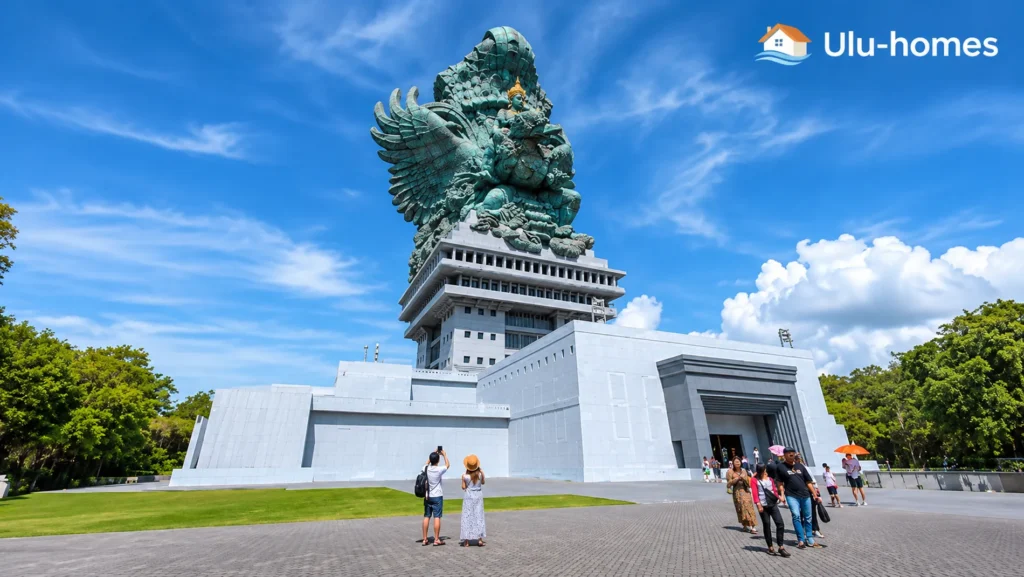
Garuda Wisnu Kencana Cultural Park, or GWK, is not in Jimbaran Bay itself. According to its operator, it is located on Jalan Raya Uluwatu in Ungasan, Badung Regency. Reaching it from Jimbaran involves a separate trip, so treat it as a distinct stop in your itinerary.
Why visit. The official GWK website identifies the monumental Garuda Wisnu Kencana statue as the park’s main attraction. The grounds also feature cultural performances, Jendela Bali Restaurant with panoramic views, shops and souvenir stalls, and recurring events such as Ogoh-ogoh and Penjor festivals. If you want to vary your time at the beach, it offers an opportunity to experience another side of Balinese culture.
Tickets. According to the official GWK ticketing website, standard admission costs IDR 150,000 per person and includes access to the cultural park, scheduled Balinese performances, the animated film Petualangan Garuda Cilik, and a complimentary dessert with an order at Jendela Bali Restaurant. Performance times depend on the daily programme and should be checked before visiting. The GWK Ultimate Package costs IDR 400,000 and includes a guided tour of the statue’s 9th and 23rd floors, subject to the tour schedule. Tickets are valid for the day, with re-entry arrangements available through a hand stamp. An optional buggy shuttle costs IDR 40,000 per person and operates on designated one-way routes involving Plaza Bhagawan, the GWK statue, and Mandalaloka. Routes may change without notice, and the buggy ticket is purchased separately from admission.
Standard admission does not include the guided tour inside the statue or the optional buggy shuttle, which must be purchased separately or included through a qualifying package. The official ticketing website states that children under 100 cm in height can enter free of charge; other visitors are subject to the applicable ticket category. Evening programmes, including BarAong, may have separate schedules and admission conditions, so confirm their availability directly with GWK. Check the park’s operating hours and daily performance programme before travelling, as schedules and optional services can change.
Much of the park is outdoors, which should shape your preparations. Bring water, comfortable shoes, and sun protection, and allow breaks in the shade during hot weather. Do not rely on GWK as a guaranteed rainy-day alternative, as some performances and activities take place outside.
GWK combines well with a day exploring southern Bukit. After visiting the park, you can return to Jimbaran for an evening seafood dinner at Muaya or a reserved visit to Rock Bar.
Half-Day and Full-Day Itineraries
Trying to fit all five places into one day would not make for a particularly sensible itinerary—and there is no need to do so. A morning at the market and dinner by the sea do not call for nonstop sightseeing in between. The two suggested plans below use editorial time estimates; journey times depend on the day and traffic and are not guaranteed.
| Itinerary | Order of Stops | Approximate Duration | Evening Choice |
|---|---|---|---|
| Half day | Arrive around 60–90 minutes before sunset for a shoreline walk and dinner, or follow your confirmed Rock Bar reservation time | 3–4 hours, excluding longer transfers | Choose one: Muaya for beachfront dining, Kelan for a coastal walk, or Rock Bar for a pre-booked experience. Check the reservation time rather than assuming it coincides with sunset |
| Full day | Kedonganan Fish Market in the morning, a break, GWK during the day, then back to the bay in the evening | 8–10 hours including breaks and travel | Choose one: Muaya, Kelan, or Rock Bar |
For a full day, it makes sense to separate the experiences. Start with a walk through the fish market and breakfast nearby, then take a break at your hotel or a café. Visit GWK later in the day, allowing for the heat and the drive back. Towards evening, return to the bay and choose one sunset experience.
For sunset, choose one of three places: Muaya, Kelan, or Rock Bar. You cannot realistically combine all three in a single evening: sessions are time-limited, and journeys and seating arrangements take time.
Choose your sunset destination in advance: Muaya for an uncomplicated dinner on the sand, Kelan for a relaxed walk near the airport, or Rock Bar for a reserved table and ocean views from above.
If you have time to explore a neighbouring area, make Uluwatu a separate day’s outing. Read more in our complete Uluwatu area guide and our guide to 10 must-visit places in Uluwatu. This is an optional extension to your trip. Watching sunset in Uluwatu and Jimbaran on the same evening is not practical, so choose a different evening for each.

 Bali, Bukit, Jimbaran
 from 82м²



What to Check Before Your Trip
Start with transport. The bay is generally easiest to reach by rental car, with a driver, or through a ride-hailing app, although availability and conditions vary by location and time. Roads near popular venues can become congested in the evening, so arrange your return journey ahead of time, particularly if you plan to combine GWK and dinner on the same day.
Season and weather. Bali generally has a wetter period from November to March and a drier period from April to October, although seasonal conditions vary by location and year. According to the BMKG rainy-season outlook published on October 2, 2026, the 2026–2027 rainy season was expected to begin later than usual in much of Indonesia, with many parts of Bali entering the season in December and some areas in November. Rainfall peaks and seasonal duration vary by local climate zone. These are forecasts, not guarantees of daily weather. Cloud cover, showers, and wind can affect sunset plans in any month, so keep an alternative in mind and check the latest local forecast before travelling.
Beach access and commercial services are not the same kind of expense. Walking along the shore is generally free, while tables, loungers, and meals are provided by individual businesses. It would be misleading to say that the entire beach is paid access or that every service is free. Confirm the terms locally.
Cost breakdown (figures are included only where published by an operator as of November 1, 2026):
| Expense | What You Pay For | What to Confirm in Advance |
|---|---|---|
| Beachfront dinner | Seafood by weight, preparation, sides, and drinks | Pricing unit, weight, tax, service charge, and minimum spend; there are no universal fixed rates |
| Market purchase | Seafood from a vendor and preparation at a nearby restaurant | Unit price, cooking fee, and the restaurant’s agreement to prepare your purchase |
| Rock Bar | Minimum spend for non-resident guests: Tapas Table IDR 350,000++ or Dinner Table IDR 550,000++ per person, plus 11% tax and 10% service charge | Seating area, session, minimum spend for other seats, and payment method |
| GWK admission | Standard ticket IDR 150,000; Ultimate Package IDR 400,000; buggy IDR 40,000 | Ticket inclusions, daily programme, and opening hours |
| Transport | Car, driver, or ride-hailing service | Outbound and return arrangements and waiting time |
Check ocean conditions before entering the water. Swimming conditions in Jimbaran Bay can vary with the weather, tides, currents, and the exact section of shoreline. A beach that looks calm from a distance is not necessarily safe, and dangerous currents may be difficult to recognise. Follow all posted warning signs, flags, and instructions from authorised beach personnel. Do not enter the water when conditions are uncertain or warnings advise against swimming. Children require close supervision near the shoreline, including in shallow water.
Ocean conditions change throughout the day and across seasons. Assess them on arrival, follow warning signs, and never assume in advance that swimming will be safe.
Before you set off:
- Choose one sunset option and book ahead if you are going to Rock Bar or planning an important dinner.
- Bring a card or QRIS payment option: Rock Bar accepts cashless payments only.
- Pack water, a hat, sunscreen, and closed-toe shoes for the fish market.
- Arrange how you will get back after dinner.
- Check GWK’s tickets and opening hours and confirm market arrangements on the day.
Exploring the area often raises the question of what it would be like to stay near the bay for longer. Everyday life varies considerably by location: living beside the bay and living in the Bukit hills mean different routes to beaches, markets, and main roads. Our detailed Jimbaran area guide explores the practicalities of living here.
Considering Jimbaran for a longer stay or as a place to live? Start with location: daily journeys will be different beside the bay and up in the hills. Complete the property selection questionnaire, specifying your budget, reason for buying, and preferred area.
What to Choose for Your First Visit
For a first visit, a beach walk and seafood dinner are enough: it is the classic Jimbaran experience and requires little advance planning. Add Kedonganan Fish Market if you are interested in the fishing trade and happy to start early. Choose Rock Bar if you want an evening above the ocean and have a reservation. Include GWK if you would enjoy a cultural attraction and have a full day to explore southern Bukit.
 Real estate in Georgia
 Real estate in Cyprus
 Real estate in the UAE
 Real estate in Montenegro
 Real estate in Thailand
 Real estate in Spain
 Real estate in Saudi Arabia
 Real estate in Turkey
 Real estate in Zanzibar
 +62 895 001 924 667
 hello@ulu-homes.id
 Tibubeneng, Canggu, Kuta Utara, Badung Regency, Bali 80361, Indonesia




 Get catalogue of TOP-7 objects