
 +62 895 001 924 667


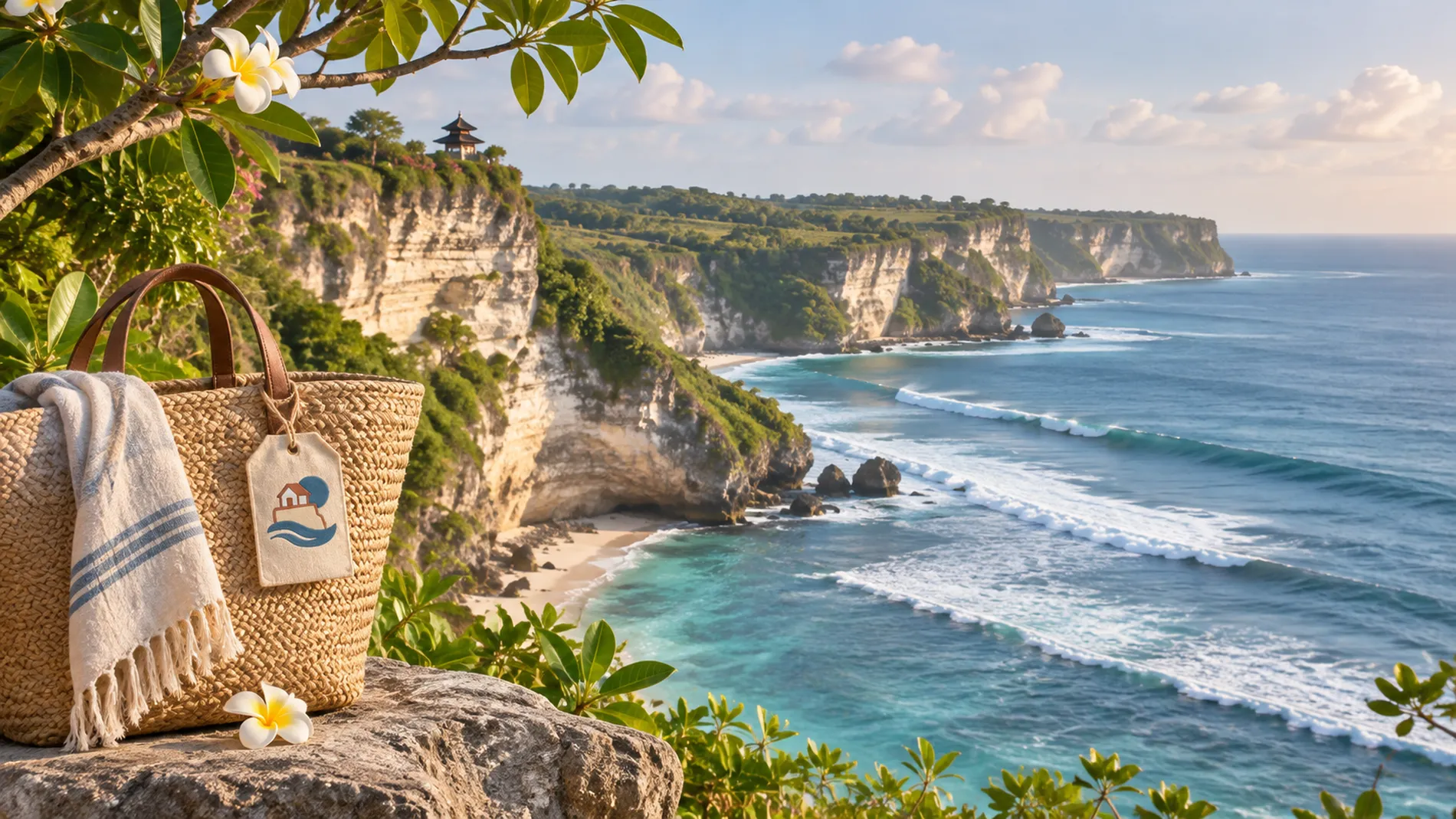

The top attractions to see in Uluwatu are Pura Luhur Uluwatu Temple, perched on a 70-metre cliff and famous for its evening Kecak performance; the spectacular Karang Boma cliff viewpoint; Balangan Viewpoint; and the beaches tucked beneath the limestone cliffs—Suluban, Padang Padang, Thomas, and Dreamland.
In a single day, you can realistically visit the temple, one or two beaches, and a scenic viewpoint. Roads across the Bukit Peninsula are narrow, and reaching the beaches often takes longer than the distances on a map suggest. Padang Padang involves approximately 120 steps, while Thomas Beach has around 130–175, depending on the source. Nyang Nyang has several access routes: the eastern approach involves approximately 500 steps, while the western route follows a steep access road. The difficulty of reaching each beach depends on the chosen entrance, weather, and conditions underfoot.
For each attraction, this guide covers entrance and parking fees in Indonesian rupiah, the number of steps, approximate descent and return times, tidal conditions, and the facilities actually available at beach level.
Prices and visiting conditions were reviewed on November 1, 2026, using information published between August and October 2026. Actual charges and arrangements may differ, so carry some extra cash. This is an editorial selection, not an official ranking.
Where Is Uluwatu?
Uluwatu occupies the southwestern tip of the Bukit Peninsula in southern Bali. Strictly speaking, the name refers to the temple and the cliff itself, but travel guides have long used “Uluwatu” to describe the wider coastal area stretching from Padang Padang to Dreamland and Balangan.
The drive from Ngurah Rai International Airport to Uluwatu Temple takes around an hour, while Pecatu—the village through which the roads to most of the beaches pass—is slightly closer.
Ungasan, home to Melasti Beach and Garuda Wisnu Kencana (GWK) Cultural Park, lies farther east. GWK is approximately 10–11 km by road from Ngurah Rai International Airport. Although the journey can be relatively short when traffic is light, allow around 30–40 minutes or longer when planning your visit. Ungasan is outside the immediate Uluwatu Temple area, but its more accessible attractions make it a convenient addition to a Bukit Peninsula itinerary.
The coastline is dominated by limestone cliffs, with access to the water provided by concrete stairways, walking trails, or passages through the rock.
As a result, straight-line distances tell you very little about actual travel times. Two neighbouring coves may be only a few hundred metres apart as the crow flies, yet reaching one from the other can mean returning to Jalan Raya Uluwatu before turning onto another narrow road leading to the beach car park.
Thomas Beach, for example, is approximately a 25-minute walk from Padang Padang via a footpath, but only about five minutes away by scooter along Jalan Labuansait. In the evening, traffic heading towards popular sunset viewpoints slows everything down.
The season also affects which places are worth visiting.
Bali’s dry season generally runs from April to October, while November to March brings wetter weather to the Bukit Peninsula. Trails and stairways can become slippery, and visiting Nyang Nyang during the rainy season is often discouraged.
If you are travelling in November or later, allow extra time for changing weather conditions and avoid building your entire itinerary around a single sunset opportunity.
Bingin Beach has been excluded from the main selection because access arrangements and the surrounding visitor facilities have been affected by redevelopment. In July 2025, local authorities began demolishing dozens of structures along the beachfront and cliffs. By July 2026, local reporting indicated that the Badung Regency administration had begun the procurement process for improvements to the area, although detailed planning was still being finalised. Traveller reports from 2026 described remaining debris and changes to the beachfront environment, but these accounts do not establish the precise condition of the beach on every subsequent date. The beach itself should not be assumed to be completely closed, nor should access and facilities be assumed to have returned to their previous condition. Visitors should verify the latest entry arrangements, construction restrictions, and available services before making a special trip.
Ten Places to Compare
Each attraction was selected for three reasons: it offers a distinctive landmark or view, has a reasonably identifiable access route, and provides an experience noticeably different from the other nine.
The Kecak performance is included as part of the Uluwatu Temple visit, while surfing, bars, and beach clubs are outside the scope of this list.
The suggested visiting times in the table are editorial estimates rather than official recommendations. Heat, queues, and the condition of stairways can all make a visit longer.
Step counts and prices are drawn from travel guides published in 2026. The exact number of steps sometimes varies between sources.

| Attraction | Main Highlight | Entrance and Parking Fees (IDR) | Access and Physical Demands | Suggested Time |
|---|---|---|---|---|
| 1. Pura Luhur Uluwatu | Temple on a 70-metre cliff, evening Kecak performance | Entrance: 60,000 (foreign adult); Kecak: 150,000; parking: 2,000 scooter, 5,000 car | Paths with steps, limited shade | 1.5–2 hours; 3–3.5 hours with Kecak |
| 2. Karang Boma | Panoramic cliff views from a plateau | 10,000, including parking | Unpaved path through vegetation; unprotected cliff edges | 40–60 minutes |
| 3. Suluban | Rock passages and surf breaks | Free entry; parking: 5,000 scooter, 10,000 car | Steep concrete stairs, narrow passage, tide-dependent access | 1–1.5 hours |
| 4. Padang Padang | Narrow bay enclosed by limestone cliffs | 15,000 adult, 10,000 child; parking: 2,000–5,000 | Approximately 120 steps through the rock and a narrow grotto | 1.5–2 hours |
| 5. Thomas Beach | Long sandy beach beneath the cliffs | Free entry; informal parking, reportedly free | Approximately 130 steps; 5–10-minute descent | 2–3 hours |
| 6. Nyang Nyang | Remote beach and dramatic cliffs viewed from below | Voluntary entrance contribution; scooter parking: 5,000–10,000 | Eastern route: approximately 500 steps; western route: steep access road. Difficulty depends on entrance. | 3–4 hours |
| 7. Balangan Viewpoint | Elevated bay views and sunset | Free entry; parking: 5,000 scooter, 10,000 car | Historically accessible from the northern parking area without a long staircase; access reported restricted in October 2026 and requires confirmation. | 30–45 minutes |
| 8. Dreamland | Wide beach and powerful surf | Free entry; parking: 5,000 scooter, 20,000 car | Around ten steps from the scooter parking area | 1.5–2.5 hours |
| 9. Melasti | Scenic road between towering white limestone walls | 10,000 per person; parking: 2,000 scooter, 5,000 car | Parking close to the sand; easiest beach access on the list | 1.5–2.5 hours |
| 10. GWK Cultural Park | Monument standing 121 metres tall | Standard ticket: 150,000; Ultimate: 400,000 | Mostly level walkways, but substantial distances | 2–3 hours |
1. Pura Luhur Uluwatu Temple

What to see. The temple stands on a cliff approximately 70 metres above the Indian Ocean. According to local tradition, its origins are associated with the spiritual teacher Mpu Kuturan in the 11th century. In the 16th century, the Javanese priest Dang Hyang Nirartha is said to have strengthened the temple and spent his final years here.
The official Indonesian tourism portal presents these accounts as traditional narratives, and they should be understood as such rather than treated as a historically verified chronology.
Visitors can explore the outer temple grounds, follow the walking paths along the cliffs, and admire the main viewpoints overlooking the temple gates. The inner courtyards remain dedicated to religious worship.
Location and how to find the entrance. Search for Pura Luhur Uluwatu in your navigation app. The temple stands at the far end of Jalan Raya Uluwatu, approximately 30 km from Denpasar.
The access road leads to a parking area where, according to travel guides, parking costs IDR 2,000 for a scooter and IDR 5,000 for a car. From there, continue on foot to the ticket counter and temple gates.
Access and physical demands. The pathways are made of stone and have uneven surfaces, steps, and changes in elevation. Shade is limited.
The site is inconvenient for pushchairs, and visitors who find climbing difficult may prefer to restrict their visit to the lower sections of the grounds. Stone surfaces can become slippery after rain.
Best time to visit and how long to allow. The temple is open daily from 7:00 am to 7:00 pm.
The middle of the day can be extremely hot, with very little shade. The light becomes softer towards sunset, but this is also when the cliffside paths and viewpoints attract their largest crowds.
Allow approximately 1.5–2 hours to explore the temple without attending a performance. If you include the Kecak dance, the entire evening visit will typically take 3–3.5 hours from arrival to departure.
Entrance fees and other costs. According to information published on the temple’s website on August 27, 2026, admission costs IDR 60,000 for foreign adults and IDR 40,000 for foreign children. Indonesian visitors pay IDR 40,000 for adults and IDR 30,000 for children.
Other sources quote different amounts, including IDR 50,000 and IDR 100,000, so it is sensible to bring additional cash in case the prices at the ticket counter differ.
A sarong and ceremonial sash are included in the admission ticket and provided at the entrance. Visitors wearing long trousers or a long dress generally only need the sash.
As noted in materials published by Indonesia.travel, women who are menstruating are not permitted to enter the temple’s main sacred area.
Facilities and restrictions. Food and drinks are not sold inside the amphitheatre during the Kecak performance, so buy water near the parking area beforehand.
The monkeys living around the temple are regarded as sacred and protected, but they are also notorious for snatching sunglasses, hats, phones, and bottles.
Do not feed them or chase after a monkey that has taken something. Instead, notify a member of staff, who can help retrieve the item. Keep glasses, jewellery, and other loose valuables securely inside your bag.
Kecak performance. The Kecak is a separate evening performance held in the amphitheatre beside Uluwatu Temple. Temple admission does not include the Kecak performance. Published ticket prices are IDR 150,000 for adults and IDR 75,000 for children aged 2–9. The regular performance runs from 6:00 pm to 7:00 pm, with ticket sales generally beginning at 4:00 pm. Additional performances starting at 7:00 pm have been reported during busy periods, but visitors should not assume that a second show is available every evening. Check the current schedule through the temple’s recognised ticketing channels before making plans. Seats in the upper central rows offer a good overall view, while the front rows are closer to the fire sequence and may be hotter or smokier. Aim to arrive around 4:30 pm, particularly during weekends and peak travel periods. Light rain does not necessarily prevent a performance, but weather-related changes or cancellations are possible. At the stated ticket prices, a foreign adult should budget at least IDR 210,000 for temple admission and the Kecak performance, excluding parking.
2. Karang Boma Cliff

What to see. From the plateau, you can enjoy sweeping views of the coastline, with a long succession of limestone cliffs rising more than 100 metres above the ocean. This height is an estimate provided by a travel guide author, not a verified measurement.
Karang Boma is all about the scenery rather than a conventional attraction with buildings, exhibitions, or organised activities. The main draw is the natural panorama, along with nearby Dimastos Sunset Point, which has benches and can be reached by car.
Location and how to find the entrance. Search for Karang Boma Cliff in your navigation app. According to travellers’ directions, turn off Jalan Raya Uluwatu onto Jalan Batu Lesung just before the turn-off for Nyang Nyang Beach.
After several hundred metres, you should reach a fee collection point. The paved road ends near a locked gate, where a dirt path branches off to the right. Visitors typically leave their scooters near the path and continue through the surrounding scrub on foot.
As of November 1, 2026, I could find no confirmation that the viewpoint had closed. A travel guide updated in June 2026 continued to describe it as accessible.
Access and physical demands. The approach is relatively short but follows an unpaved dirt path. It is unsuitable for pushchairs and visitors with limited mobility. There are no protective barriers or safety ropes, and the cliff edges can be unstable.
Best time to visit and how long to allow. There are no confirmed official opening hours. One travel guide reports occasions when the gates were closed in the morning.
Aim to arrive about an hour before sunset, around 5:00 pm. This gives you a better chance of finding parking and a suitable viewing spot, although queues can form at the most popular photo locations.
Allow approximately 40–60 minutes for your visit, provided you do not have to wait in a queue.
Entrance fees and other costs. Admission is reported to cost IDR 10,000, including parking. Bring cash, as it is required for payment.
Visitors are sometimes asked to pay an additional IDR 100,000 to fly a drone. This is a separate charge and is not included in the standard entrance fee.
Facilities and restrictions. Toilets and drinking water may not be available at the viewpoint, so bring your own supplies and keep personal belongings secure. The main safety concern is the exposed cliff edge, where protective barriers may be absent and the ground can be unstable. Stay on established paths and viewing areas, and never step onto exposed rock ledges for photographs. There is no universally safe distance from an unprotected cliff edge: wind, rain, slippery surfaces, and crowds can create additional hazards. Avoid visiting during heavy rain or strong winds.
Who should visit and what to combine it with. Karang Boma is ideal for travellers who want dramatic coastal views without visiting a beach or tackling a long staircase.
Nyang Nyang Beach is nearby, with its turn-off close to the road leading to Karang Boma. However, it is better to visit the two at different times of day: Nyang Nyang is more suitable in the morning, while Karang Boma is best enjoyed towards sunset.
3. Suluban Beach

What to see. Suluban’s main attraction is not an expansive stretch of sand but a narrow passage through the limestone cliffs, a small beach below, and surfers riding the reef breaks offshore.
The beach is also known as Blue Point. This name is used for both the shoreline and the restaurant complex above the cliffs, so make sure your navigation app is directing you to Suluban Beach (Pantai Suluban) rather than one of the businesses on the clifftop.
Nearby Single Fin is one of Uluwatu’s best-known bars, with a terrace offering spectacular sunset views over the surf break.
The surfing area features five left-hand reef breaks: The Peak, directly opposite the rock passage; Racetracks; Outside Corner; The Bombie; and Temples. According to surf guides, these waves are suited to experienced surfers rather than beginners.
Location and how to find the entrance. The access road leads to a clifftop parking area surrounded by cafés, restaurants, and surf-related businesses.
The descent begins with a steep concrete staircase passing surfboard racks and local warungs. At the bottom, access to the beach continues through a narrow opening between the limestone cliffs, often referred to as a cave.
The descent takes approximately 5–10 minutes, while the return climb is noticeably more demanding.
Access and physical demands. The staircase is steep and winding, and the rocks below can be slippery. The beach is not accessible to pushchairs or visitors with limited mobility.
Access through the rock passage depends on the tide. At high tide, the passage can become flooded, leaving very little exposed sand.
Best time to visit and how long to allow. Low tide generally provides better opportunities to explore Suluban’s narrow limestone passages and exposed beach areas. However, the amount of accessible sand depends on the tide, swell, and local wave conditions. Tide heights quoted in different guides are not universal safety thresholds, and predicted low tide does not guarantee that the passage will be safe. Check the local tide forecast for your visiting date, observe the conditions on arrival, and avoid entering enclosed rock passages when waves are washing through them. Tide times change from day to day, so do not assume that low tide will coincide with sunset. Allow approximately 1–1.5 hours for the descent, a short visit, and the return climb, provided conditions permit safe access.
Entrance fees and other costs. Access to Suluban Beach is free. The only compulsory charge mentioned in the guides is parking:
- Scooter: IDR 5,000.
- Car: IDR 10,000, although some sources quote up to IDR 20,000.
Additional spending is entirely optional and generally involves food or drinks at the cafés and restaurants above the beach.
Facilities and restrictions. The clifftop businesses provide shade, food, and toilets, but there are no facilities down on the beach itself.
There are no lifeguards, currents can be strong, and the reef is sharp. Suluban is therefore not a suitable beach for relaxed swimming.
Wear footwear with good grip, especially when negotiating the rocks and passageways. Avoid turning your back on the ocean near the entrance to the rock passage, where unexpected waves can be dangerous.
Mobile reception at beach level can be unreliable, so arrange your return taxi before descending.
Who should visit and what to combine it with. Suluban is particularly appealing to visitors interested in limestone formations, narrow rock passages, and watching surfers from the shore.
Padang Padang Beach is a convenient nearby stop along the same coastal route.
For sunset, consider heading back up to one of the terraces overlooking the ocean rather than remaining at beach level.
4. Padang Padang Beach
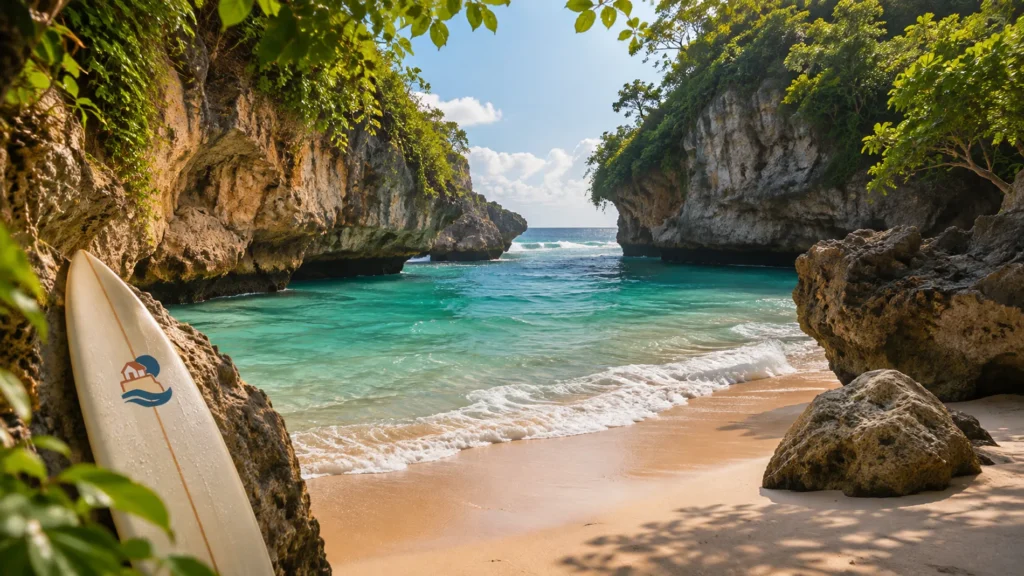
What to see. Padang Padang is a narrow sandy cove framed by limestone cliffs, with access through a small opening in the rock.
The beach itself is relatively compact, so it can feel crowded on popular days. However, the enclosed bay is particularly photogenic and offers an excellent place to watch the waves.
Water levels and the amount of exposed sand change throughout the day with the tides.
Location and how to find the entrance. Search for Pantai Padang Padang, also known as Pantai Labuan Sait, in your navigation app.
The parking area is close to the main road, followed by a walk down the steps to the beach.
One travel guide counts approximately 120 steps descending through the limestone, while other sources do not provide an exact number. The final section passes through a narrow rock grotto.
Access and physical demands. Reaching the beach involves descending stairs and passing through a narrow opening in the cliffs. The return climb requires some effort.
The route is unsuitable for pushchairs, and visitors with limited mobility may prefer to admire the bay from above.
Young children and older visitors may also find the stairs tiring.
Best time to visit and how long to allow. The morning and middle of the day can be hot, and by midday the limited stretch of sand often becomes crowded.
For a more comfortable experience, arrive early in the morning, around the start of the visiting day, or later in the afternoon.
Allow 1.5–2 hours for exploring the beach, a short swim, and the return climb.
Travel guides generally recommend visiting at low tide. At high tide, the passage through the grotto can become more difficult, while the usable beach area becomes narrower.
Entrance fees and other costs. According to an outdoor activity website with information dated October 1, 2026, admission costs IDR 15,000 for adults and IDR 10,000 for children.
Parking charges are reported as follows:
- Scooter: IDR 2,000.
- Car: IDR 3,000–5,000, depending on the source.
Payment is cash only, so bring small-denomination notes.
According to one website, surfboard rental costs approximately IDR 100,000 per hour.
Facilities and restrictions. Near the entrance, you will find local warungs, toilets, showers, and rental services. Lifeguards are also reported to be present on the beach itself.
According to visitor descriptions, the waves close to shore can be relatively gentle, and children sometimes swim here on calm days.
However, the surf break farther offshore is powerful and suited to experienced surfers.
Visiting the beach, swimming, and surfing are three separate activities with different safety considerations. Padang Padang should not be described as a universally beginner-friendly surf spot.
Monkeys are known to snatch belongings near the entrance, and valuables should never be left unattended while you are in the water.
Who should visit and what to combine it with. Padang Padang is ideal for visitors looking for a beautiful, enclosed cove without a particularly long walk.
Thomas Beach makes a convenient second stop. It is approximately a 25-minute walk along a footpath or about five minutes away by scooter via Jalan Labuansait.
5. Thomas Beach

What to see. Thomas Beach is a long stretch of sand beneath a limestone cliff, offering noticeably more space and generally fewer visitors than Padang Padang.
The beach faces west, giving it beautiful golden light in the evening.
Several cafés with ocean views sit along the clifftop. Some visitors choose to enjoy the scenery from these terraces, while others make the descent to explore the long sandy shoreline.
Location and how to find the entrance. Search for Pantai Thomas or Thomas Beach in your navigation app.
The beach lies between Padang Padang and Suluban.
There is no prominent direct sign marking the entrance. From Padang Padang, follow Jalan Labuansait for approximately five minutes.
Useful landmarks include the blue “Welcome to Padang Padang Beach” sign and Suka Espresso, located opposite the entrance.
There is no formal parking area. Visitors leave cars and scooters on an unpaved area near the path, which travellers report is free of charge.
Access and physical demands. The route down to the beach begins beside a small warung and follows a concrete staircase.
Different travel guides count between 130 and 175 steps, with the descent taking approximately five minutes.
The climb back up is considerably more demanding, especially in the heat, and the staircase is not illuminated after dark.
The beach is unsuitable for pushchairs and visitors with limited mobility.
Best time to visit and how long to allow. Aim to arrive before 11:00 am if you want to secure sun loungers.
The afternoon can be very hot, with little natural shade on the sand apart from a few rocks near the southern end of the beach.
It is best to return to the clifftop before dark.
Allow 2–3 hours for the descent, relaxing on the beach, and the return climb.
Entrance fees and other costs. Access to Thomas Beach is free.
According to a traveller’s report, typical rental and activity prices include:
- Beach umbrella with two sun loungers: approximately IDR 100,000 per day.
- Surfboard rental: approximately IDR 50,000 per hour.
- One-hour surfing lesson: approximately IDR 300,000.
These are reported prices rather than guaranteed current rates, so check them on arrival.
Payment is generally made in cash.
Facilities and restrictions. There are cafés and toilets at the top of the cliff, while beach-level facilities include local establishments such as Thomas Warung and Rocky Warung.
At high tide, sun loungers can occupy much of the remaining exposed sand.
At low tide, rocks become visible along the shoreline. This can make swimming less convenient, although the exposed rock pools can be interesting to explore.
Thomas Beach is not guaranteed to be quiet or uncrowded, and the water is not automatically safe for swimming. Waves and currents can change significantly from day to day.
When deciding whether to visit a beach below the cliffs, consider the return climb as carefully as the descent. After swimming and spending time in the heat, the same staircase can become the most physically demanding part of the day.
Who should visit and what to combine it with. Thomas Beach is a good choice for travellers looking for a long sandy shoreline and a relaxed coastal walk.
Padang Padang is nearby along the same road, making the two beaches easy to combine in a single outing.
Older visitors and families with very young children should assess whether they are comfortable tackling the staircase on the way back. If there is any doubt, enjoying the ocean views from the clifftop terrace may be the more practical option.
6. Nyang Nyang Beach

What to see. Nyang Nyang offers a long, exposed stretch of coastline where you can walk beside the ocean and admire the towering limestone cliffs from below. The sheer scale of the cliffs is often more impressive from the beach than from the viewpoints above.
At low tide, a reef platform emerges, revealing shallow natural rock pools.
This is primarily a destination for walking and exploring rather than a conventional beach day with umbrellas and sun loungers.
Older travel reports mention shipwreck remains along the Nyang Nyang coastline, but their current condition and exact location could not be independently verified for November 2026. Do not treat the wreck as a guaranteed attraction or enter the tidal zone specifically to search for it. Any metal debris encountered on the shore should be avoided because of potentially sharp edges, unstable structures, and changing wave conditions.
Location and how to find the entrance. Nyang Nyang Beach is located on the southern coast of the Bukit Peninsula, near Pecatu. There are several access routes, and they should not be treated as interchangeable. The eastern approach involves a steep walking trail with hundreds of steps, while the western approach includes a newer, very steep road leading towards the shoreline. Some visitors use scooters on the western route, but the gradient and road conditions make it unsuitable for inexperienced riders. Cars may need to remain at the upper parking area. Before setting off, confirm which entrance your navigation app is using and check recent reports of road conditions, particularly after rain.
Access and physical demands. The difficulty of reaching Nyang Nyang depends on which entrance you use. The eastern walking route involves approximately 500 steps, although reported counts vary. Allow roughly 15–30 minutes for the descent and considerably longer for the climb back, especially in hot weather. The western approach follows a steep access road rather than the same staircase, but this does not make it suitable for everyone: the gradient, uneven surfaces, and limited shade can still make the journey demanding. Neither route should be assumed to offer step-free or wheelchair-accessible beach access. Visitors with limited mobility and families with young children should assess the current route conditions carefully before attempting the descent.
Best time to visit and how long to allow. The ideal time is between 7:00 am and 10:00 am during the dry season, from April to October, when temperatures are lower and the beach is generally quieter.
From November to March, rain can make the trail dangerously slippery, and travel guides advise against attempting the descent during this period.
Allow 3–4 hours for the entire visit, including walking down, exploring the shoreline, and climbing back up.
Set a firm turnaround time before beginning your walk, as tidal conditions can change quickly.
At high tide, waves can be powerful, making swimming inadvisable. At low tide, the reef becomes exposed.
Entrance fees and other costs. There is no clearly established formal entrance fee.
Visitors report either making a voluntary contribution or paying approximately IDR 5,000–10,000 for scooter parking.
One travel directory quotes an entrance charge of IDR 10,000–20,000.
The inconsistency suggests that some charges may be informal, so carry small-denomination notes.
Facilities and restrictions. There are no toilets, shops, or lifeguards on the beach itself.
Recent visitor reports mention a café near the entrance that accepts cards, along with two small warungs. Nevertheless, bring your own water and snacks.
For the long descent and return climb, carry at least 1.5 litres of water per person.
This is an open-ocean beach, where strong waves and currents can create hazardous conditions.
Who should visit and what to combine it with. Nyang Nyang is best suited to travellers who enjoy walking, relatively deserted beaches, and physically demanding coastal scenery.
Karang Boma Cliff is nearby, with its turn-off close to the Nyang Nyang access road.
However, combining both destinations in a single day is best avoided unless you have sufficient energy and time, particularly given the demanding climb back from the beach.
7. Balangan Viewpoint

What to see. The main attraction is a sweeping clifftop panorama of Balangan Bay, which stretches for more than 500 metres.
From above, you can see the long strip of sand, lines of surf breaking over the coral seabed, and the surrounding limestone cliffs.
The beach itself has a northerly orientation, with a headland at its western end. As a result, sunset is not always clearly visible from the sand.
The clifftop viewpoint at the northern end is considered the better place to watch the evening light.
Search for Tebing Pantai Balangan in your navigation app.
Location and how to find the entrance. Balangan Beach is generally considered part of the Jimbaran area, close to Dreamland.
The northern car park provides access to the clifftop without a long staircase.
To reach the sand from the main parking area, however, visitors must descend approximately 50 steps.
A separate southern parking area, accessible only to scooters via an unpaved road, is located close to beach level.
Grab and Gojek drivers generally drop passengers on the main road, from where it is approximately 100 metres downhill to the beach.
Access and physical demands. The clifftop viewpoint has traditionally been reached from the northern parking area without a long staircase, although the terrain is exposed and some areas lack protective barriers. Access is currently uncertain. A visitor report from October 2026 described fencing and construction work near the viewpoint entrance, and I could not independently confirm whether unrestricted access had been restored by November 1, 2026. Separate redevelopment and demolition activity has also affected parts of the Balangan beachfront. Visitors should check recent local access information before travelling and must not cross construction barriers, enter restricted areas, or approach unprotected cliff edges. If the viewpoint is inaccessible, consider Dreamland Beach or another confirmed open coastal viewpoint instead.
Best time to visit and how long to allow. The best time for the viewpoint is generally between 4:30 pm and 6:00 pm.
The viewing area is relatively small, so aim to arrive about an hour before sunset if you want a good position.
Allow 30–40 minutes for the clifftop viewpoint alone.
If you also plan to descend to the beach and spend time there, allow approximately two hours in total.
Entrance fees and other costs. Access is reported to be free.
Parking charges at the northern car park are approximately:
- Scooter: IDR 5,000.
- Car: IDR 10,000.
At the southern parking area, scooter riders are reportedly asked for a voluntary contribution of around IDR 2,000.
There are no public toilets at the viewpoint. Some nearby establishments allow visitors to use their facilities for approximately IDR 5,000.
A pair of sun loungers with an umbrella at one of the beachfront restaurants costs around IDR 150,000.
Facilities and restrictions. Cafés, restaurants, and beach clubs have operated around Balangan, but their availability and facilities may be affected by ongoing redevelopment. Check whether individual establishments are open and confirm menus, admission conditions, and minimum spending requirements directly with the operator. Swimming can be difficult because of the coral and rocky seabed, so water shoes are recommended. Do not assume that walking along the shoreline from Balangan to Dreamland is safe or possible, particularly when tides and waves are changing. Travelling between the two beaches by road is the more practical option.
Who should visit and what to combine it with. Balangan Viewpoint is a good option for families and travellers seeking impressive coastal scenery without a demanding staircase, provided the clifftop access is open.
Dreamland Beach is nearby and makes a convenient additional stop.
However, avoid trying to watch sunset at both locations on the same evening.
8. Dreamland Beach

What to see. Dreamland is a broad, west-facing sandy beach framed by limestone cliffs and known for its powerful surf. Compared with Padang Padang, it offers considerably more space, while the western orientation makes it an attractive place to watch the sunset. Dreamland is unusual among the Bukit Peninsula’s major surf breaks because parts of the break have a predominantly sandy bottom, although rocks and reef sections are also present. Some waves may suit surfers with limited experience when conditions are favourable, but other sections can be powerful and unsuitable for beginners. Anyone considering a lesson should check the day’s conditions with a qualified local instructor. Walking farther north along the beach may lead to quieter areas and additional shade from the cliffs.
Location and how to find the entrance. Search for Pantai Dreamland in the Pecatu area.
The scooter parking area is only a short distance from the sand, although the access road is steep and uneven.
From the car parking area, the beach is approximately a two- to three-minute walk via short stairways and an elevated walkway.
You can also reach Dreamland using Grab or Gojek.
If arranging a return journey proves difficult, drivers may be easier to find near Klapa Beach Club.
Access and physical demands. Dreamland has one of the easier beach approaches in this selection, with around ten steps from the scooter parking area.
However, easier access does not mean the route is completely step-free.
There are stairs, uneven surfaces, and sections of soft sand, making the beach inconvenient for wheelchair users and visitors with pushchairs.
Best time to visit and how long to allow. Mornings are generally quieter, while the entrance area becomes busier towards sunset.
Allow 1.5–2.5 hours for swimming, relaxing, and exploring the beach.
Sun loungers farther along the shoreline are usually packed away before sunset.
Entrance fees and other costs. Entrance to Dreamland Beach is free.
Reported charges include:
- Scooter parking: IDR 5,000.
- Car parking: IDR 20,000.
- Two sun loungers for the day: Approximately IDR 200,000.
- Toilet: IDR 3,000.
- Shower: IDR 10,000.
Parking is payable in cash.
You may be able to negotiate a lower price for sun loungers later in the afternoon.
Klapa Beach Club advertises a minimum spend of approximately IDR 100,000.
Facilities and restrictions. Dreamland Warung, described as the only warung directly on the sand, charges more than some other local eateries but accepts card payments.
Dogs sometimes roam along the beach. Most are described as friendly, but it is best not to approach unfamiliar animals.
During the rainy season, rubbish can occasionally wash ashore, noticeably affecting the beach’s appearance.
Two red flags near the entrance mark an area where waves are particularly strong and swimming is discouraged.
Easy access to the sand does not mean the water is safe. Swimming is not recommended for children when conditions are hazardous.
A beautiful beach and a safe swimming beach are not necessarily the same thing. A bay may be spectacular to photograph yet better suited to walking along the shore than entering the water.
Who should visit and what to combine it with. Dreamland appeals to travellers looking for a wide sandy beach, sunset views directly from the shoreline, and opportunities to watch surfers. Surfing lessons may be available when conditions are suitable, but the beach should not be treated as consistently safe for beginners. It pairs well with nearby Balangan Viewpoint, provided the viewpoint is accessible.
9. Melasti Beach
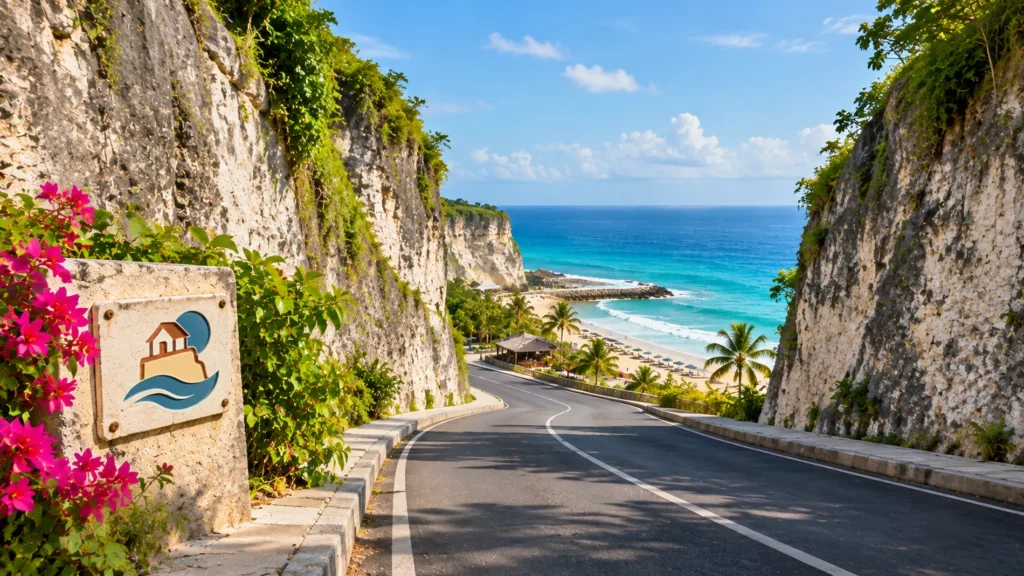
What to see. The approach to Melasti Beach is almost an attraction in its own right. The access road winds between towering white limestone walls before revealing a broad stretch of pale sand and turquoise water. Unlike many beaches around Uluwatu, Melasti can be reached by road almost to the shoreline, making it one of the more convenient options for visitors who prefer to avoid long staircases. Several commercial beach clubs operate in the surrounding area, offering food, seating, swimming pools, and other facilities under their own admission or spending arrangements. These services are separate from general beach access, and visitors should check each venue’s location and conditions individually.
Location and how to find the entrance. Search for Pantai Melasti Ungasan in your navigation app.
The beach is located in Ungasan.
The access road has been cut through the limestone almost to sea level, allowing cars and scooters to reach parking areas close to the sand.
From there, the walk to the beach is only a few dozen metres.
Access and physical demands. Parking is available close to the beach, and much of the approach is relatively level.
However, convenient vehicle access does not guarantee full accessibility.
There may still be steps, uneven paving, and soft sand, all of which can make moving around difficult with a wheelchair or pushchair.
Best time to visit and how long to allow. The most pleasant visiting periods are:
- 6:00–9:00 am: For a quieter beach experience.
- 4:30–6:30 pm: For sunset light and evening views.
The beach becomes busier around midday and at weekends, although its relatively wide shoreline provides more room than some of Uluwatu’s smaller coves.
Allow 1.5–2.5 hours for your visit.
Entrance fees and other costs. A travel guide updated in September 2026 quotes an entrance fee of IDR 10,000 per person.
Another source lists IDR 15,000, so bring some extra cash in case the fee differs.
Reported parking charges are:
- Car: IDR 5,000.
- Scooter: IDR 2,000.
Toilets, showers, and changing facilities are available for a small fee or donation.
Facilities and restrictions. Melasti has warungs, cafés, sun loungers, and beach clubs.
Public access to the beach and services offered by private beach clubs are separate arrangements.
The clubs provide amenities such as umbrellas, food, and swimming pools, but these are commercial facilities rather than part of the public beach infrastructure.
Some travel guides describe Melasti as having relatively calm water compared with other beaches on the Bukit Peninsula, making it popular with families.
However, one reader reported that the beach was unsuitable for swimming because of shallow water and coral.
This is a meaningful difference in reported conditions rather than a minor disagreement.
Check the water depth, exposed coral, and current conditions before settling in for a swim.
Who should visit and what to combine it with. Melasti is a practical choice for families and travellers who prefer straightforward access to the beach.
GWK Cultural Park is also located in Ungasan, making the two attractions easy to combine in a single day.
10. Garuda Wisnu Kencana (GWK) Cultural Park
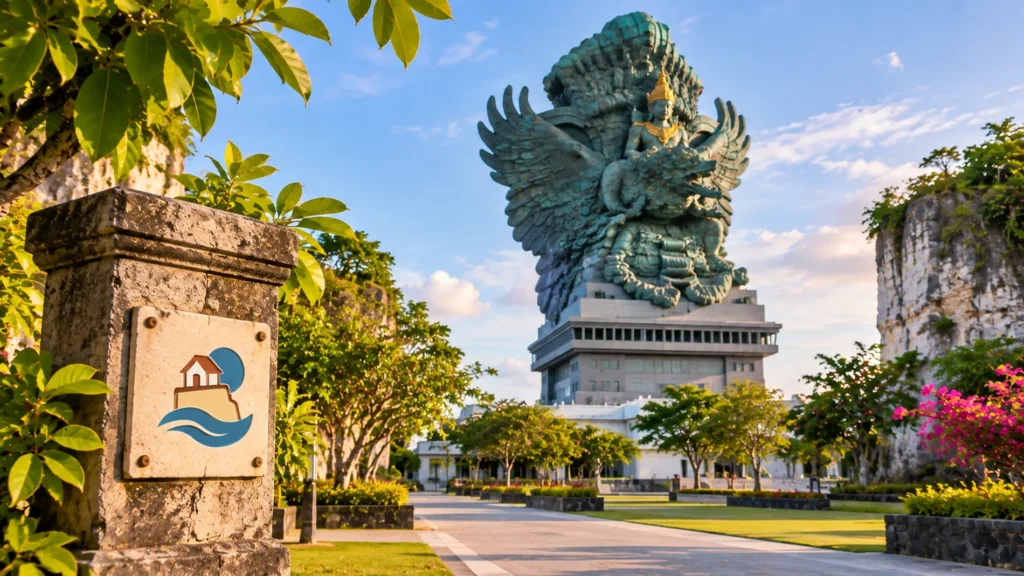
What to see. Garuda Wisnu Kencana Cultural Park is dominated by a monumental statue of the Hindu god Vishnu riding Garuda.
Including its base, the monument stands 121 metres tall, with a wingspan of 64 metres. According to official information, its construction required approximately 3,000 tonnes of copper and brass.
The cultural park covers around 60 hectares and includes open plazas surrounding the monument, Festival Park opposite the statue, the 4,200 m² Lotus Pond area, an amphitheatre, and Jendela Bali Restaurant.
This is a cultural attraction in Ungasan rather than an oceanfront viewpoint.
Location and how to find the entrance. Search for Garuda Wisnu Kencana Cultural Park, Jalan Raya Uluwatu, Ungasan. The park is approximately 10–11 km by road from Ngurah Rai International Airport. Driving times vary considerably with traffic: the journey may take around 15 minutes in favourable conditions, but 30–40 minutes or longer is a more cautious allowance when planning a visit. Travel times from Jimbaran and Denpasar also depend on your starting point and traffic conditions. The access road leads to parking near the main entrance, after which visitors explore the grounds using the park’s internal walkways.
Access and physical demands. The main paths are generally more level than the access routes to Uluwatu’s beaches, although the park covers a large area and shade is limited across some of the open plazas.
For visitors using pushchairs or those with mobility limitations, GWK is one of the more accessible attractions in this selection.
An electric buggy shuttle operates for longer journeys within the park.
The reported fare is IDR 40,000 one way, travelling from Plaza Bhagawan towards the monument and onwards to Festival Park.
Best time to visit and how long to allow. Daytime cultural performances take place in the amphitheatre and around Lotus Pond, generally between 11:00 am and 4:00 pm.
According to the official ticketing information, the children’s performance Petualangan Garuda Cilik is scheduled for 10:00 am and 2:00 pm.
The evening BarAong performance begins at 6:00 pm and requires a separate ticket.
I could not confirm the park’s general opening hours on its website, so check them before travelling.
Allow 2–3 hours for your visit, including a break in the shade.
Entrance fees and other costs. Standard admission, a guided tour inside the statue, and the evening performance are separate products.
According to the official ticketing information available on November 1, 2026:
| Ticket or Service | Price (IDR) | What’s Included |
|---|---|---|
| Standard admission | 150,000 | Park access, daytime performances, and dessert at Jendela Bali with a qualifying order |
| Ultimate package | 400,000 | Guided access to the 9th and 23rd floors inside the monument |
| Electric buggy shuttle | 40,000 | One-way transport within the park |
| BarAong evening performance | 125,000 (separately advertised ticket; check available packages) | Evening performance at 6:00 pm on selected dates; confirm admission conditions when booking |
The BarAong evening performance is available on selected dates rather than necessarily every day. The official ticketing system lists different ticket categories, and the inclusions should be checked before purchase. Standard and Ultimate admission tickets allow same-day re-entry using a hand stamp, subject to the published conditions. Children under 100 cm tall are listed as eligible for free admission. Current ticket categories, availability, performance schedules, and optional services can be checked through the official GWK ticketing website.
Facilities and restrictions. The park has cafés, toilets, shaded resting areas, and Jendela Bali Restaurant, which accepts reservations.
Access to the interior of the statue is included only in the Ultimate package and is subject to scheduled guided tours.
Tour times should be confirmed at the Plaza Bhagawan information desk.
Who should visit and what to combine it with. GWK is a good option for visitors seeking a cultural experience with relatively level walking paths, including families with children.
Melasti Beach makes a convenient pairing: visit the beach in the morning and explore the cultural park later in the day.
One-Day and Two-Day Uluwatu Itineraries
Trying to visit all ten attractions in one day is unrealistic.
In practice, a comfortable itinerary includes three or four stops, allowing time for driving, heat, and the climbs back from the beaches.
Sunset in Bali generally falls between approximately 5:45 pm and 6:20 pm, depending on the month.
This leaves a relatively short window for evening viewpoints.
The 6:00 pm Kecak performance and a sunset visit to one of the clifftop viewpoints also compete for the same time slot, so it is better to choose one.
The first itinerary focuses on two neighbouring attractions along the western coast and an evening temple visit, with time for lunch in the shade.
The second divides the Bukit Peninsula into two manageable areas over two days, reducing unnecessary travel along the same roads.
The third is designed for visitors who find stairs challenging. It prioritises attractions with easier access and ends with a viewpoint rather than another demanding beach descent.
| Itinerary | Order of Stops | What to Leave Out | What to Check |
|---|---|---|---|
| One day: Temple and coastal views | Around 8:30 am: Padang Padang, provided the tide and wave conditions are suitable; adjust the beach stop if necessary. Around noon: lunch at a clifftop restaurant near Suluban; 2:00 pm: break; 4:30 pm: Uluwatu Temple; 6:00–7:00 pm: Kecak performance | Karang Boma, Nyang Nyang, Balangan, Dreamland, Melasti, GWK | Tide and wave forecasts, Kecak ticket availability, cash, and traffic |
| Two days: Western coast and Ungasan | Day 1: 8:00 am Thomas Beach before the heat; 11:30 am Padang Padang; 4:30 pm temple and Kecak. Day 2: 7:00 am Melasti; 10:30 am GWK; daytime cultural programmes from 11:00 am to 4:00 pm | Balangan, Dreamland, Nyang Nyang, Karang Boma | GWK performance schedule, travel between areas; evening of Day 2 remains free |
| Fewer stairs | Morning: Melasti Beach, using the parking area closest to the shoreline; late morning or early afternoon: GWK Cultural Park; late afternoon: a confirmed accessible coastal viewpoint or a return to Melasti. Consider Balangan only if access has been verified in advance. | Thomas, Suluban, Padang Padang, Nyang Nyang | Current access restrictions, parking arrangements, walking surfaces, and weather conditions |
Step-by-step plan for a one-day Uluwatu trip:
- Set off between 8:00 am and 8:30 am, while traffic is lighter and temperatures are more comfortable.
- Start with the beach involving the longest descent while you still have plenty of energy.
- Check the tides before descending to Padang Padang or Suluban.
- Arrange your return transport in advance, especially if you plan to leave in the evening.
- Arrive at Uluwatu Temple by 4:30 pm to allow time for admission, collecting a sarong, and finding a seat.
- Do not schedule two separate sunset stops. Choose either the temple and Kecak performance or a coastal viewpoint.
For a single evening, choose one main sunset destination—Uluwatu Temple with the Kecak performance, Karang Boma, or a beach—and plan the rest of your route around it.
If exploring Uluwatu has made you consider living in Bali long-term, begin with your location requirements: road access, everyday travel routes, and proximity to essential amenities. World Estate Homes can help you find property in Bali that matches your budget and preferences.


 Bali, Bingin, Uluwatu
 from 117м²




How to Prepare for Your Uluwatu Trip
Transport around the Bukit Peninsula requires careful planning. Scooter rental may cost around IDR 100,000 per day according to traveller reports, but actual prices depend on the vehicle, rental period, and operator. Foreign visitors should hold a valid driving licence with the appropriate motorcycle entitlement and a recognised International Driving Permit, or an applicable Indonesian driving licence. A standard car licence is not sufficient for riding a motorcycle. Before renting, confirm that your travel insurance covers motorcycle use and check any restrictions relating to engine size, protective equipment, and licensing. Roads around Uluwatu can be narrow, steep, and congested, so renting a scooter is not advisable for inexperienced riders. Alternatives include Grab, Gojek, taxis, and private drivers. Arrange return transport in advance when visiting remote beaches, especially towards evening, when mobile reception and driver availability may be limited. See the UK government’s official road safety guidance for Indonesia for further information.
Heat and humidity can quickly drain your energy.
During the rainy season, from November to March, stone steps and paths become slippery, visibility at viewpoints may deteriorate, and rubbish can wash onto beaches.
On such days, consider adjusting your itinerary to prioritise cultural attractions, the temple, and GWK rather than difficult beach descents.
Carry cash for parking, small ticket booths, sun loungers, and toilets, as cards are not accepted everywhere.
Your phone is essential for navigation and booking transport, so conserve its battery.
What to bring:
- Water: At least 1.5 litres per person for routes involving long descents and climbs.
- Supportive footwear with good grip: Choose shoes with textured soles rather than flip-flops. Stairs can be slippery, and water shoes are recommended for Balangan.
- Sun protection: A hat, sunglasses, and sunscreen. Keep sunglasses safely packed away near monkeys.
- Small-denomination cash: Parking, toilets, and sun loungers are commonly paid for in cash.
- Temple-appropriate clothing: Clothing covering your knees or a lightweight sarong.
- A fully charged phone and power bank.
What to check on the morning of your trip:
- Tide times and predicted water levels at your chosen beaches.
- Weather conditions and the likelihood of rain.
- Kecak performance times and ticket availability.
- The current access status of Balangan Viewpoint and GWK’s opening schedule.
- Your return transport arrangements and planned departure time.
For marine conditions, consult the BMKG maritime forecast for waters south of Bali.
A regional marine forecast does not replace local safety warnings or an assessment of conditions at a specific beach.
Short-term wave measurements are not included in this guide because they can become outdated quickly.
How Much Does a Trip to Uluwatu Cost?
The prices below were compiled on November 1, 2026, using publications from August to October 2026 and the official GWK ticketing information.
They are indicative amounts for foreign adult visitors, not guaranteed current prices.
Actual charges at ticket counters may differ, and sources disagree on certain fees, particularly those at Uluwatu Temple.
All amounts are in Indonesian rupiah (IDR), with no conversion into other currencies.
| Expense | Typical Cost (IDR) | How to Avoid Miscalculating |
|---|---|---|
| Transport | Scooter rental around 100,000 per day; Grab, Gojek, and private drivers charged according to their rates | Confirm whether waiting time and the return journey are included |
| Entrance fees | Uluwatu Temple 60,000; Padang Padang 15,000; Melasti 10,000; Karang Boma 10,000; GWK 150,000 | Check the visitor category and source date; children’s tickets may cost less |
| Parking | Uluwatu Temple 2,000 / 5,000; Suluban 5,000 / 10,000; Dreamland 5,000 / 20,000; Balangan 5,000 / 10,000 | The first amount is for a scooter, the second for a car; parking is charged per vehicle, not per person |
| Kecak performance | 150,000 per adult; 75,000 per child aged 2–9 | Requires a separate ticket; not included in temple admission |
| Food | Food prices vary by establishment; check current menus and allow extra spending at beachside venues. | Bring your own drinking water; prices near beaches tend to be higher |
| Beach facilities | Illustrative visitor-reported prices: around 100,000–200,000 for a pair of sun loungers; toilets and showers may be charged separately. Rates vary by beach, operator, season, and time of day. | Confirm the full price, included services, and rental duration before paying. Do not assume negotiation or discounts are available. |
Separate essential costs—transport, entrance fees, and parking—from optional expenses, such as the Kecak performance, sun loungers, and meals.
To illustrate the overall cost, consider the first one-day itinerary for a foreign adult travelling by scooter: Padang Padang, a parking stop at Suluban, and Uluwatu Temple with the Kecak performance.
The calculation is:
IDR 15,000 + 2,000 + 5,000 + 60,000 + 2,000 + 150,000 = IDR 234,000.
That is IDR 234,000 for entrance fees, the Kecak ticket, and parking alone, excluding scooter rental, food, and sun loungers.
How to Choose the Right Stops for Your Uluwatu Itinerary
A well-planned Uluwatu itinerary combines one cultural attraction, one beach, and one scenic viewpoint, with the remaining choices determined by travel distances and how much physical effort you are comfortable with.
For example, you could visit Uluwatu Temple and Padang Padang Beach on the same day, then save Melasti Beach and GWK Cultural Park for another.
Three key factors will help you decide:
- How much physical effort are you prepared for in the heat? Consider both the descent and the return journey. Padang Padang involves approximately 120 steps, while Thomas Beach has around 130–175, depending on the route and source. At Nyang Nyang, the eastern approach includes approximately 500 steps, while the western approach uses a steep access road. Check the entrance and current conditions before choosing your route.
- How do you want to spend your evening? Decide whether to attend the Kecak performance at Uluwatu Temple, starting at 6:00 pm, or enjoy sunset from a scenic viewpoint.
- How much time are you willing to spend travelling between attractions? Consider actual driving distances and traffic conditions when deciding how many stops to include in a single day.
 Real estate in Georgia
 Real estate in Cyprus
 Real estate in the UAE
 Real estate in Montenegro
 Real estate in Thailand
 Real estate in Spain
 Real estate in Saudi Arabia
 Real estate in Turkey
 Real estate in Zanzibar
 +62 895 001 924 667
 hello@ulu-homes.id
 Tibubeneng, Canggu, Kuta Utara, Badung Regency, Bali 80361, Indonesia




 Get catalogue of TOP-7 objects