
 +62 895 001 924 667


Renting a villa to tourists in Bali is a business activity. As such, it typically requires a registered operator with the correct business classification, documented land use authorisation, current building approvals, any sector-specific licences, standards certificates and supporting approvals required for the applicable activity and risk classification, and tax registration. There is no single document called a “Bali villa rental licence” that resolves every one of these requirements in one step. What applies to a specific property depends on who owns it, who operates it, what the land is designated for, whether the building has current permits, and how the rental activity is structured.
That distinction matters most to buyers. Purchasing a villa based on projected rental income is only sound if the property can legally generate that income. The licensing position should be assessed — at least in outline — before any significant payment is made. A property with incomplete permits, unclear land use, or a mismatch between its registered operator and its actual activity carries risks that affect both the return and the legal position of the owner.
This guide explains each layer of Bali’s villa licensing framework, how the layers interact, and what to check at every stage of ownership or acquisition.
Bali villa rental licensing: key facts for 2026
| Question | Quick answer |
|---|---|
| Is a rental licence required? | Commercial tourist accommodation generally requires business licensing and applicable property approvals |
| Main business registration | NIB through OSS, with the correct KBLI classification |
| Villa classification | KBLI 55193 (2020) → KBLI 55203 (2025) |
| Homestay classification | KBLI 55130 (2020) → KBLI 55201 (2025) |
| Building approvals | PBG or applicable legacy IMB, plus SLF requirements |
| Spatial planning | Permitted use must be verified under the applicable RDTR/RTRW and KKPR procedures |
| Regional accommodation tax | PBJT on taxable hotel services: statutory ceiling of 10%; local rates and taxable base must be checked |
| Foreign investors | PT PMA eligibility or a properly licensed operating arrangement must be verified |
| Government licensing costs | No reliable single total applies to every property |
| Processing time | Depends on the property, applicant, permits and any required remediation |
| OTA deadline | 31 March 2026 was an announced compliance target; OTA acceptance does not prove government approval |
Important: A villa advertised as “rental-ready” is not necessarily approved for tourist accommodation. Check the land, building and operating business separately before committing funds.
Do You Need a Villa Rental Licence?
The key question is not how many nights per year a villa is rented — it is whether the activity constitutes the provision of commercial tourist accommodation. Indonesia treats short-term accommodation for paying tourists as a business activity, governed by the risk-based business licensing framework and subject to sector-specific standards from the Ministry of Tourism.
Three situations produce different positions:
Recurring short-term tourist bookings. Renting a villa to tourists on a nightly or weekly basis — through Airbnb, Booking.com, a local villa management company, or direct bookings — is providing an accommodation service. This category typically requires a registered business operator, whether an eligible individual or legal entity, with the appropriate KBLI (Klasifikasi Baku Lapangan Usaha Indonesia) classification, an NIB (Nomor Induk Berusaha), and the business licences and compliance documents applicable to its KBLI code, risk level and business scale. Land use and building approvals are additional, separate requirements.
Long-term residential lease. Renting to a single tenant under a formal lease agreement is a different legal arrangement. A genuine residential tenancy may fall outside tourism accommodation licensing, depending on its actual use, contractual structure and applicable rules. Some developers describe properties as “rental villas” without specifying which category of use they are approved for, which is a distinction buyers should press on.
Occasional personal use with incidental rental. An owner who uses a villa personally and occasionally hosts paying guests occupies a less defined position. Occasional paid tourist accommodation is not automatically exempt from business licensing merely because bookings are infrequent. Where there is doubt about the threshold, proper business registration is the lower-risk path.
The number of rental days is not the only, or even the primary, criterion. The commercial nature of the activity — providing accommodation to tourists for payment on a recurring basis — is what typically brings a villa within the licensing framework.
| Rental model | Typical activity | Licensing considerations | What to verify |
|---|---|---|---|
| Tourist short-term rental via OTA or agent | Regular nightly or weekly bookings for visiting tourists | Business registration (NIB), correct KBLI, applicable compliance documents, tax registration | Identity of the registered operator; whether land use permits tourist accommodation |
| Long-term genuine residential tenancy | Single tenant, formal lease, occupying as a home | Tourism accommodation licensing typically not required; tax obligations may still arise | Whether the arrangement’s actual use matches its classification; applicable zoning rules |
| Villa managed entirely by a third-party operator | Owner provides property; management company handles all bookings and guests | Operator must hold appropriate business licences; property-level approvals remain with the property | Operator’s legal entity, KBLI scope, and whether coverage extends to this specific villa |
| New-build marketed as “rental investment” | Developer promotes projected rental income; promises licensing support | A developer’s business licence should not be assumed to authorise each buyer’s future rental operation; the applicable operator and property approvals must be verified | Land certificate, KKPR, PBG, SLF, and how guest contracts will be structured after purchase |
Listing a property on Airbnb does not define its legal category. A villa can appear on any OTA platform before any local authority has checked its compliance. The listing is what the host has chosen to publish; it is not a verification by any government body.
What Permits Does a Bali Villa Need?
Legal operation of a tourist villa in Bali involves three largely independent levels: the land, the building, and the business operator. A document at one level does not compensate for a gap at another.
Land level. The designated use of the parcel must permit commercial tourist accommodation. This is determined through the spatial planning framework — RDTR (Rencana Detail Tata Ruang, the detailed district spatial plan) or RTRW (Rencana Tata Ruang Wilayah, the regional spatial plan). The applicable spatial-planning requirements and KKPR (Kesesuaian Kegiatan Pemanfaatan Ruang) status should be verified through OSS and the competent local authority. Not all land with a villa on it carries the right designation.
Building level. The physical structure must have current, accurate approvals. The PBG (Persetujuan Bangunan Gedung) is the building permit framework that replaced the older IMB (Izin Mendirikan Bangunan) for new applications under Government Regulation No. 16 of 2021. The SLF (Sertifikat Laik Fungsi) confirms the completed building is suitable for its authorised use. Buildings constructed without correct documentation — or buildings that differ materially from what was approved — present compliance risks regardless of what other licences may be in place.
Business operator level. The individual or legal entity conducting the accommodation business must obtain the business registration and licences applicable to its legal form and activity through the OSS system (Online Single Submission, Indonesia’s central business licensing portal), with the KBLI code that reflects the actual accommodation activity. Under Indonesia’s risk-based licensing framework — governed principally by Government Regulation No. 28 of 2025 — the required compliance documents vary by risk category: medium-low-risk and medium-high-risk activities generally involve a Sertifikat Standar (standards certificate), subject to the applicable verification rules, while high-risk activities require the licences specified under the risk-based framework. The OSS system additionally lists Sertifikat Laik Sehat — a regional health and sanitation suitability certificate — as a required supporting business licence for the Vila activity classification.
| Document | Purpose | Responsible authority or system | Main verification point |
|---|---|---|---|
| NIB (Nomor Induk Berusaha) | Business identity number; required for all registered businesses | OSS system (BKPM / DPMPTSP) | Identifies the registered business operator, whether an individual or legal entity; does not alone establish authorisation to operate a particular tourist villa |
| KBLI classification code | Activity code that determines licensing requirements | OSS — assigned at registration | Must match actual activity; wrong code creates compliance exposure at inspection |
| Sertifikat Standar or applicable Izin | Sector compliance document; type depends on the risk classification of the activity | Ministry of Tourism / local tourism authority | Confirm whether the selected KBLI and risk classification require a Standard Certificate, an Izin, or another instrument, and whether verification or renewal applies |
| KKPR | Space-use conformity for the land parcel | Ministry of ATR/BPN or local government | Spatial-planning conformity must be addressed in accordance with applicable OSS procedures; check for exceptions or transitional provisions |
| PBG (Persetujuan Bangunan Gedung) | Current building permit for new/modified structures | Local DPMPTSP | Confirms the authorised building footprint and use; older IMB may apply to pre-existing structures |
| SLF (Sertifikat Laik Fungsi) | Confirms completed building is fit and safe for its designated use | Local government | Separate from building permit; must match actual function of the building |
| Sertifikat Laik Sehat | Health and sanitation suitability certificate | Local health authority | Listed in the OSS licensing scope for Vila (KBLI 55193/55203); confirm applicability for the specific location and model |
| NPWP | National tax identification for the business entity | Directorate General of Taxation | Required for income tax and national reporting |
| NPWPD | Regional tax identification | Regional revenue office (BAPENDA) | Required for PBJT accommodation tax registration and remittance |
The precise combination of required documents depends on the activity, business scale, legal form and applicable rules. NIB registration is generally required for operators conducting a registered accommodation business, while additional approvals and certifications depend on the specific operation. What is consistent is the principle:
A business registration number does not automatically make every villa legally rentable.
Consider a villa operated by a business holding an NIB, where the building has no SLF and spatial-planning conformity for tourist accommodation remains unverified. The NIB alone does not establish that the property is authorised to accommodate paying guests.

KBLI Codes and OSS Registration
Indonesia’s OSS (Online Single Submission) system is the central portal through which businesses in all sectors register and obtain licences. Every business registration includes a KBLI code — the classification that determines which licensing requirements apply, which government authorities are involved, and which sector standards must be met. The OSS framework is governed principally by Government Regulation No. 28 of 2025, with OSS procedures further addressed by Ministry of Investment and Downstreaming/BKPM Regulation No. 5 of 2025. Tourism-specific business activity standards and administrative supervision are set out in Ministry of Tourism Regulation No. 6 of 2025.
Selecting a KBLI code based on what appears most commonly in online articles is not a reliable method. The code must correspond to the business activity that is actually being conducted. Misclassification — registering a KBLI that does not accurately reflect the real operation — creates exposure when compliance is checked, and does not provide legal protection for the actual activity.
Villa vs Pondok Wisata
Under the OSS system, Vila is classified as KBLI 55193 (under KBLI 2020). The official Indonesian description covers businesses providing accommodation services to the general public in private houses that are specifically rented out to tourists, with associated facilities, and managed by the owner. The classification places it under short-term accommodation, within the broader accommodation and food services category.
Two aspects of this definition carry practical weight. First, the official definition refers to private houses rented to tourists — multi-unit developments may require assessment under a different accommodation classification. Second, it envisages the property being managed by the owner themselves. Operations that differ significantly from this model may fall under a different classification. The applicable KBLI 2025 equivalent should be confirmed directly through OSS at the point of registration.
Pondok Wisata is a distinct category. Under KBLI 2020, Pondok Wisata (KBLI 55130) generally refers to tourist accommodation offered within an owner-occupied residential home, where part of the dwelling is rented to guests — closer in concept to a homestay than a standalone holiday villa. The corresponding KBLI 2025 classification is 55201 (Aktivitas Rumah Tinggal Sewa / Homestay). Pondok Wisata should not be treated as an interchangeable or automatically simpler licensing route for an independently operated holiday villa. Choosing a classification based on which code appears to involve fewer requirements, rather than which accurately describes the property and activity, creates a compliance risk.
Other accommodation categories — hotel, apartment hotel, other short-term accommodation, and property management services — each have their own KBLI codes, licensing criteria and applicable compliance documents. The classification determines the full compliance pathway.
KBLI 2025 Changes
Indonesia’s business classification system was updated to KBLI 2025. The official OSS system records that KBLI 55193 (Vila, KBLI 2020) converts on a 1:1 basis to KBLI 55203 (Aktivitas Vila, KBLI 2025). Both codes cover the same underlying activity.
For businesses registered under KBLI 55193, the transition to the KBLI 2025 framework is subject to OSS system provisions and any implementing guidelines. The existence of KBLI 55203 in the updated directory does not automatically establish that every applicant — individual or corporate, domestic or foreign — can immediately use it without further eligibility checks.
The distinction matters: a code appearing in a classification directory describes an activity. It does not grant permission to conduct it. Eligibility depends on the applicant’s legal form, ownership structure, and compliance with any applicable sectoral or investment rules in force at the time of registration.
| Accommodation type | Relevant KBLI classification | Typical operating model | Foreign-investment considerations | Verification required |
|---|---|---|---|---|
| Vila | 55193 (KBLI 2020) / 55203 (KBLI 2025) | Private house rented to tourists; owner-managed | Eligibility for foreign-owned entities must be individually verified; cannot be assumed | Confirm current eligibility through OSS at point of registration |
| Pondok Wisata / Homestay | 55130 (KBLI 2020) / 55201 (KBLI 2025) | Tourist accommodation in an owner-occupied dwelling; part of the home rented to guests | Foreign-investment eligibility must be checked against current investment regulations and OSS classification | Confirm applicable KBLI, risk category and foreign-participation rules |
| Hotel / apartment hotel | Separate hotel sector KBLI | Purpose-built managed hospitality operation | PT PMA may operate at certain scales subject to sector-specific rules | Full OSS verification; hotel sector licensing and applicable compliance documents apply |
| Property management | Management sector KBLI, distinct from accommodation | Third-party company managing properties on behalf of owners | Separate activity from accommodation; operator holds its own licences | Confirm the management company’s KBLI matches its actual activity |
Can Foreigners Legally Rent Villas?
Foreign nationals and foreign-owned entities face a distinction that is frequently blurred in investment marketing: holding property rights in Bali is a legally separate matter from having the right to operate a tourism accommodation business there. The two involve different regulations, different entities, and different obligations. Meeting one requirement does not automatically satisfy the other.
A foreign national cannot hold freehold land (Hak Milik) in Indonesia — that right is reserved for Indonesian citizens under the Basic Agrarian Law. Options available to foreigners include Hak Pakai (right to use) and Hak Sewa (right to lease). A PT PMA (Penanaman Modal Asing — a foreign-owned limited liability company) is a business entity that may hold eligible land rights, subject to applicable land and investment law; it is not itself a form of land tenure. Forming or operating through a PT PMA is a common structure for foreign investment, but it should not be conflated with the separate questions of which land rights the company can hold and whether it can operate a given accommodation activity.
Operating Through a PT PMA
A PT PMA is the standard vehicle for foreigners wishing to conduct registered business activities in Indonesia. Forming a PT PMA involves defining the company’s authorised activities through OSS, including selecting KBLI codes. This is where a common assumption causes problems: not every KBLI code in the OSS directory is accessible to every PT PMA.
Indonesia’s investment regulations specify which business activities are open to foreign investment, which carry conditions, and which are reserved for Indonesian nationals or cooperatives. Confirm the applicable foreign-investment eligibility, investment requirements and business-scale conditions under current regulations before forming a PT PMA for any accommodation activity. This cannot be assumed from a general reading of the KBLI directory.
What is unambiguous: PT PMA registration does not replace property-level permits. A company can be validly registered and have a NIB, while the villa it is operating lacks a confirmed KKPR for tourist use, an SLF, or any sector certification. The company’s licences and the property’s approvals are distinct.
Using a Licensed Operator
Many villa owners — Indonesian nationals and foreign investors alike — hand operations to a licensed villa management company. This is a legitimate and common model. But it requires understanding what the operator’s licence actually covers.
Key questions to resolve before signing any management agreement:
- What is the management company’s registered legal entity name and what KBLI codes appear in its NIB?
- Does the company hold a current Sertifikat Standar or applicable licence specifically for accommodation activity — or only for property management services?
- Who legally enters into the accommodation contract with each guest?
- Who receives the guest payment, and who is identified as the legally responsible party for PBJT accommodation tax under the applicable regional regulation?
- Who bears regulatory responsibility if an inspection identifies a problem with the villa?
These questions are not bureaucratic formality. They determine, in the event of an inspection or dispute, which party is the operator of record and which party carries the compliance obligation.
A management company’s licence is not proof that your specific villa is approved for tourist accommodation.
The operator’s authorisation covers the operator’s business activity. The villa’s land designation and building approvals are attached to the property, not to the operator. An operator with a valid NIB cannot transfer those property-level approvals to a villa that does not have them.
On nominee arrangements — where an Indonesian individual holds title or business registration on behalf of a foreigner — the risks are serious. Nominee arrangements intended to circumvent foreign land-ownership restrictions carry substantial enforceability risks and may be invalid under Indonesian law. The consequences extend beyond licensing to the property interest itself.
What to agree with a villa management company
| Issue | What the management agreement should specify |
|---|---|
| Booking and guest contracts | Which legal entity contracts with guests |
| OTA accounts | Who controls listings, reviews, pricing and platform access |
| Rental income | Who collects payments and when the owner is paid |
| PBJT | Statutory taxpayer, filing arrangements and payment evidence |
| Management commission | Percentage, calculation base, exclusions and payment dates |
| Housekeeping and staffing | Included services and separately charged items |
| Repairs | Authorisation limits, emergency spending and maintenance reserves |
| Licensing | Who maintains business authorisations and handles regulatory requests |
| Insurance and guest damage | Policyholder, coverage, claims and deductibles |
| Termination | Notice period, outstanding bookings, guest refunds and data handover |
Management contracts cannot override statutory licensing or tax obligations. Independent review is particularly important when the owner and operator are different legal entities.
Which rental operating model fits your situation?
| Question | Own PT PMA operating the villa | Licensed third-party operator | Long-term residential tenancy |
|---|---|---|---|
| Who conducts the business? | PT PMA, if eligible for the activity | The licensed operator, subject to the actual agreement | The landlord or lessor under the applicable rental arrangement |
| Who handles guest bookings? | Company’s staff or appointed service providers | Management company | Usually not applicable to tourist bookings |
| Who needs relevant business authorisation? | The PT PMA | The actual accommodation operator | Depends on whether the activity constitutes residential letting or a regulated business |
| Who manages tax compliance? | PT PMA and its accountant | Statutory taxpayer, with tasks allocated by contract where permitted | Taxpayer under the applicable residential rental regime |
| Main benefit | Direct control of the operating business | Outsourced day-to-day operations | No routine tourist accommodation operations |
| Main risk | Investment eligibility, compliance and operating overhead | Dependence on the operator and unclear contractual responsibilities | Misclassifying tourist accommodation as residential letting |
| Most important document to review | OSS registration and underlying corporate and property approvals | Accommodation licence scope and management agreement | Lease terms, permitted use and applicable tax treatment |
The right model depends on who legally supplies accommodation to guests. Simply appointing a management company does not automatically authorise a property that lacks the required land or building approvals.
For more on ownership structures available to foreign buyers, see “PT PMA for Bali Property” and “How a Foreigner Can Buy Property in Bali“.
Explore Villa Developments in Bali


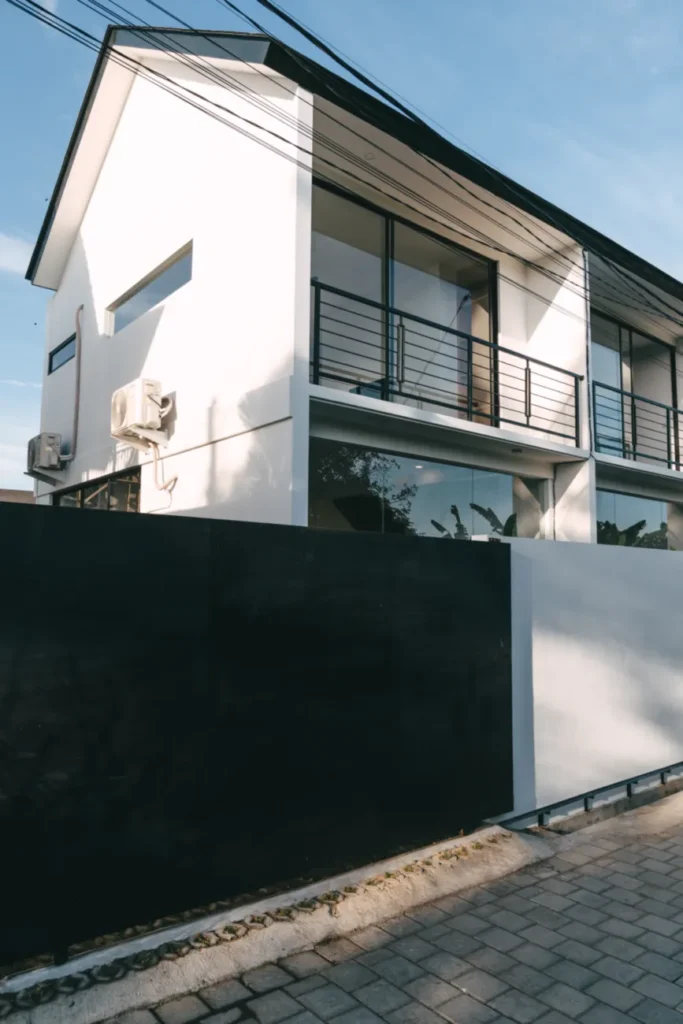


 Bali, Canggu
 from 100м²


Zoning and Building Requirements
Land designation and building documentation can create serious compliance obstacles, particularly where remediation is legally or technically unavailable. A property can have a functioning pool, a management contract, and active guest bookings, while still lacking the documented approval for tourist accommodation use.
Spatial planning and KKPR. Bali’s land use is governed by the RTRW (provincial or regional spatial plan) and, where available, the more detailed RDTR (Rencana Detail Tata Ruang). A parcel designated for residential, mixed residential, or agricultural use is not automatically available for commercial tourist accommodation. The KKPR — the space-use conformity statement — confirms that the proposed activity matches the land’s spatial designation. The applicable KKPR documentation, including a KKKPR (Konfirmasi Kesesuaian Kegiatan Pemanfaatan Ruang) where relevant, should be obtained and its scope and validity verified. Without confirmed spatial-planning conformity for tourist accommodation, subsequent building and business licensing sits on an uncertain legal foundation.
PBG and the legacy of IMB. New building permits since 2021 are issued as PBG under Government Regulation No. 16 of 2021. Existing buildings with a valid IMB retain that document — but the IMB’s coverage is limited to what was originally approved. Additions, changes of use, or extensions made after the original IMB was issued are not automatically covered. A villa that has expanded its accommodation capacity or changed from one use category to another without a revised permit has a gap between the document and the actual building.
SLF: Why the Certificate Matters. The SLF is issued after construction is complete, following an inspection confirming the building meets the standards required for its designated use. It is separate from the building permit. Some existing villas may lack an SLF, or have building documentation that does not match their current use. This is a documentation gap that should be checked explicitly.
The specific risk in investment properties. A villa marketed as a rental investment may sit on land whose RDTR designation does not include tourist accommodation. The developer’s own permissions may cover the developer’s operations without extending to the buyer’s individual unit. The approved building may differ from what was actually constructed. These issues may not be apparent during a site visit or disclosed in marketing materials.
What to check before committing to a property:
- Request the applicable KKPR documentation, including a KKKPR where relevant, and verify its scope and validity — confirm tourist accommodation is explicitly included
- Obtain the PBG or original IMB and compare the approved footprint, use and specifications with the actual building
- Ask for the SLF and verify that the certified function matches the intended rental use
- Verify the land-right certificate and its underlying title, such as SHM, SHGB/HGB or the applicable Hak Pakai documentation, and confirm that the holder has the right to allow the planned rental activity
- Check whether any local authority (DPMPTSP or local tourism office) has issued notices, warnings or enforcement orders relating to the property
- If the villa has previously operated as a rental, verify that PBJT accommodation tax was registered and paid
- Obtain written confirmation of the current spatial designation from the local planning office — not from the developer’s own documents

Off-plan vs completed vs operating villa: licensing risks
| Question | Off-plan villa | Completed, never rented | Existing rental villa |
|---|---|---|---|
| Building approval | Check approved PBG and plans before committing | Compare the completed building with approved plans | Check current approvals and alterations |
| SLF | May not yet be available before completion | Verify whether the required certificate has been issued | Check validity and actual authorised use |
| Tourism operation | Future eligibility must be established | Must be verified before commencing rentals | Verify the actual operator and licensing status |
| Rental history | Projections only | Usually no operating track record | Request booking, payout and expense records |
| Main contractual risk | Construction, handover and missing future approvals | Completion of outstanding certification | Undisclosed liabilities and non-compliant past operations |
| Best protection | Documented pre-purchase checks and appropriate contractual conditions | Independent property and licensing checks before operation | Verification of current licences, tax history and operator agreements |
A newly completed villa is not necessarily approved for tourist accommodation, and a villa with existing bookings is not necessarily compliant. The required verification depends on its current development and operating status.
Not sure which Bali villa fits your rental plans?
“Tell us your budget, preferred location and intended use. ULU Homes can help you shortlist suitable properties and identify what documents need independent verification.”
How to Apply for a Rental Licence
Obtaining the right to operate a tourist villa legally in Bali is a sequence of steps, not a single application. Some checks must be completed before others, while certain registration and approval processes may proceed in parallel under OSS. An NIB may be issued before all property-level and sector-specific requirements are satisfied, but it does not by itself establish that guest accommodation may lawfully commence. Attempting to rely on a NIB registration while property-level approvals remain outstanding creates a compliance gap that the business registration alone cannot resolve.
Before Applying
Before approaching OSS or any authority, establish the following:
The legal model. Who will be the operator — the property owner personally, a domestic company, a PT PMA, or a licensed third-party management company? The answer determines which entity registers the business, which KBLI is applicable, and which supporting documents are required.
Applicant eligibility. An Indonesian individual may register as a sole proprietor (Usaha Perseorangan) or through a domestic PT. A foreign investor typically requires a PT PMA. For PT PMA, the current conditions attaching to the intended KBLI must be confirmed before the company is formed — including any investment thresholds or activity restrictions.
Land use. Spatial-planning conformity should be established at the stage required by the applicable OSS procedure and before commencing any activity that depends on that approval. Confirm the KKPR status and applicable procedures for the specific parcel with the competent local authority.
Building approvals. The PBG or applicable IMB must match the actual building, and the SLF must be in place. If gaps exist, a remediation pathway must be identified — including its cost and feasibility — before proceeding.
KBLI. Based on the actual activity and the applicant’s legal form, select the correct classification and confirm eligibility through OSS. Do not select a code purely on the basis of what appears common in online guides.
Registration and Approval
| Step | Action | Who is responsible | Confirmation required | Common problem |
|---|---|---|---|---|
| 1 | Define the legal business structure | Owner / legal adviser | Entity type confirmed; eligibility assessed | Using a structure that cannot hold the required licence |
| 2 | Confirm KBLI eligibility for the chosen entity | Applicant with OSS / adviser | Entity can validly apply for selected KBLI | Assuming all KBLI codes are open to all applicants |
| 3 | Verify spatial-planning conformity for the property | Local government / ATR-BPN via OSS | Tourist accommodation is a permitted use for the parcel | Discovering the land designation does not allow this use |
| 4 | Confirm PBG/SLF status of the building | Local DPMPTSP | Building is approved and fit for intended use | Building has undeclared modifications or lacks SLF |
| 5 | Register business through OSS | Applicant via oss.go.id | NIB issued; KBLI recorded correctly | Wrong KBLI entered; eligibility not confirmed beforehand |
| 6 | Complete sector-specific compliance requirements | Applicant with tourism authority | Applicable Sertifikat Standar or Izin obtained, per the risk classification | Not completing self-declaration or waiting for inspection |
| 7 | Obtain Sertifikat Laik Sehat | Local health authority | Health and sanitation standard confirmed | Verify and obtain this certificate as required for the applicable accommodation activity, taking into account current OSS requirements and any location-specific procedures |
| 8 | Register for national and regional tax | Applicant with DJP and BAPENDA | NPWP and NPWPD active; PBJT ready to remit | Omitting NPWPD; operating without accommodation tax registration |
| 9 | Review ongoing obligations before accepting first guests | Operator | All layers confirmed; guest reporting obligations known | Accepting bookings before all permits are verified |
This table reflects the logical dependency of the steps, not a guarantee that every process follows identical procedures in every case. Some approvals may proceed in parallel; local authorities may have their own procedural requirements. When the situation is complex — a PT PMA acquiring an existing building needing remediation, for instance — qualified guidance from a local adviser, the DPMPTSP, or directly through OSS is the appropriate path.

Licensing Costs and Timeframes
The cost of licensing a tourist villa in Bali depends significantly on whether the property and business structure are already in order, or whether gaps need to be resolved first. These are two substantially different situations.
Costs can be estimated more reliably once the property documents, operating structure and applicable sector requirements have been confirmed.
An existing villa with documentation gaps — an outdated IMB that does not match the current structure, no SLF, or land use designation that has never been formally confirmed — requires resolving those issues before the business registration can be fully meaningful. That process may involve technical surveys, revised building applications, and engagement with multiple local authorities. Resolving documentation gaps may take significantly longer than obtaining an NIB, and complex cases can require several months.
Why licensing timeframes vary
| Situation | Likely source of delay | What to clarify before purchase |
|---|---|---|
| Eligible operator, compliant existing property | OSS processing and applicable sector certification | Current requirements and processing status |
| New PT PMA | Incorporation, investment eligibility and OSS registration | Whether the selected activity is open to the intended company |
| Building without SLF | Technical assessment and certificate issuance | Building’s actual compliance and eligibility |
| Building inconsistent with approved PBG or IMB | Revised drawings, assessment or corrective work | Feasibility and written professional estimate |
| Unconfirmed tourist-use zoning | Spatial-planning conformity assessment | Whether commercial tourist accommodation is permitted |
| Existing business with incomplete taxes | Local registration, reconciliation and possible historical liabilities | Taxpayer identity and outstanding obligations |
There is no single reliable licensing timeline for all Bali villas. Ask qualified professionals for a property-specific written schedule that identifies dependencies, supporting documents and possible remediation.
| Cost item | What affects the cost | One-time or recurring | What to request in writing |
|---|---|---|---|
| Business entity formation (PT PMA or PT) | Shareholder structure, authorised capital, complexity | One-time | Notarised deed, OSS registration confirmation |
| Notary / legal adviser fees | Scope of work, entity type, additional agreements | One-time (with possible updates) | Itemised fee engagement letter before commencing |
| OSS registration and NIB | Official government charges are distinct from optional professional service fees; separate these and verify applicable charges through OSS | One-time | Official NIB document from OSS |
| Sector compliance (Sertifikat Standar or Izin) | Risk category; inspection or verification requirements if applicable | One-time (renewal if required by the applicable standard) | Written scope of requirements from local authority |
| PBG application (new or revised) | Building size, complexity, required technical drawings | One-time per building approval | Approved PBG from DPMPTSP |
| SLF application and inspection | Building size; may involve technical or structural assessment | Periodic renewal according to the building’s legally classified function | Certificate and inspection report; confirm the applicable validity period under PP No. 16 of 2021 — different periods apply depending on the building’s approved classification |
| Sertifikat Laik Sehat | Health authority inspection, where applicable | Periodic | Issued certificate and stated conditions |
| Remediation or construction correction | Entirely dependent on the specific non-compliance | Situation-specific | Written scope and cost assessment from qualified contractor |
| Ongoing compliance (accounting, reporting, renewals) | Volume of transactions; complexity of structure | Recurring annually | Fee schedule from adviser or accountant |
For any cost item not governed by a published government tariff, get a current written quotation from the relevant authority or qualified professional. Figures circulating in online guides and property marketing materials vary widely and should not be treated as reliable budgeting inputs for a specific property.
A reliable timeline should be based on the property’s documents, required approvals and any outstanding compliance work. A seller or developer who guarantees a licensing completion date without that review is making a representation that the facts may not support.
Find villas that match your total investment budget
“Your purchase price is only one part of the budget. Tell us how much you plan to invest and whether you prefer a completed or off-plan villa.”
Taxes and Ongoing Compliance
Obtaining the applicable licences does not complete a villa operator’s legal obligations. A running rental business generates continuing tax and compliance requirements alongside every booking.
PBJT and income tax are two different obligations
| Tax | What it applies to | Rate or method |
|---|---|---|
| PBJT on taxable hotel accommodation services | Relevant accommodation payments | Up to 10% under national law; the applicable local rate is established by regional regulation |
| National income tax | Taxable income of the relevant individual or company | Depends on legal status, taxable income and applicable tax regime |
| Other possible tax obligations | Property ownership, relevant transactions or other taxable activities | Must be assessed separately |
PBJT is not the same as income tax. A villa may generate local accommodation tax obligations even when its operating profit is low.
Check the applicable tax base, collection method, reporting deadline and legally responsible taxpayer with the BAPENDA in the regency or municipality where the villa operates.
PBJT — accommodation tax. Law No. 1 of 2022 restructured local taxation in Indonesia, reclassifying what was formerly the hotel tax (Pajak Hotel) into the broader PBJT (Pajak Barang dan Jasa Tertentu) framework. Villa accommodation supplied as a taxable hospitality service may fall within PBJT on hotel services, subject to the applicable district or municipal regulation. PBJT is administered at the regency or municipal level: the current rate, taxable base and filing procedures must be verified with the BAPENDA responsible for the villa’s specific location. Residential property leasing should be assessed separately from taxable tourist accommodation services. The person or entity identified as the PBJT taxpayer under the applicable regional regulation must complete the required local tax registration and reporting, including obtaining NPWPD.
National income tax. The operating entity — whether an individual, domestic PT, or PT PMA — has national income tax obligations. The applicable rate and method depend on the entity type, annual revenue, and applicable tax regimes. Corporate entities and individual entrepreneurs are taxed differently. Registration with the Direktorat Jenderal Pajak (Directorate General of Taxation) and obtaining an NPWP is required for all registered businesses.
Understanding the flow of a single booking. The following shows the structure of one accommodation transaction using variables rather than fixed rates, because the exact figures depend on the entity type, platform, tax base and management arrangement:
- Guest payment: the total amount the guest pays for accommodation
- PBJT (accommodation tax): the legally responsible PBJT taxpayer must be identified under applicable regional tax law; contractual arrangements between owner and operator may allocate administrative tasks but do not automatically transfer statutory liability
- OTA platform commission: retained by Airbnb, Booking.com or whichever channel processed the booking
- Management fee: retained by the villa management company, if applicable
- Remaining revenue to owner or operating entity: before income tax and other operating costs
These amounts may have different accounting and tax treatments, and the parties responsible for collecting, reporting and remitting each of them must be identified. Treating the entire guest payment as owner revenue, without accounting for PBJT collection and remittance, creates a compliance gap regardless of whether the operator eventually passes tax amounts along.
Example: how much of villa rental revenue reaches the owner?
Consider a villa generating IDR 100,000,000 in accommodation sales during one month.
The figures below are hypothetical inputs for understanding cash flow, not verified market averages or a forecast for any villa.
| Item | Illustrative calculation | Amount |
|---|---|---|
| Guest accommodation sales, excluding separately charged PBJT | — | IDR 100,000,000 |
| PBJT collected from guests, assuming an applicable 10% rate | 10% × 100,000,000 | IDR 10,000,000 |
| Total guest payments including PBJT | 100,000,000 + 10,000,000 | IDR 110,000,000 |
| PBJT payable to the local authority | Collected tax, not rental profit | IDR 10,000,000 |
| OTA commission | Assumed 15% of accommodation sales | IDR 15,000,000 |
| Property management | Assumed 20% of accommodation sales | IDR 20,000,000 |
| Cleaning and laundry | Illustrative monthly expense | IDR 5,000,000 |
| Utilities, pool and garden upkeep | Illustrative monthly expense | IDR 7,000,000 |
| Maintenance reserve | Illustrative provision | IDR 5,000,000 |
| Balance before income tax and other costs | 100,000,000 − 52,000,000 | IDR 48,000,000 |
The remaining IDR 48,000,000 is not guaranteed net profit. It excludes applicable income taxes, financing costs, major repairs, insurance, property-related charges and other expenses not included in this illustration.
Actual OTA fees and management commissions may use different calculation bases, and some expenses may already be included in the management fee. Always request an itemised management agreement.
How occupancy changes villa rental income
Assume an advertised accommodation rate of IDR 2,000,000 per occupied night, excluding PBJT.
| Occupancy scenario | Equivalent occupied nights per year (before rounding) | Annual accommodation revenue |
|---|---|---|
| 40% | 146 | IDR 292,000,000 |
| 55% | 201 | IDR 401,500,000 |
| 70% | 256 | IDR 511,000,000 |
| 85% | 310 | IDR 620,500,000 |
These are mathematical scenarios, not actual or predicted occupancy levels in Bali. They represent gross accommodation revenue before OTA fees, management, maintenance, taxes, vacancies caused by repairs and other expenses. Actual selling rates may also change by season.
Before relying on projected income, request historical booking and payout reports for the specific villa. For new projects, use several scenarios instead of assuming that the advertised nightly rate will be achieved throughout the year.
Records, guest registers and reporting. A licensed villa operator must maintain booking records, payment records, and guest identity information. Operators accommodating foreign guests must comply with Indonesian immigration reporting requirements. These include the applicable use of the Aplikasi Pelaporan Orang Asing (APOA), administered by the Directorate General of Immigration. Operators should confirm current registration, check-in and check-out reporting procedures directly through the official APOA system at apoa.imigrasi.go.id.
For property-level taxes that apply in Bali beyond accommodation tax, see “Property Taxes in Bali“.
Airbnb and Booking.com Requirements
OTA platforms such as Airbnb and Booking.com are widely used to market tourist accommodation in Bali, and Indonesia’s Ministry of Tourism has been clear that listings on these platforms are subject to the same licensing requirements as any other form of tourist accommodation.
In December 2025, the Ministry of Tourism issued an official clarification confirming that the government does not ban OTA platforms — Airbnb and similar services are described as strategic partners in national tourism development. According to the Ministry of Tourism’s official statement, the focus of government enforcement is on unlicensed tourist accommodation, not on the platforms themselves. Compliance obligation falls on the accommodation operator.
In December 2025, Indonesia’s Ministry of Tourism announced 31 March 2026 as the target date for OTA-listed tourist accommodation providers to hold the required business licences. This was an announced compliance deadline — not proof that every listing was automatically removed or that inspections were completed by that date. Indonesia’s Ministry of Tourism has continued working with OTA partners on accommodation licensing compliance. In a 2026 announcement, the Ministry described plans for an integrated verification system using NIB, KBLI and business activity data, with a targeted launch in June 2027, and noted a mechanism for removing non-compliant listings following notification. Operators should not assume that current platform acceptance constitutes government verification of their licences.
What this means in practice:
- An active listing on Airbnb or Booking.com does not confirm that a property has passed local licensing checks. The listing reflects what the host submitted; verification by the platform is a separate and distinct process.
- If a villa is operated by a management company, the company is typically responsible for providing business documentation to OTA platforms. Verify that this has been done for your specific property — not just for the company’s overall portfolio.
- Different OTA platforms use different verification procedures and ask for different types of documentation. Acceptance on one platform does not establish compliance on another.
- Operators should maintain accurate OSS registration details and ensure that any certificates or licences subject to renewal remain valid, since platforms may request updated documentation.
An active Airbnb listing is not evidence that a villa has passed all local licensing checks.
Before accepting the first guests through any online platform, confirm that the registered operator holds a current NIB with the applicable KBLI, has completed any required sector compliance, and is registered for PBJT remittance. These are the operator’s obligations — the platform listing is a distribution channel, not a compliance certificate.
Risks of Renting Without a Licence
Operating a short-term tourist rental without the required documentation creates a range of risks that extend beyond regulatory penalties. The specific consequences depend on the nature of the gap, the local enforcement context, and the circumstances. What is consistent is the category of risks.
Administrative enforcement. Indonesian regional and local authorities hold powers to inspect tourist accommodation businesses. Peraturan Menteri Pariwisata Nomor 6 Tahun 2025 (Ministry of Tourism Regulation No. 6 of 2025, available in the Ministry’s legal register) sets the framework for supervision and administrative sanctions under the risk-based tourism licensing system, replacing earlier ministerial regulations from 2021. Where an inspection identifies missing or non-compliant documentation, the administrative pathway may include written warnings, requirements to cease or suspend activity, and other sanctions as provided under the applicable regulation and its implementing rules. Specific penalty amounts should not be assumed from general guides without reference to the current text of the applicable regulation.
Platform delisting. OTA platforms that request and verify operator credentials may remove listings that cannot provide adequate documentation. A delisting directly and immediately affects bookings and income.
Tax liability. Operating without NPWPD or PBJT registration does not eliminate the tax obligation — it means the obligation has been accumulating unreported. Tax authorities can assess back-payment obligations for the period of activity, with applicable late charges under the prevailing tax administration rules.
Operator disputes. If a management company represents that it operates under licences covering the villa, and a compliance issue arises, contract terms may allocate financial responsibility between owner and operator, but statutory liability remains governed by applicable law. Without clear written terms, the contractual position may be uncertain or disputed.
Structural impossibility of legalisation. Not every villa can be brought into compliance. A property on land not designated for tourist accommodation under the current spatial plan, where no reclassification pathway is available, may not be legally operable as a short-term rental regardless of other steps taken.
Common licensing mistakes and how to avoid them:
- Buying without verifying land use designation. Consequence: the villa cannot legally host tourists; land reclassification may not be available. Prevention: obtain and review KKPR documentation before any deposit or commitment.
- Assuming NIB is sufficient. Consequence: operating without sector compliance documents and property-level approvals. Prevention: understand that all three levels — land, building, operator — must be in place.
- Selecting an incorrect KBLI. Consequence: licences may not cover the actual activity; compliance gap identified at inspection. Prevention: verify KBLI selection with OSS and a qualified adviser before registration.
- Relying on a management company’s licence without checking its scope. Consequence: operator’s authorisation does not extend to property-level gaps. Prevention: ask specifically what the operator’s NIB and compliance documents authorise, and whether coverage applies to the specific property.
- Lacking current building documents (PBG/SLF). Consequence: building may be considered non-compliant; remediation may be costly or unavailable. Prevention: verify building documents before purchase; require the seller to resolve gaps.
- Using nominee arrangements. Consequence: the arrangement may be invalid under Indonesian law; risk of loss of the property interest. Prevention: establish a proper legal structure with independent legal advice.
- Mixing accommodation tax and income tax obligations without proper accounting. Consequence: errors in reporting; exposure to two separate tax authorities. Prevention: engage a local accountant familiar with both PBJT (at the district level) and national income tax obligations.
- Relying on a developer’s promise of “rental-ready” licensing. Consequence: developer’s own licences do not transfer to the buyer’s property. Prevention: verify every document independently before signing; never rely on verbal assurances.
Check a Villa Before Buying
The licensing position of a villa should be reviewed — at least in outline — before any reservation deposit is paid, before a leasehold agreement is signed, and certainly before acquiring an operating rental business or committing to a management company. What appears uncomplicated at the marketing stage may reveal documentation gaps, mismatches or structural limitations that only appear when documents are examined.
Documents to request before paying a reservation deposit
Ask the seller or developer to provide a reviewable document package before signing or paying any non-refundable amount:
- Land-right certificate details and evidence of the seller’s authority to sell or lease.
- Current spatial-planning information and applicable KKPR documentation.
- PBG or valid legacy IMB, with approved drawings and authorised building use.
- SLF, if issued, including its validity and approved function.
- Draft sale or lease agreement, including permitted tourist use and subletting rights where relevant.
- Operator’s NIB, registered KBLI and applicable tourism business authorisation if the villa is advertised as operational.
- Management agreement, including fees, tax reporting, permitted activities and termination rights.
- Evidence of regional accommodation tax registration and reporting if the property has previously been rented.
- Actual rental statements, platform payouts and operating expenses for any claimed historical income.
Do not treat document delivery as verification. Have an independent Indonesian legal professional check land rights and contractual authority, a qualified technical professional assess building documentation, and the relevant authority confirm land-use and business-licensing status.
The pre-purchase review covers five areas: the seller’s right to deal with the property, the land, the building, the current operator’s position, and tax compliance history.
| What to check | Document or evidence | Who provides it | Warning sign | Recommended next action |
|---|---|---|---|---|
| Seller or lessor’s right to deal | Land certificate and underlying title; identity documents | Seller; verifiable through BPN | Certificate in a different name; unclear chain of title | Engage a notary to verify title before any payment is made |
| Leasehold terms (if applicable) | Lease agreement, notarised where required or appropriate, specifying the term, renewal rights, subletting permissions and permitted use | Seller or lessor | No commercial use clause; short remaining term; no renewal mechanism | Obtain independent legal review before signing; see “Leasehold vs Freehold in Bali“ |
| Explicit permission to sublet or use commercially | Specific clause in lease or use agreement | Seller or lessor | No clause, or clause excludes commercial activity | Do not assume permission is implied; require written confirmation |
| Land use designation | KKPR documentation, including KKKPR where relevant; written confirmation from local planning authority | Seller or local DPMPTSP | No KKPR available; designation appears residential or agricultural | Verify independently with the local authority before proceeding |
| Current building permit | PBG or original IMB | Seller | Document missing; permit does not match actual building footprint or use | Commission independent technical assessment; do not proceed without resolution |
| Operational fitness certificate | SLF from local government | Seller | No SLF; SLF is expired; function category does not match intended rental use | Assess whether obtaining or renewing SLF is feasible and at what cost |
| Health and sanitation certificate | Sertifikat Laik Sehat | Seller or operator | Certificate never obtained or overdue | Confirm whether this is obtainable for the property and under what conditions |
| Management operator’s business documentation | Operator’s NIB, KBLI codes, applicable compliance documents | Management company | Licences reference management activity only; accommodation KBLI not listed | Ask explicitly what the operator’s authorisation covers and whether it applies to this property |
| Tourism activity compliance status | Applicable Sertifikat Standar or Izin for accommodation | Seller or operator | Not in place; application not started; no timeline given | Clarify who is responsible for obtaining it, by when, and at whose cost |
| Tax registration and compliance | NPWPD registration; evidence of PBJT reporting and payment | Seller or operator | No NPWPD; no records of accommodation tax remittance for the rental period | Assess potential back-tax liability with a local tax adviser before committing |
Where to verify Bali villa documents
| Document or information | Main verification channel | What to confirm |
|---|---|---|
| Land rights and certificate | ATR/BPN land office, assisted by an authorised PPAT or legal professional | Registered holder, land-right type, restrictions and relevant encumbrances |
| RDTR/RTRW and KKPR | OSS and competent regional spatial-planning authority | Whether the proposed tourist accommodation activity is permitted on the parcel |
| PBG and SLF | SIMBG and competent regional building authority | Authenticity, authorised building function, approved scope and validity |
| NIB and KBLI | OSS and applicant’s registration records | Operator identity and registered activity |
| Tourism business licence or Standard Certificate | OSS and relevant tourism licensing authority | Applicable activity, location, risk classification and status |
| Sertifikat Laik Sehat | Relevant local health authority and OSS where applicable | Whether the certificate is required and valid for the activity |
| NPWPD and PBJT records | Relevant regency or municipal BAPENDA | Taxpayer registration and available evidence of reporting or payment |
Access to records may require the document holder’s cooperation. A publicly accessible search result is not always equivalent to official confirmation of the document’s validity.
When a document is missing or does not align with the property:
- Missing but obtainable: establish the realistic cost, timeline and conditions; do not proceed on optimistic assumptions
- Missing and structurally unresolvable: reconsider the purchase or restructure the terms to reflect the risk
- Present but mismatched: treat as equivalent to missing until a written explanation is obtained and verified
Looking for a rental-ready villa in Bali? ULU Homes can help you shortlist properties that match your budget, location preferences and rental plans. Use our Bali property finder to start your search, then verify licensing and permitted use before committing.
For a more detailed approach to property verification, see the “Bali Property Due Diligence Checklist“.

What If Your Villa Is Unlicensed?
Owners of villas that are already operating without full documentation face a different starting question from prospective buyers: not whether to acquire, but what to do with what they have. The first step is not to file an OSS registration — it is to understand what is actually missing and whether it can be obtained.
Some gaps are administrative: a certificate that was never filed, a tax registration that was overlooked. Others are structural: a building that was constructed without authorisation, or land that is not designated for the activity being carried out on it. These two categories require very different responses.
Steps to assess an unlicensed villa:
- Gather all existing documents. Collect the land certificate, any IMB or PBG, SLF (if one exists), the current management agreement, and any correspondence from local authorities. Establish what is actually in place before deciding what is missing.
- Verify the land use designation. Obtain written confirmation of the current RDTR or RTRW designation for the parcel from the local planning authority. If the land is not designated for tourist accommodation, and no pathway exists to seek a change, the rental activity may not be legalised regardless of other steps.
- Assess the building’s documentation. Compare the existing IMB or PBG against the actual building. If there are undeclared additions, changes of use, or modifications, obtain a professional assessment of whether a revised PBG is feasible and at what cost. Check SLF status independently of any prior representations.
- Review the operator’s legal position. If the villa is managed by a third party, obtain the operator’s NIB, review the KBLI codes registered, and check any applicable compliance documents. Confirm whether those authorisations cover short-term tourist accommodation specifically, and whether the specific property is within the stated scope of the operator’s activity.
- Assess the tax position. If PBJT has not been registered or remitted, engage a local tax adviser to understand the scope of any back-obligation and the process for regularisation with the relevant BAPENDA.
- Decide whether to continue, pause or suspend. Where clear structural risks exist — particularly on land use or building documentation — pausing rental activity while remediation is under way reduces ongoing exposure. Continuing to accept bookings while knowingly non-compliant carries additional risk, particularly where enforcement or platform verification activity is in progress.
- Engage the right professionals. The intersection of property law, Indonesian corporate regulation, local building rules and tax compliance is not resolvable through a general guide. A notary, a licensed Indonesian legal adviser, and a local accountant working together are the appropriate team for any non-trivial situation.
Example: a villa offered for sale without an SLF
A buyer finds a completed villa advertised as ready for Airbnb rentals. The seller provides a land certificate, an old building permit and screenshots of previous bookings, but cannot provide an SLF or documentation confirming tourist accommodation use.
The buyer should not assume the missing documents can be obtained after purchase.
A safer process is to request the approved building drawings, confirm the current spatial-planning status, commission an independent building assessment and obtain professional advice on the possibility, cost and conditions of regularisation.
If the problem appears resolvable, the buyer may consider negotiating contractual conditions linked to documentary verification. If the necessary approvals cannot be obtained, the property should not be valued on the assumption that it can legally generate tourist rental income.
Previous rental earnings are evidence of past commercial activity, not proof of lawful operation.
The fact that a villa has been renting to tourists without incident does not confirm that the activity was legal, or that it can continue without liability. The absence of past enforcement is not a compliance certificate.
Final Advice for Villa Owners
Treating a Bali villa as a rental investment means treating licensing as a component of the investment analysis, not something to resolve after the purchase is complete. The income potential of any villa is directly connected to whether it can legally generate that income — and that depends on the land’s designated use, the building’s documentation, the operator’s legal structure, and the compliance obligations that follow from all three.
The most reliable approach is a systematic review of all three levels before any substantial payment or binding commitment is made. This means requesting and reading actual documents — not just developer summaries or agent assurances. Where documents are missing, unclear, or inconsistent with the property as it actually exists, the appropriate response is written clarification, independent professional advice, and adjustment of the purchase terms or decision accordingly.
ULU Homes works with buyers and investors looking at property in Bali and can help identify properties that match specific criteria — including rental suitability — as part of the search process. Licensing verification itself is the responsibility of qualified Indonesian legal and technical professionals.

This article provides general information as of October 2026 and is not legal or tax advice. Requirements depend on the property, business structure and current regulations. Confirm your specific situation with the relevant Indonesian authorities and qualified local professionals.
 Real estate in Georgia
 Real estate in Cyprus
 Real estate in the UAE
 Real estate in Montenegro
 Real estate in Thailand
 Real estate in Spain
 Real estate in Saudi Arabia
 Real estate in Turkey
 Real estate in Zanzibar
 +62 895 001 924 667
 hello@ulu-homes.id
 Tibubeneng, Canggu, Kuta Utara, Badung Regency, Bali 80361, Indonesia




 Get catalogue of TOP-7 objects