
 +62 895 001 924 667


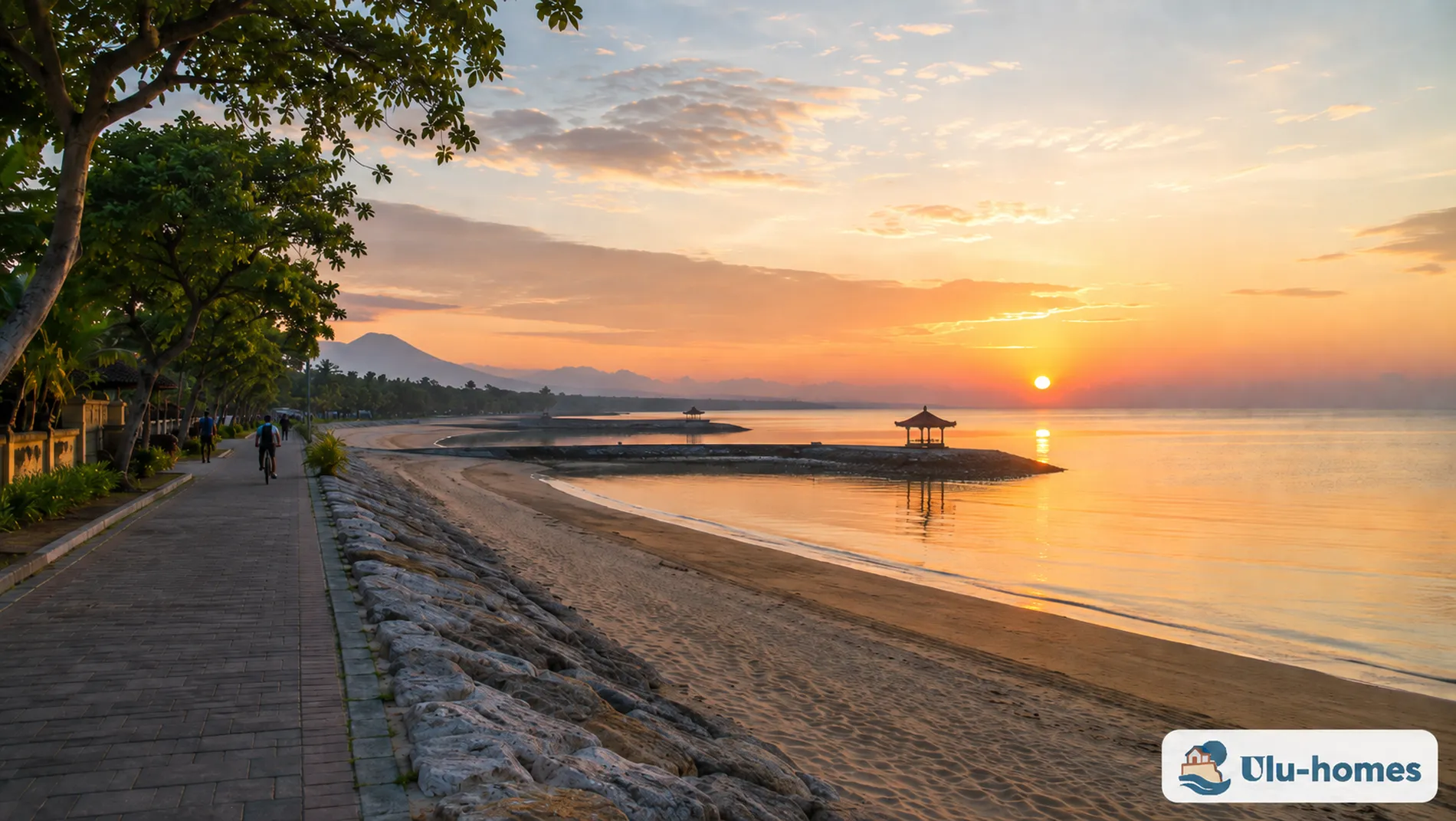

Sanur is an established coastal area in southeast Bali known for its calm beaches, long beachfront promenade, residential neighborhoods and growing healthcare infrastructure. For property buyers, its appeal is different from Canggu or Uluwatu: Sanur combines tourism with long-stay residential demand and offers everything from established beachside villas to newer developments in the south and more affordable housing west of the bypass. Property prices vary sharply by micro-location, lease term and distance from the beach, so choosing the right part of Sanur matters as much as choosing the property itself.
The area lies on Bali’s southeastern coast, just east of Denpasar. Its location shapes much of what defines Sanur: calm, shallow waters without large waves, a well-developed beachfront promenade, convenient access to some of the island’s best medical facilities, and a stable expatriate community whose residents tend to stay for years rather than months. In 2025, Bali International Hospital opened in Sanur as part of Indonesia’s government-backed Health and Tourism Special Economic Zone. The hospital and the surrounding Health & Wellness Special Economic Zone add a new healthcare dimension to Sanur and may create additional accommodation demand over time, although the scale of that effect on the local property market is still developing.
For property buyers, Sanur is particularly compelling because several distinct sources of demand coexist here: short-term tourism, long-term residential demand, and medical tourism. Each segment has different expectations when it comes to location, property type, amenities, and pricing. Understanding this structure is essential to understanding why two villas located only a few blocks apart can differ significantly in both value and investment potential.
Where Sanur Is Located
Sanur lies on Bali’s southeastern coast, immediately east of Denpasar, the island’s administrative capital. Administratively, it forms part of South Denpasar (Kecamatan Denpasar Selatan), which sets it apart from most of Bali’s best-known resort areas, many of which are located in Badung Regency.
This location has several practical implications. First, Sanur is essentially a coastal extension of the wider urban area rather than an isolated resort enclave. Second, residents have relatively quick and direct access to Denpasar’s administrative, business, and healthcare infrastructure. Third, because Sanur sits on the eastern side of the island, it avoids much of the traffic associated with the main tourist corridors along Bali’s west coast—at least within the district itself.
Ngurah Rai International Airport is roughly 15 km away as the crow flies. In normal traffic, the drive usually takes around 25–35 minutes. During peak periods, particularly when traffic is heavy around Denpasar, journey times can easily double. This is worth bearing in mind for anyone who flies frequently: Sanur does not offer quite the same exceptionally fast airport access as Jimbaran or Nusa Dua, although under light traffic conditions the difference is relatively modest.
Sanur Harbour is one of Bali’s main departure points for fast boats to Nusa Penida and Nusa Lembongan, making inter-island trips particularly convenient for Sanur residents. For Sanur residents, this makes trips to the neighbouring islands particularly convenient, without the need to cross heavily congested parts of Denpasar.
| Destination | Approximate travel time | Practical significance |
|---|---|---|
| Ngurah Rai International Airport | ~25–40 min, depending on traffic | Reasonably convenient for regular travel |
| Central Denpasar | ~15–20 min | Banks, government offices, markets, hospitals |
| Ubud | ~50–70 min | Practical as a day trip |
| Canggu / Berawa | ~50–75 min | Farther away than it appears on the map |
| Nusa Dua | ~20–30 min | Close by; beaches and business hotels |
| Sanur Harbour / departures for Nusa Penida and Nusa Lembongan | ~10–15 min | Convenient for island trips |
| Seminyak | ~35–50 min | Moderately accessible |
Travel times in Bali always depend heavily on the time of day. Morning traffic heading toward Denpasar and evening congestion in the opposite direction are genuine variables that should be tested in person before choosing a property. Marketing claims such as “20 minutes to the airport” should never be treated as a fixed constant.
Geographically, Sanur stretches along a narrow coastal strip approximately 8 km from north to south. This matters because Sanur is not simply a single point on the map but an elongated coastal corridor. Travelling from its northern end to its southern end can already take around 15–20 minutes by scooter.
How Sanur Is Structured

Sanur should not be viewed as a single point on the map. Distance from the beach, which side of Jalan Bypass Ngurah Rai a property is located on, and the surrounding residential environment can fundamentally change how that property is used.
The district’s main transport artery, Jalan Bypass Ngurah Rai, runs parallel to the coastline and effectively divides Sanur into two very different areas. East of the bypass lies the beachside zone, with its pedestrian promenade, hotels, seafront restaurants, and the district’s most expensive residential properties. To the west is a denser, less tourist-oriented residential area governed by a different pricing logic and attracting a different type of tenant.
Understanding this distinction is far from an academic exercise. Two properties with the same number of bedrooms, both technically located in Sanur, can differ substantially in price and appeal to very different rental audiences.
North and Central Sanur
The northern part of Sanur, stretching roughly from the neighborhoods bordering Denpasar to the central beachfront cluster, has traditionally been the most residential. A significant share of the area’s long-term expatriate community lives here, among smaller villas, houses with gardens, narrow lanes lined with local warungs, and everyday convenience shops. Tourist density is noticeably lower than in central Sanur. Jalan Danau Poso and the surrounding side streets are typical of northern Sanur: quiet, green, and only a few minutes’ drive from the waterfront.
Central Sanur is the heart of the district. This is where the beachfront promenade is at its most developed, where many of the best restaurants and popular cafés are concentrated, and where most of Sanur’s landmark hotels are located. The main commercial spine is Jalan Danau Tamblingan, which runs for several kilometers past cafés, boutiques, pharmacies, small banks, and tourism-related services.
Property in the central beachside area commands the highest prices in Sanur. Here, proximity to the sea is something you can genuinely feel in daily life: many villas are within a 5–10-minute walk of the promenade, while the best-located properties may be only two or three minutes away on foot.
South Sanur
The southern part of Sanur becomes progressively quieter as you move away from the tourist center. There are more residential neighborhoods, less commercial activity, and a considerable number of new development projects that have appeared in recent years. Southern Sanur is also home to the Sanur Special Economic Zone and Bali International Hospital, a flagship component of the area’s emerging medical infrastructure.
The SEZ may create an additional source of accommodation demand from medical professionals, patients, accompanying family members, and wellness visitors. The scale of this effect on Sanur’s rental market is still developing and should not be assumed for every property. If this segment expands, proximity to medical infrastructure may become more important for some tenants than walking distance to the beach.
Mertasari forms part of southern Sanur and includes residential properties within relatively easy reach of the beach and the southern end of the promenade.
Beachside and West Sanur
Beachside Sanur is the narrow strip running directly along the coastline. According to Indonesia’s official tourism portal, Sanur Beach is an east-coast destination known for its calm waters, well-developed pedestrian infrastructure, and opportunities for outdoor activities by the sea.
True beachfront properties and homes with genuine sea views are limited in number and rarely come onto the market. The area was developed long ago and is already densely built up.
The neighborhoods west of the bypass are a very different proposition. This is residential Sanur in the everyday sense: denser, more affordable, and far less oriented toward tourism. Depending on the exact location, reaching the beach typically takes around 10–20 minutes by scooter.
For long-term tenants who have their own transport, this is often an acceptable trade-off in exchange for significantly lower rental costs.
| Part of Sanur | Atmosphere | Typical Property | Best Suited For | Investment Scenario |
|---|---|---|---|---|
| North Sanur | Quiet, residential, green | 2–4 bedroom villas, houses with land | Families, long-stay expats | Long-term rental, own use |
| Central beachside | Lively, tourist-oriented | Beachfront villas, boutique hotels | Broad range of residents and visitors | Short- and medium-term rental |
| South Sanur / near the SEZ | Quiet, developing | New villas and residential complexes | Investors, medical-related demand | Medium-term and long-stay rental |
| West Sanur, west of the bypass | Residential, non-tourist | Houses, smaller villas | Long-term residents with their own transport | Long-term rental |
Once you have studied the map, the first practical conclusion is straightforward: before viewing individual properties, decide what you want the property for. Only then should you choose which part of Sanur fits that purpose—not the other way around.
What It’s Like to Live in Sanur
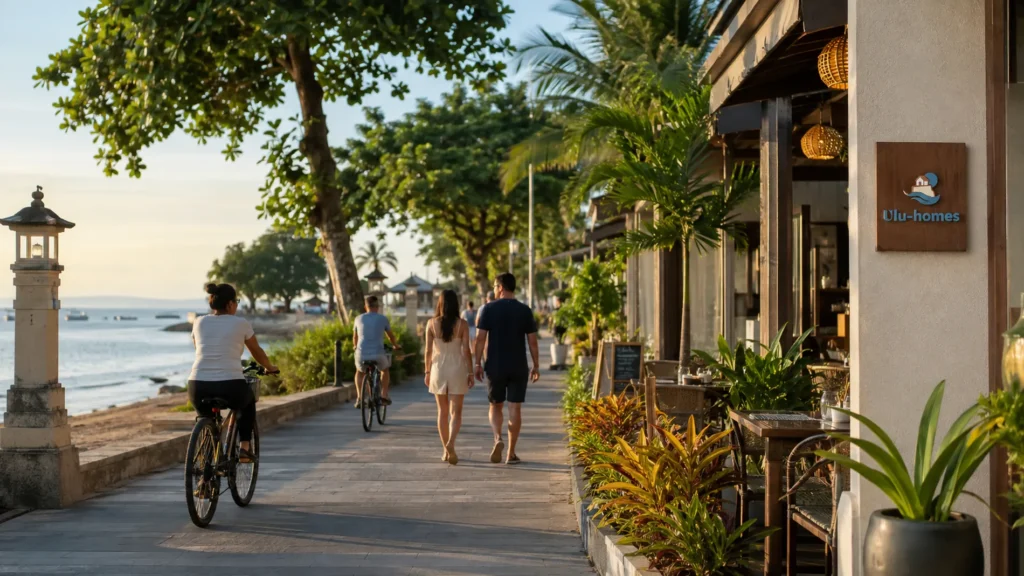
The main difference between everyday life in Sanur and life in most of Bali’s tourist areas is not the beach itself, but how easily you can access it on a normal day—without a car, without sitting in traffic, and without fighting your way through tourist crowds. The roughly 8 km beachfront promenade makes it possible to cycle along the coast in the morning and take an evening walk by the sea. This is not simply an attractive amenity; for long-term residents, it is a tangible part of what makes the area comfortable to live in.
Beach and water. Bali’s east coast is fundamentally different from the west. There are no large surf breaks here; instead, the coastline is characterized by shallow water and a protected lagoon, making swimming more comfortable for children, older people, and anyone who simply wants to enter the sea without having to deal with strong waves. Popular water activities include kitesurfing, stand-up paddleboarding, snorkeling, and kayaking. Surfing, however, is not really part of the Sanur lifestyle, which is an important consideration for anyone choosing where to live based on their favorite sport.
Cafés, restaurants, and dining. Sanur’s food scene is established and varied, although it does not try to compete with Bali’s trendiest dining destinations. Jalan Danau Tamblingan is the area’s main restaurant strip, with options ranging from inexpensive local warungs to seafront restaurants where an average meal may cost around $30–50 per person. Good coffee and reliable Wi-Fi are easy to find throughout the beachside part of Sanur. One important distinction is that many businesses here cater to permanent and long-term residents rather than relying exclusively on short-stay tourists. That tends to show in more consistent service and menus that remain stable over time.
Groceries and shopping. Sanur has ICON Bali, which includes one of the island’s better supermarket options, as well as Pepito Market and several Indomaret and Circle K convenience stores. For more specialized groceries—European cheeses, organic products, or imported beverages—you may occasionally need to travel to Denpasar City Square or one of the larger malls in Badung. A weekly market along the beachfront is also a good alternative for fresh fruit and vegetables.
Healthcare is one of Sanur’s major strengths. This is one of the strongest arguments in favor of the area for families and residents over 40. In 2025, Bali International Hospital (BIH) opened as part of the Sanur Special Economic Zone. It is Indonesia’s first state-owned international-standard hospital developed with advisory support from Mayo Clinic. Bali International Hospital is a major healthcare facility within the Sanur Special Economic Zone, with 255 beds, eight operating rooms, four catheterization laboratories and several specialist Centers of Excellence.
In May 2025, the Icon Cancer Centre also opened, marking the first time a foreign healthcare provider had been authorized to operate inside Indonesia. In addition to BIH, Sanur and the surrounding part of Denpasar are served by several private clinics with English-speaking staff, including BIMC, Kasih Ibu, and Siloam. That is worth taking into account when choosing health insurance.
International schools. Families living in Sanur have access to several international and bilingual schools in Sanur and the wider Denpasar area. Actual travel time varies significantly depending on the school and the property’s location, so school access should be checked from the specific address rather than assumed for Sanur as a whole.
- Bali Island School (BIS) — founded in 1986 and the only school in Bali offering the full IB continuum, from PYP and MYP through the IB Diploma, from preschool to Grade 12. Tuition for 2025–2026: IDR 75–295 million per year (approximately $4,500–18,000).
- Australian Independent School (AIS) Bali is located in West Denpasar rather than Sanur itself, but it remains one of the international-school options accessible by car from the area.
- Sanur Independent School (SIS) — follows a British curriculum, including IGCSE and A-Level programs.
- Dyatmika School — a bilingual school combining Cambridge IGCSE with Indonesia’s Kurikulum Merdeka. Tuition: IDR 100–180 million per year (approximately $6,000–11,000).
For families with school-age children, Sanur is one of the most predictable choices on the island in terms of education infrastructure. Families specifically targeting BIS have traditionally concentrated in Sanur and eastern Denpasar.
Sports and wellness. Yoga studios, Pilates studios, smaller gyms, and wellness centers are spread throughout central Sanur. The scene is more understated than in Ubud, but it is more than sufficient for everyday life. Sanur also has one of the best cycling environments on the island: the dedicated path along the beachfront makes it possible to ride in the morning without constantly sharing the road with scooters.
Transport and traffic. Within Sanur itself, getting around by bicycle or scooter is genuinely practical. A car becomes more useful for trips outside the area—for school runs, shopping centers, or meetings elsewhere in Denpasar. Public transport in Bali remains very limited, so taxis and Grab are the main alternatives. During peak hours, traffic on the bypass and on roads leading toward Denpasar can be just as congested as elsewhere on the island.
Cost of living. Day-to-day living costs in Sanur vary widely with lifestyle. Local food and everyday services remain available alongside international cafés, supermarkets and private healthcare, while housing is usually the largest variable. Rental costs differ particularly sharply between beachside properties and residential neighborhoods west of Jalan Bypass Ngurah Rai, so current listings should be checked for the specific property type and lease period rather than relying on a single average budget.
Trade-offs worth understanding in advance. Sanur is quiet, and that is both one of its advantages and one of its limitations. Nightlife is minimal. Some residential properties are 15–25 minutes from the coast by road, which in practical terms means you will need transport if you want to visit the beach every day. The tropical climate also creates real ongoing costs: air conditioning, pool maintenance, and high humidity all affect utility bills and property upkeep. Occasional power outages during the rainy season are part of life in Bali generally, not something specific to Sanur.
What to check before moving to Sanur:
- The actual walking distance from the property to the beachfront promenade—not whether the listing claims it is “five minutes away,” but how long the walk really takes.
- Whether the property has parking and proper car access if you expect to drive regularly to Denpasar or to school.
- The nearest medical facility—not just its name, but its real distance from the property and the services it provides, including pediatrics, dentistry, and emergency care.
- The school and its curriculum: IB, Australian, or British, depending on your child’s existing education system and your longer-term plans.
- Internet speed and reliability at the specific property, especially if you work remotely.
- Noise levels from Jalan Bypass Ngurah Rai or other major roads if the property is located nearby.
- The operating patterns of local cafés and restaurants, as some reduce their activity during the low season in February and March.
- The cost and structure of electricity bills. Ask to see recent electricity bills for the specific property, especially for a villa with a pool and multiple air-conditioning units, because consumption can vary significantly with occupancy and usage patterns.
Who Sanur Is Best Suited For
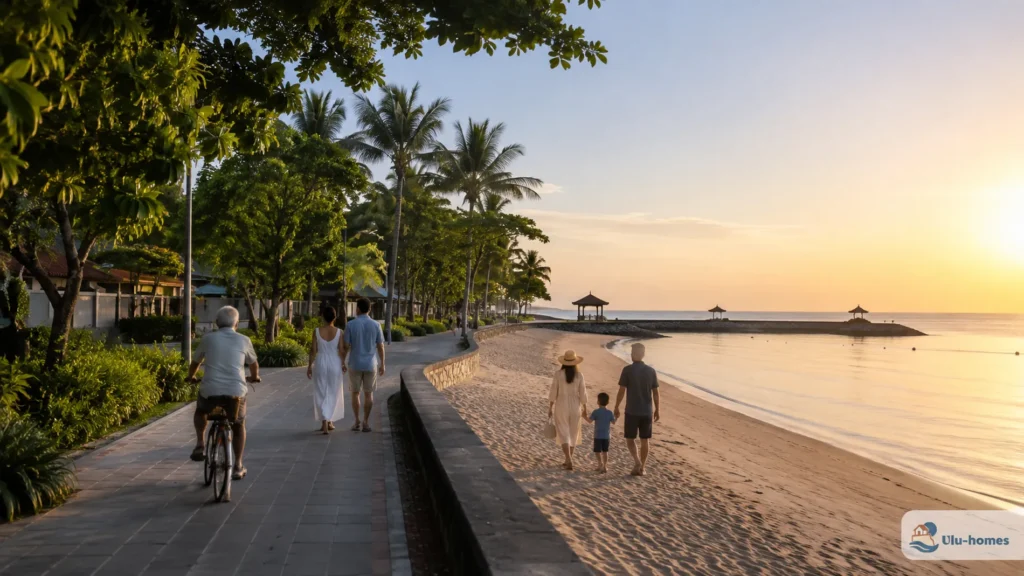
Sanur attracts several well-established groups of residents and buyers, each with their own reasons for choosing the area. That distinction matters: the same location can be an ideal fit for one person and completely unsuitable for another.
Families with children are one of Sanur’s core audiences. For them, the area offers a rare combination: international schools within easy reach, calm and child-friendly waters, healthcare facilities that meet international standards, and a walkable environment where children can move around with greater independence. This is an unusually valuable quality in Bali, where most areas require frequent scooter use even for short everyday trips.
Couples and people aged 40–55+ often find in Sanur the sense of balance that is missing from younger, more tourism-driven areas: good infrastructure without the chaos, a strong dining scene without the usual tourist clichés, and access to the sea without overwhelming crowds. Sanur is commonly associated with a quieter long-stay audience than Canggu, although there is no reliable public demographic dataset that allows a precise comparison of expatriate age profiles between the two areas.
Buyers aged 55+ and retirees are particularly drawn to Sanur. Proximity to BIH and other medical facilities, a slower pace of life, walkability, and an established community of people with similar lifestyles and priorities make Sanur particularly relevant for buyers who prioritize walkability, healthcare access and a quieter residential environment. Canggu and Uluwatu offer different lifestyle advantages and should be compared according to the buyer’s priorities.
Remote professionals and entrepreneurs who are not looking for a constant digital-nomad social scene can also find a comfortable balance here. There are cafés with reliable internet, although fewer than in Canggu. Sanur is best suited to people who want to work quietly in the morning and cycle to the beach in the afternoon, rather than those looking for coworking spaces, networking events, and a packed social calendar every evening.
Medium- and long-term rentals are an important part of Sanur’s market because the area serves not only tourists but also residents staying for extended periods. This can reduce an owner’s dependence on nightly holiday bookings, although actual occupancy and rental income still vary by property, lease terms, pricing and location.
Second-home buyers are another particularly natural fit for Sanur. The typical model is straightforward: the owner wants a private place by the sea for several weeks or months each year, while renting it out for the rest of the time. Sanur can suit this strategy because the same property may appeal both to its owner for personal use and to longer-stay tenants, depending on its location and operating model.Quality of life is high, demand for medium- and long-term rentals is consistent, and local property management companies are well accustomed to managing homes while owners are abroad.
Who Sanur May Not Be Right For
Sanur may not be the best choice if:
- Your main priority is an active nightlife scene. Sanur simply does not offer one. A handful of waterfront bars stay open until around midnight, but there is no real clubbing scene. Those coming to Bali primarily for nightlife are more likely to prefer Seminyak or Canggu.
- Your investment strategy depends on aggressive short-term rentals and maximum occupancy. Prime beachside properties are limited, entry prices are high, and competing with Canggu on average short-term rental rates can be challenging.
- Your budget is based on finding inexpensive land. Sanur is already a mature, established area, and plots in the beachside zone are expensive. Buyers looking for the lowest possible land prices for development are more likely to consider Tabanan, Nyang Nyang, or eastern parts of Bali.
- Surfing is a top priority. Bali’s east coast is fundamentally less suitable for that lifestyle. The nearest major surf option is Nusa Dua, roughly a 20–30-minute drive away.
- You need to be close to Canggu’s nightlife, creative, or arts scene. The distance may look manageable on a map, but in real traffic conditions the journey can take 50–70 minutes, which is too long for comfortable daily commuting.
Sanur Real Estate: What You Can Buy
Sanur’s housing stock has developed over several decades, which is reflected in its diverse built environment. The area is not dominated by large tourism clusters, rows of identical new villas, or a single major developer. This variety makes the market attractive, but also more complex to evaluate.
Villas are the dominant property type, ranging from compact two-bedroom homes in western neighborhoods to spacious beachside villas on large plots, some 20–30 years old. “A villa in Sanur” can therefore mean very different things: two properties with the same bedroom count may differ in price by a factor of two depending on location, condition, remaining leasehold term, and zoning.
Older and renovated villas make up a substantial part of the resale market. Some are carefully restored Balinese homes on large plots that would be difficult to replicate today because land is scarce and expensive. Others require major investment and thorough technical inspection. Bali’s tropical climate can quickly damage roofs, plumbing, and timber structures if maintenance has been neglected.
New villa developments are appearing mainly in southern Sanur and adjacent neighborhoods. They appeal to buyers seeking a more predictable product: a clearly specified contractual lease term, contemporary finishes, and, in some developments, developer-provided management. Their plots are generally smaller than those of established villas, often around 1.5–2.5 are, or 150–250 sq. m.
Public listings from mid-2026 illustrate the asking-price range. A new three-bedroom leasehold villa with 27 years remaining and within walking distance of the beach is marketed at approximately IDR 5.5–8.5 billion ($340,000–520,000). A four-bedroom villa with a 25-year lease and 5 are of land is around IDR 12.5 billion ($770,000). Compact two-bedroom villas with roughly 27 years remaining are listed at IDR 3.9–5.8 billion ($240,000–360,000). These are asking prices, not confirmed transaction prices.
The figures are an illustrative snapshot of publicly advertised properties reviewed in mid-2026 rather than a formal Sanur price index. They should be used to understand the breadth of current seller expectations, not to value an individual property.
Townhouses exist but remain a minor segment, usually within small residential developments with shared facilities such as pools and security. They can suit buyers with smaller budgets who prioritize ease of management.

 Bali,Sanur
 from 35м²
Apartments and condominiums are also uncommon. Several apartment-style projects exist, including near the Special Economic Zone, but Sanur has historically been a villa market. Apartments may appeal to buyers seeking a lower entry price or professional management.
An older spacious villa and a new compact villa often serve very different tenants. A family renting for six months may prioritize space, a garden, a proper kitchen, and a quiet yard for children. A couple staying for two weeks may care more about contemporary interiors, a pool, and proximity to the beachfront promenade. These properties therefore represent different investment strategies, tenant profiles, occupancy patterns, and operating models.
| Property Type | Typical Buyer | Key Strengths | Limitations | Best-Suited Scenario |
|---|---|---|---|---|
| Mature beachside villa | Investor, second-home buyer | Unique location, strong demand | High entry price, maintenance issues, lease considerations | Short- and medium-term rentals |
| New villa in a development | Investor, family | Modern specification, clearly defined lease term | Smaller plot, standardized product | Medium-term rental, personal residence |
| Mature villa in a residential neighborhood | Family, long-stay tenant | Space, larger plot, value | Inspection and renovation may be required | Long-term rental, own use |
| Townhouse | Budget-conscious buyer | Easier management, lower entry price | Less space, potentially lower liquidity | Long-term rental |
| Apartment / condominium | Investor seeking a lower entry point | Lower purchase threshold, professional management | Unusual for Sanur, potentially weaker demand | Short- or medium-term rental |
| Renovated Balinese house | Buyer seeking authenticity | Larger plot, distinctive character | Risks associated with older buildings; inspection essential | Own use, boutique rental |
Leasehold is the predominant legal structure used by foreign buyers across Bali. Freehold ownership, or Hak Milik, is available only to Indonesian citizens. Depending on the buyer, property and intended use, lawful structures may include a contractual lease, certain Hak Pakai arrangements available under Indonesian law, or—where there is a genuine qualifying business structure—land rights such as HGB held by an eligible Indonesian legal entity. These structures are not interchangeable and require transaction-specific legal advice.
Each structure has its own requirements, restrictions, and tax implications. These should be reviewed for the specific transaction with an independent Indonesian lawyer rather than based on generalized information published online.
Sanur Property Prices in 2026
There is no meaningful single-number answer without context. Sanur is not one market price; prices vary substantially depending on the exact micro-location, property type, age, land area, lease term and legal structure. A buyer who evaluates the area based on an “average price” risks comparing fundamentally different assets.
Current market benchmarks (asking prices, mid-2026, IDR/USD at approximately 16,200):
- Compact two-bedroom leasehold villa with 25–27 years remaining in a residential neighborhood: $240,000–360,000
- Three-bedroom leasehold villa with 27–29 years remaining within walking distance of the beach: $340,000–530,000
- Four-bedroom leasehold villa with 25 years remaining and a large plot: $470,000–780,000
- Beachside villa with a genuine sea view or direct beach access: from $700,000 upward, with no meaningful upper limit
Important: all figures above are listing asking prices, not completed transaction prices. Asking prices can differ from final negotiated transaction values, so listing data should be treated as an indication of seller expectations rather than verified sale prices, particularly for properties with documentation issues or sellers whose expectations are above the market. Indonesia does not publish comprehensive public transaction statistics, so any quoted “average market price” should be treated with caution.
A high advertised yield tells you very little about the quality of an investment unless you also know the purchase price, occupancy, operating costs, and management fees.
What actually determines the value of a specific property:
| Factor | Impact on Price | What the Buyer Should Check |
|---|---|---|
| Location: beachside vs west side | Beachside locations can command a substantial premium, but the size of that premium varies by street, walking access, tenure, plot size and property condition. | Actual walking distance to the waterfront |
| Land plot size | Strong direct correlation in prime areas | Cadastral boundaries and whether they match the physical site |
| Building size | Affects achievable rental rates | Building legality and consistency with the applicable building approval documentation, including legacy IMB documentation for older buildings or PBG documentation where applicable |
| Remaining leasehold term | Shorter terms result in substantial discounts | Lease commencement date, extension terms, and who controls the extension |
| Freehold vs leasehold | Leasehold is generally cheaper | Actual legal status and transparency of the ownership structure |
| Zoning: pariwisata / perumahan | Tourism zoning may provide greater rental potential | Whether the actual use of the property complies with zoning |
| Age and condition | Older properties require either a discount or additional investment | Independent technical inspection |
| Construction quality | Directly affects maintenance costs | Property history, materials used, and developer track record |
| Swimming pool | A private pool can improve a villa’s appeal in the holiday-rental segment, but its effect on achievable rent depends on the overall property, location and competing supply. | Condition, equipment, and ongoing maintenance costs |
| Parking and vehicle access | Particularly important for long-term rentals | Access width and space for two cars |
| Proximity to the SEZ / BIH | Additional value factor for medical-related demand | Actual distance and walkability |
Leasehold decay also deserves particular attention: the gradual decline in value as the end of the lease term approaches. A villa with 28 years remaining and an otherwise identical villa with only nine years remaining are completely different assets in terms of liquidity and valuation. Yet they often appear side by side in property listings, and only a careful review of the lease terms reveals the true difference.
Rental Market and Investment Demand
Sanur is not Bali’s most aggressive short-term rental market, and paradoxically, that is part of its appeal to a certain type of investor. Rental demand here is structured differently from Canggu or Seminyak, and understanding that structure is more important than relying on headline yield figures.
Short-Term Rentals
Sanur attracts families, couples aged 35+, and travelers looking for a quieter, more relaxed holiday. This is a different audience from the typical Canggu or Seminyak guest, and it responds to properties differently. These visitors tend to value space, a proper kitchen, a calm residential setting, and proximity to safe swimming conditions rather than access to nightlife and late-night bars.

Short-term asking rates in Sanur vary enormously between standard villas and exceptional beachfront properties, which makes a district-wide nightly-rate average of limited practical value. Investors should compare current rates for genuinely comparable properties—similar bedroom count, walking distance to the beach, condition and amenities—and then test those rates against realistic occupancy rather than annualising peak-season prices.
Seasonality in Bali is significant. July–August and December–January are typically the strongest occupancy periods, Occupancy can vary sharply by season, location, property quality, pricing and management strategy. April–May and October–November are shoulder seasons, while February–March is traditionally weaker for tourist-focused short-term rentals. According to Bali’s BPS statistics office, the average occupancy rate for star-rated hotels across the province was 57.94% in April 2026. This is a province-wide hospitality indicator, not a Sanur-specific figure, and should not be applied directly to an individual villa or investment property.
Medium- and Long-Term Rentals
This is one of Sanur’s most important distinguishing features as an investment market. Long-term asking rents vary materially between west Sanur, established residential streets and beachside properties. For investment analysis, current comparable listings should be checked at the time of purchase and separated by bedroom count, pool, lease period and micro-location. Asking rents are not the same as achieved rents, so existing rental history is more valuable than a district-wide listing average.
Long-term rental demand in Sanur is supported by several relatively stable tenant groups:
- Expat families connected to schools such as BIS and AIS: may seek longer-term family housing and prioritize space, privacy, and quiet residential surroundings
- Employees of international companies and NGOs: may require medium- or long-term accommodation, frequently with extensions
- Medical professionals working at BIH and associated clinics: an emerging and growing tenant segment that values proximity to the SEZ
- Long-stay wellness travelers: may create demand for furnished medium-term accommodation for recovery, treatment, or wellness programs
- Retirees and people of independent means: long-term residents whose housing demand is relatively insensitive to tourism seasonality
One practical point about rental terms is particularly important: in Bali, it has traditionally been common for tenants to pay a full year’s rent upfront in a single payment. Payment structures vary by landlord and contract. Annual upfront payment remains common in Bali’s long-term rental market, while some properties are offered with shorter payment intervals, sometimes at different effective rates.
Yield calculations: gross vs net. Gross yield is annual rental income divided by the purchase price. Net yield is what remains after all operating expenses have been deducted. The difference between the two can be substantial and is critical when assessing an investment.
Typical operating costs for a rental property in Sanur include:
- Property management fees: depend on the service model and may be structured as a percentage of revenue, a fixed fee, or a combination of both.
- Utilities: highly property- and occupancy-dependent; request recent bills.
- Pool and garden maintenance: obtain current service quotes for the specific property.
- Indonesian tax rules generally impose final PPh Article 4(2) at 10% of the gross rental value for qualifying land and building rental income. The treatment of a particular investment can depend on the ownership and operating structure, so it should be confirmed with an Indonesian tax adviser.
- Maintenance and repair costs vary considerably with the building’s age, construction quality, pool and garden size, materials, equipment and exposure to Bali’s tropical climate.
- Insurance: obtain a property-specific quote because coverage and premiums depend on the building, insured risks and policy terms.
Rental returns in Sanur vary substantially by purchase price, lease term, location, occupancy, nightly or monthly rate, management structure, taxes, and operating costs. For that reason, projected yield should be calculated for the individual property rather than treated as a standard percentage for Sanur as a whole.
Any yield figure presented without the underlying purchase price, occupancy assumptions, operating costs, and tax burden is an incomplete calculation.
Is Sanur a Good Property Investment?
Sanur can suit some property strategies, particularly those built around own use, medium- or long-term rental demand and established residential infrastructure. It should not, however, be treated as a universally “safe” or high-yield market: the result depends on the individual property, lease structure, acquisition price, permitted use and operating model.
Investor interest in Sanur is driven by several factors that are worth assessing objectively—without marketing hype, but also without dismissing the area’s potential out of hand.
An Established Residential Area
Unlike newer development zones in Bali, where demand is often heavily influenced by tourism trends and developer marketing, Sanur is an established neighborhood with a stable community and organically developed demand.
Many people who live here have deliberately chosen Sanur for the long term, rather than moving there simply because “Sanur is trending right now.” As a result, Sanur’s housing demand is not tied exclusively to short-stay tourism, although it remains exposed to broader economic and property-market conditions.
Limited Prime Land
Sanur’s beachside zone has been densely developed for years. New plots close to the waterfront are extremely scarce; most opportunities that come onto the market are resales of existing properties.
Limited new supply close to the waterfront is one factor buyers may consider when evaluating beachside property, although scarcity alone does not establish future price performance or resale liquidity. Scarcity alone does not automatically guarantee price appreciation—it matters only when demand remains strong. But combined with Sanur’s diversified tenant base, constrained supply becomes a meaningful factor.
The Health & Wellness SEZ and Bali International Hospital
The Sanur Special Economic Zone was established under Indonesian Government Regulation No. 41 of 2022 and focuses on healthcare and tourism. It is Indonesia’s first special economic zone with this particular specialization. The zone covers 41.3 hectares along the coastline of South Denpasar.
Bali International Hospital (BIH) is the SEZ’s anchor project. The hospital opened in 2025 and was officially inaugurated by Indonesian President Prabowo Subianto on June 25, 2025. It is operated by Indonesia Healthcare Corporation (IHC) and was developed with advisory input from Mayo Clinic. Mayo Clinic provided consulting support for the development of Bali International Hospital; it does not operate the hospital.
The facility spans 67,465 square meters and includes 255 beds, eight operating rooms, four catheterization laboratories, and five specialized centers. In May 2025, Icon Cancer Centre also opened within the zone, adding specialist oncology services to the healthcare facilities developing within the Sanur SEZ.
What could this mean for the real estate market?
- The emergence of a new tenant segment: BIH employees and staff from related clinics looking for long-term accommodation
- Potential long-stay demand from patients travelling for treatment and accompanying family members, particularly for properties with convenient access to healthcare facilities.
- Potential growth in medical tourism from Southeast Asia: One of the policy objectives behind the Sanur healthcare SEZ is to develop Indonesia’s domestic medical-tourism capacity and attract patients who might otherwise seek treatment abroad.
- Further healthcare and wellness development within the SEZ could broaden the range of users and visitors to southern Sanur, but only completed or officially announced projects should be treated as confirmed infrastructure.

The Health & Wellness SEZ is an additional infrastructure driver for Sanur, but it does not guarantee appreciation in the value of any individual villa.
The SEZ’s actual impact on property prices will depend on the pace of project implementation, the eventual scale of medical tourism, and how closely a particular property matches the needs of this new audience.
A villa located three kilometers from BIH in a quiet residential neighborhood may benefit from this new source of demand. A villa in central Sanur’s beachside sector, by contrast, serves an entirely different target market.
Tourism Infrastructure and Bali’s Broader Market
Bali welcomed 6,948,754 international visitors in 2025, representing year-on-year growth of 9.72%. This provides a genuine market backdrop supporting rental demand across the island.
However, these figures apply to Bali as a whole. Extrapolating island-wide tourism statistics directly to a specific neighborhood—or to an individual property—without considering its particular characteristics would be methodologically unsound.
Sanur vs Other Areas of Bali
Comparing Bali neighborhoods is not really about asking “which one is better?” The more useful question is: “which one fits a particular strategy?”
No area of Bali is objectively superior in every respect. Each has its own target audience, investment logic, advantages, and limitations.
| Area | Lifestyle | Type of Demand | Property Format | Key Strength | Main Trade-Off |
|---|---|---|---|---|---|
| Sanur | Quiet, residential, family-oriented | Long-stay tenants, families, medical-related demand | Villas, including established stock and new developments | Infrastructure, healthcare, stability | Higher entry price, limited nightlife |
| Canggu / Berawa | Active, youthful, surf-oriented | Short-term rentals, digital nomads | New villas, coworking-oriented developments | High tourist occupancy, strong trend appeal | Traffic, risk of market overheating |
| Uluwatu | Surf, cliffside, boutique luxury | Short-term rentals, luxury travelers | Cliffside villas, boutique hotels | Distinctive landscape, high average nightly rates | Remoteness, weaker infrastructure |
| Seminyak | Upscale, tourist-oriented | Short-term rentals, boutique tourism | Villas, retail, restaurants | Mature tourism infrastructure | High competition, mature market |
| Ubud | Cultural, nature-focused | Long-stay tenants, retreats, wellness | Eco-villas, rice-field properties | Atmosphere, wellness, natural surroundings | Far from the beach and airport |
Canggu and Uluwatu are more strongly associated with short-term holiday-rental strategies, while Sanur has a larger residential and long-stay component. This can produce different patterns of seasonality, operating workload and revenue, but there is no single reliable district-wide yield that should be applied to every property. Returns should be modelled from comparable rental evidence and the actual acquisition cost of the individual asset.
The distinction between gross and net returns remains important across all areas. The gap between gross and net return can be substantial once management, utilities, maintenance, taxes, insurance, platform commissions and vacancy are included.
Practical takeaway:
- Sanur — best suited to families, buyers aged 40+, second-home purchasers, and investors seeking stable long-term demand with an emphasis on predictability
- Canggu — better suited to younger investors focused on short-term rentals and market trends, and who are comfortable with a fast-moving, highly competitive environment
- Uluwatu — a stronger fit for luxury and boutique investment strategies, where a distinctive setting and higher average spend matter more than mature infrastructure
- Ubud — suitable for buyers who value nature and culture, do not need to be close to the beach, and want exposure to the wellness and retreat market
- Seminyak — appropriate for investors targeting tourist demand in one of Bali’s most developed commercial and hospitality environments
Sanur Property: Beachside vs West of the Bypass
For property buyers, one of the most important distinctions in Sanur is whether a property sits east or west of Jalan Bypass Ngurah Rai. Beachside properties generally offer easier walking access to the promenade, restaurants and the sea, while west-side neighborhoods tend to offer more residential surroundings and a different price structure. Neither side is automatically the better investment: the answer depends on whether the target user is a holiday guest, a long-stay tenant or the owner themselves.
For short-term accommodation, walking access to the beachfront can materially influence guest appeal. For long-term residential use, parking, road access, bedroom count, utilities and overall value may matter just as much as distance from the coast.
Buyers should therefore compare properties within the same micro-location rather than treating all Sanur listings as one market.
Factor Beachside Sanur West of the Bypass
Beach access Usually easier on foot Usually requires transport
Property profile Villas, hospitality-oriented stock, established homes Residential houses, villas, newer stock
Typical use Own use, holiday and medium-term rental Long-term residential use
Main advantage Walkability and coastal lifestyle More choice for residential budgets
Main compromise Higher entry expectations Less convenient beach access
What to verify Actual walking route, lease, access, zoning Traffic crossings, road access, utilities, zoning
Risks of Buying Property in Sanur
Sanur is a mature, well-established market, but that does not mean it is free of risk. Some risks are common across Bali, while others are more specific to this particular area. Ignoring them is one of the most common mistakes made by buyers who are drawn to Sanur’s reputation as a “quiet and reliable” location.
The property’s legal status should always be the first thing you verify. Leasehold agreements in Indonesia can differ substantially in their terms: who holds the right to extend the lease, under what conditions an extension is possible, and what happens if the landowner changes or passes away. Buying a property with only 10 years remaining on the lease and no clearly defined extension terms creates substantial valuation and exit risk and should be assessed against the purchase price, expected income over the remaining term, and the enforceability of any extension mechanism.
Leasehold decay refers to the gradual decline in a property’s market value as the lease approaches expiry. A shorter remaining lease term generally reduces the economic life of the buyer’s contractual interest and can materially affect valuation and resale liquidity. The extent of that effect depends on the extension mechanism, location, market conditions and the property itself. Yet some listings still market short-lease properties as “investments.” Buyers need to recognize this for what it is: misleading positioning rather than a sound investment proposition.
Zoning and permits are another critical issue. Tourism zoning (kawasan pariwisata) and residential zoning (perumahan) are not interchangeable. A property’s suitability for short-term tourist accommodation should be checked against the applicable spatial rules, permitted use and required business licensing. The fact that a property is physically suitable for Airbnb or another booking platform does not by itself establish that short-term accommodation is legally permitted.
Construction quality varies widely. Bali’s tropical climate quickly exposes weaknesses in roofing, foundations, plumbing, waterproofing, electrical systems, and timber structures. An independent technical inspection before signing the purchase or lease agreement should be treated as an essential step, not merely a recommendation.
Property management is a major operational consideration for investors who do not live in Bali. A reliable professional management company can make a substantial difference to performance. Professional management can affect pricing, guest communication, distribution across booking platforms, maintenance and occupancy. Buyers should therefore request the actual operating history of comparable properties rather than rely on generic occupancy assumptions.
Utilities, pool servicing, gardening and routine maintenance can represent a material ongoing cost for villas. Before purchasing, request recent utility bills and actual maintenance invoices for the specific property whenever possible.
Checklist before paying a deposit:
- Confirm the legal status of the land (tanda bukti hak, sertifikat) through an independent notary/PPAT.
- Review the leasehold terms carefully: commencement date, exact duration, extension rights and mechanism, and the identity of the landowner.
- Verify the applicable spatial-planning status and any relevant KKPR documentation, and confirm that the intended use is permitted at the specific site.
- Arrange an independent technical inspection covering the roof, foundations, plumbing, electrical systems, and swimming pool.
- Verify the applicable building approval documentation. Older properties may rely on legacy IMB documentation, while newer approvals operate under the PBG framework; confirm that the building as constructed corresponds to the approved documents.
- Confirm access to utilities, including water supply through PAM or a well, PLN electricity, and wastewater infrastructure.
- Verify legal access to the plot, including any right of way (jalan gang), the width of vehicle access, and the absence of third-party claims.
- Request the property’s PBB tax payment history.
- If the property is being marketed as an investment, request documented rental history rather than relying solely on projected returns in marketing materials.
- Consult an independent tax adviser regarding the implications of the ownership structure and rental income.
How to Choose Property in Sanur
The order in which you approach the purchase matters. Many mistakes in Bali real estate happen because buyers begin by viewing properties and only later decide what they actually want to achieve. The correct process should work the other way around.
Step 1. Define your objective. Buying for personal residence, buying purely for rental income, and buying for a combination of personal use and rental are three fundamentally different scenarios. Each requires a different type of property, location, and legal structure.
Step 2. Choose your rental model if you intend to rent the property out. Short-term rentals through platforms such as Airbnb and Booking.com, medium-term rentals of one to six months, and long-term rentals of six months or more require different property formats, locations, and operating models.
Step 3. Choose the right part of Sanur. Beachside central Sanur, the residential neighborhoods in the north, newer developments in the south, and areas west of the bypass all cater to different budgets and different tenant profiles.
Step 4. Establish your real budget. The purchase price is not the total amount you will spend. Additional costs may include notary fees and BPHTB (the duty on the acquisition of land and building rights), calculated under local rules on the taxable acquisition value after the applicable non-taxable threshold. The applicable rate and tax base should be confirmed for the specific transaction in Denpasar. Total acquisition costs vary materially with the legal structure and transaction. Before signing, buyers should obtain a transaction-specific calculation covering applicable taxes, notary/PPAT fees, legal due diligence, registration costs and any other professional fees.

Step 5. Compare legal ownership structures. Leasehold is one of the most widely used structures for foreign buyers, but every lease agreement must be assessed on its individual terms. Other structures, including Hak Pakai and structures in which an eligible Indonesian legal entity, including a qualifying PT PMA, holds the relevant land right such as HGB, require advice from a licensed legal professional.
Step 6. Check the zoning before you fall in love with a property. Zoning determines how the property may legally be used.
Step 7. Assess real rental demand in the specific neighborhood rather than relying on general statements about “Sanur.” Speak to local property management companies and ask for actual occupancy levels and achieved rental rates for comparable properties.
Step 8. Calculate ongoing ownership costs. These include management, utilities, repairs, taxes, and insurance. Without this calculation, any projected yield is largely meaningless.
Step 9. Conduct technical and legal due diligence as a separate, independent stage. This should involve independent professionals rather than being reduced to a single question addressed to the seller’s agent.
Step 10. Only then should you compare projected returns, using realistic occupancy assumptions, achievable rental rates, and actual operating expenses.
If you are considering property in Bali but are still unsure which part of Sanur and which property format best match your budget and objectives, you can complete the short World Estate Homes property selection questionnaire: find suitable options.
Three typical buyer scenarios:
Scenario A: A family relocating for two to four years. The priorities are access to schools, sufficient living space, a quiet neighborhood, reliable utilities, and convenient parking. A suitable option would be a three- or four-bedroom villa in northern or central residential Sanur, with a garden and parking for two cars, preferably located on a quieter side street away from the bypass. Walking distance to the beach within approximately 15–20 minutes is desirable, but being directly on the beachfront is not essential. The remaining lease term should comfortably cover the buyer’s intended holding period, with any extension mechanism reviewed before signing. Areas worth considering include northern Sanur and the streets around Jalan Danau Poso.
Scenario B: An investor focused on long-stay rentals. The property should appeal to tenants looking to rent for three to 12 months. Important criteria include a residential neighborhood, convenient car access, at least three bedrooms, a fully equipped kitchen, washing machine, air conditioning in every room, and reliable high-speed internet. Proximity to the beach is an advantage, but it should not be the primary consideration. A quiet street, good technical condition, and an entry price that remains commercially sensible after realistic assumptions for occupancy, rent, management fees, taxes, maintenance, and vacancy are included. Northern Sanur and residential areas west of the bypass may be worth considering.
Scenario C: A buyer who wants to use the property personally from time to time and rent it out for the rest of the year. This is the most complex scenario to optimize. The property needs to reflect the owner’s personal preferences while also remaining attractive to paying guests. Periods of personal use create planned gaps in rental availability. A villa operated by a professional management company that can work flexibly around pre-agreed owner-use dates is therefore the most practical solution. Beachside or central Sanur is generally the strongest fit, ideally with two or three bedrooms and a high standard of finishes. The operating model should be agreed in advance: the property manager must know about planned “owner-occupied” periods before the management agreement is signed.
Is Sanur the Right Choice?
Sanur is not the “best area in Bali” in any absolute sense. It is a location with a clearly defined profile: a peaceful east-coast setting, an established residential environment, diversified rental demand, strong medical infrastructure, and limited new supply in prime locations. For some buyers and investment strategies, that combination is exactly what they are looking for. For others, it may not be.
For families planning to spend several years in Bali, Sanur offers a relatively rare combination of international schools, calm and family-friendly waters, a walkable environment, and access to international-standard healthcare without having to leave the island. For investors focused on long-term and mid-term rentals, it offers exposure to several types of potential demand, including long-stay residents as well as tourism, which can make the rental profile different from areas dominated by short-term visitors. For second-home buyers, it is a location where a property can realistically be rented out on a long-term basis while the owner is away, without requiring an aggressive, hospitality-style operating model.
The opening of Bali International Hospital in 2025 added another structural element to the area by expanding Sanur’s healthcare infrastructure and creating the potential for additional demand connected with medical tourism, healthcare professionals and longer-stay patients. This is a genuine infrastructure development rather than simply a marketing narrative, although its impact on individual properties will vary depending on location, property type, and positioning.
As elsewhere in Bali, investment performance in Sanur is determined not by the area as a whole, but by the specific property. The purchase price, remaining leasehold term, zoning, technical condition, choice of property management company, and actual rental demand within the immediate neighborhood all matter more than the street name or projected returns presented in marketing materials. Sanur creates the conditions; the individual property determines the outcome.
 Real estate in Georgia
 Real estate in Cyprus
 Real estate in the UAE
 Real estate in Montenegro
 Real estate in Thailand
 Real estate in Spain
 Real estate in Saudi Arabia
 Real estate in Turkey
 Real estate in Zanzibar
 +62 895 001 924 667
 hello@ulu-homes.id
 Tibubeneng, Canggu, Kuta Utara, Badung Regency, Bali 80361, Indonesia


 Get catalogue of TOP-7 objects