
 +62 895 001 924 667



Yes — with important qualifications. Foreign nationals cannot hold Hak Milik, Indonesia’s strongest form of land title, which is reserved for Indonesian citizens.
Foreign buyers do, however, have several recognised legal pathways:
- Leasehold (Hak Sewa): a contractual right to use the property for an agreed period.
- Hak Pakai (Right to Use): a registered residential land right available to qualifying foreigners.
- PT PMA + HGB: an Indonesian foreign-investment company may hold an eligible land right such as HGB (Hak Guna Bangunan, or Right to Build).
The appropriate structure depends on the buyer’s purpose, eligibility, intended holding period, and whether the property is being acquired for personal use or through a company for a genuine business activity.
The first question is not “Which villa should I buy?” but “Which legal structure matches how I plan to own and use it?”
Buying Property in Bali: Quick Answer
Foreigners can buy or control property in Bali through several legal structures, but they cannot personally hold Hak Milik (freehold land ownership).
| Question | Quick answer |
|---|---|
| Can a foreigner own Bali land freehold personally? | No — Hak Milik is reserved for Indonesian citizens |
| Main foreign-buyer structures | Leasehold / Hak Sewa, Hak Pakai, or PT PMA with an eligible land right such as HGB |
| Typical marketed leasehold term | Often around 25–30 years initially; extension rights depend on the contract |
| Hak Pakai | Registered right available to qualifying foreigners for eligible residential property |
| PT PMA | Indonesian foreign-investment company; the company, not the shareholder personally, holds the land right |
| Can you rent the property short-term? | Only where zoning, building use, business structure and licensing permit it |
| Can property purchase give residency? | No — immigration status is a separate process |
| Most important check before paying | Land title, zoning, building permits, seller/developer authority and contract |
| Can you buy off-plan? | Yes, but developer, land, permits, payment milestones and contract require additional due diligence |
The exact taxes, minimum property values, documentation requirements and permitted use depend on the ownership structure and transaction.
Can Foreigners Buy Property in Bali?
Yes — with important qualifications. Foreign nationals cannot hold Hak Milik, which is Indonesia’s strongest form of land title and is reserved for Indonesian citizens. However, Indonesian law does provide several recognised pathways through which foreigners can legally acquire and use property. These include long-term contractual lease arrangements (Hak Sewa), a registered residential right-to-use title (Hak Pakai) available to foreigners who meet the applicable eligibility requirements, and land rights held through an Indonesian foreign-investment company (PT PMA) in the form of HGB (Hak Guna Bangunan, or Right to Build). The appropriate pathway depends on the buyer’s purpose, eligibility, holding period, and whether they are buying as an individual or through a company structure.
The common phrase “foreigners cannot buy property in Bali” overstates the restriction. The more precise statement is that foreigners cannot hold direct freehold land ownership personally, but they can legally hold leasehold interests, registered use rights, or corporate land rights — each governed by its own rules.
What a foreign buyer should establish before searching:
- Purpose: personal residence, rental income, or resale/investment?
- Holding period: short-term use, long-term residence, or generational holding?
- Ownership vehicle: individual or through a corporate entity?
- Property type: ready/resale property or off-plan/under development?
- Residence status: do you have, or plan to obtain, an Indonesian residence permit?
These five questions will substantially narrow down which legal structures are viable and, by extension, which properties are relevant to evaluate.
The distinction between land ownership, lease rights, residential usage rights and corporate rights is not just semantic. It affects what you can do with the property, how long you can hold it, what happens when the term ends, whether the interest is transferable, and what protection you have if a dispute arises. The structure you choose should match your actual plans — not simply be the one the seller finds easiest to offer.
Bali Ownership Options Explained
The three main legal structures available to foreign property buyers in Bali operate through different legal mechanisms and suit different buyer profiles. None of them is simply “the safe option.” Each involves trade-offs, and the right choice depends on individual circumstances.
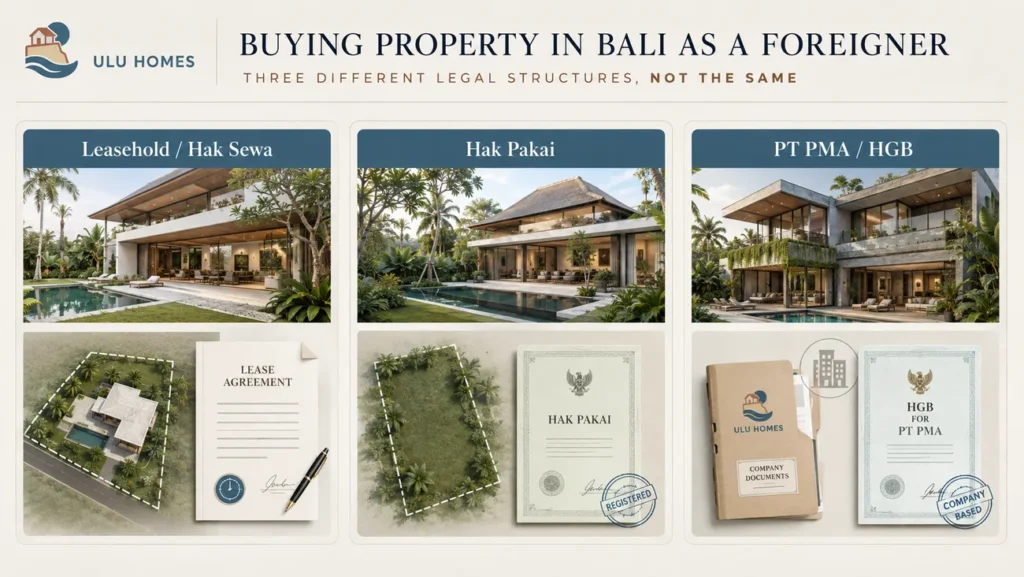
Leasehold / Hak Sewa
Hak Sewa — the right to lease — is a contractual arrangement between a buyer and a landowner. The lessee does not acquire the underlying land title; that title remains with the party legally entitled to grant the lease. In exchange for an agreed payment, the lessee receives the right to use the property for a defined period.
A carefully drafted lease documented in an appropriate notarial deed can provide materially stronger contractual evidence than an informal arrangement, but it does not convert the lease into a registered land title. The strength of a leasehold agreement depends substantially on the quality of the contract and the condition of the underlying land title.
Several terms require careful reading before signing:
- Initial term vs extension option. A lease commonly described as “25+25” or “30+30” does not mean 50 or 60 years of equal security. The initial term is the period already contracted. The extension is a separate provision — its legal force depends entirely on how the clause is drafted. An extension clause may range from a non-binding agreement to negotiate a future lease, to a mechanism that fixes or defines the extension term and price in advance. Buyers should not treat a marketed “25+25” formula as 50 years of equal certainty unless Indonesian counsel confirms that the extension mechanism is legally enforceable as drafted.
- Extension pricing mechanism. Some contracts specify a formula or a capped rate for extension. This is substantially more favourable than an open renegotiation. If the contract is silent on price, assume you will be negotiating at market rates at the end of the initial term.
- Assignment and resale. Does the lease permit you to sell or transfer your interest to a third party? Does it require landowner consent, and under what conditions? An assignment restriction can significantly limit your exit options.
- Inheritance provisions. Can your leasehold interest be inherited? Under what process? What happens if the landowner dies and the land passes to multiple heirs?
- Improvements and buildings. Who owns any structures built on the land during the lease period? The treatment of buildings, improvements and other assets at expiry depends on the lease terms and applicable Indonesian law, so the agreement should state expressly what happens to them.
- End of term. When the contractual lease term expires without an effective extension, the lessee’s contractual right to use the land ends. The treatment of any buildings or improvements at that point is determined by the specific lease agreement and applicable law — not by a single universal rule.
Leasehold is widely used in Bali’s foreign-buyer property market. It can be appropriate for buyers who understand they are acquiring a time-limited contractual right — and who have verified the underlying land title, the landowner’s authority to lease, and the contractual terms governing extension and assignment. The eligibility and documentation requirements applicable to a specific leasehold transaction depend on the legal form of the lease and the circumstances involved; these should be confirmed with an Indonesian notary or legal adviser before signing.
Sales launches on Bali
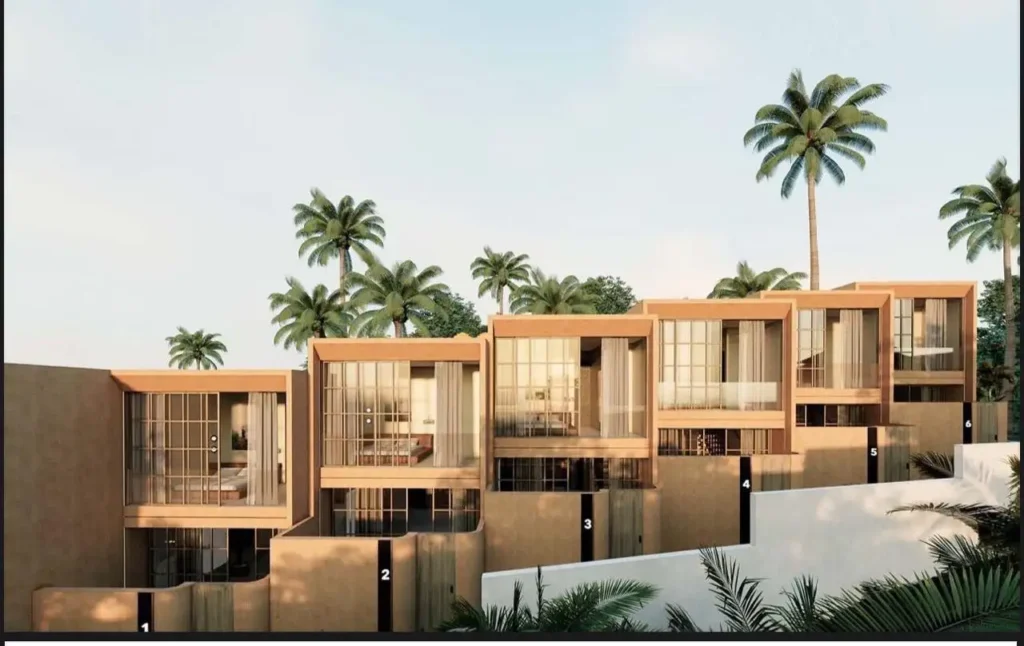

 Bali,Pererenan
 from 100м²
 Bali,Melastifrom 40м²

 Bali,Melastifrom 142,7м²
Hak Pakai
Hak Pakai translates directly as “Right to Use.” Unlike Hak Sewa, it is not merely a contract between parties — it is a registered land right that appears on a land certificate issued and registered through Indonesia’s Ministry of Agrarian Affairs and Spatial Planning / National Land Agency (Kementerian Agraria dan Tata Ruang/Badan Pertanahan Nasional — ATR/BPN). This is a meaningful legal distinction. A registered Hak Pakai is a title, recorded in the official land register and enforceable against third parties, not just against the landowner you contracted with.
Foreign nationals may be eligible to hold Hak Pakai over qualifying residential property if they meet the immigration-document and other eligibility requirements applicable under current Indonesian law. The exact documentation required for a particular transaction should be confirmed with ATR/BPN and a qualified Indonesian PPAT or legal adviser before purchase — the applicable rules should not be assumed from general descriptions.
The right is tied to residential use and is subject to a minimum property price threshold set by the government. The applicable minimum price for Bali is specified in ministerial regulation — specifically Ministerial Decision No. 1241/SK-HK.02/IX/2022 from ATR/BPN — and should be confirmed against the current version of that document before proceeding, as the figures can be updated.
Minimum Property Value for Foreign Buyers in Bali
Under Ministerial Decision No. 1241/SK-HK.02/IX/2022, the minimum property values applicable to qualifying foreign residential ownership in Bali are:
| Property type | Minimum value in Bali |
|---|---|
| Landed house (rumah tapak) | IDR 5 billion |
| Apartment unit (satuan rumah susun) | IDR 2 billion |
These thresholds apply within the foreign residential ownership framework and should not be confused with the asking-price requirements for an ordinary contractual leasehold. Because regulations can change, buyers should confirm the threshold in force at the time of the transaction with ATR/BPN and their PPAT or Indonesian legal adviser.
The duration and renewal terms of Hak Pakai are governed by Government Regulation No. 18 of 2021, which is the primary regulatory instrument currently governing land rights, land registration and related matters in Indonesia. As with any registered land right, the specific terms — including duration, eligibility conditions and renewal — should be verified against the current text of the regulation and confirmed with a qualified Indonesian PPAT before entering into any transaction.
Hak Pakai is generally viewed as a more secure structure than a purely contractual lease, because it involves a registered land title. However, it requires the buyer to meet qualifying eligibility conditions, the property must meet the applicable minimum price threshold, and it is restricted to residential use. It is not a route available to every foreign buyer.
PT PMA and HGB
A PT PMA (Perseroan Terbatas Penanaman Modal Asing) is an Indonesian limited liability company with foreign investment. It is not a personal ownership structure — it is a legal entity. When a foreign buyer acquires property “through a PT PMA,” what happens is that the company — not the individual — holds the land right. The individual holds shares in the company.
The land right a PT PMA can hold includes HGB (Hak Guna Bangunan — Right to Build), which allows the company to develop and use land for business purposes. This is a legitimate corporate land right under Indonesian law, but it involves a distinct set of obligations: the company must maintain proper accounting, file tax returns, comply with its stated business purposes, hold appropriate business licences, and meet any applicable capital and operational requirements.
A PT PMA is not a mechanism for a foreign individual to personally own Bali land as freehold. The land right belongs to the company, not to the individual shareholder. This distinction matters for tax treatment, succession planning, liability and what happens if the company is wound up or the shares change hands.
A PT PMA structure may be appropriate for a buyer who genuinely intends to operate a rental or hospitality business, has taken qualified legal and tax advice, and understands the ongoing compliance obligations. It is not typically suitable as a purely personal residential holding vehicle for a single villa without a legitimate business purpose and proper setup.
Nominee Arrangements
A nominee arrangement involves a foreign buyer placing Indonesian land held under Hak Milik in the name of an Indonesian citizen, typically through a loan agreement or power of attorney designed to give the foreign party effective control. This approach is not a recognised or legally safe pathway. The registered Hak Milik remains in the Indonesian titleholder’s name, and private side agreements do not give the foreign party registered ownership of the land. If the nominee relationship breaks down — through dispute, death, divorce, debt or a change of mind — the foreign buyer may have substantially weaker protection precisely because they are not the registered title holder. This is a known and documented source of serious property disputes in Bali, and it should not be treated as a practical workaround.
Choosing the Right Structure
| Structure | What You Hold | Typical User | Eligibility | Commercial Rental Use | Main Advantages | Key Limitations |
|---|---|---|---|---|---|---|
| Leasehold / Hak Sewa | Contractual lease right | Foreign individuals and other eligible parties, subject to applicable law | Eligibility and documentation should be confirmed for the specific lease with an Indonesian notary or legal adviser | Depends on zoning/spatial-planning status, licensing, business structure and contract | Flexible, widely available, accessible to a broad range of foreign buyers | Not a registered land title; protection depends heavily on contract quality and underlying title |
| Hak Pakai | Registered land right (residential) | Qualifying foreign buyers meeting eligibility conditions | Qualifying immigration documents and other requirements under current Indonesian law; confirm with ATR/BPN or PPAT | Restricted to residential use | Stronger legal position; registered title enforceable against third parties | Eligibility conditions required; minimum price threshold; residential use only |
| PT PMA / HGB | Corporate land right via company | Genuine business operators | Company formation, compliance and applicable capital requirements | Yes, with appropriate business licences and compliance | Can support rental/hospitality business; registered HGB | Corporate setup and ongoing compliance required; individual does not personally hold the land right |
Choosing between these structures should be based on how you actually plan to use the property — not on which structure is simplest to arrange or which sounds most reassuring in a sales presentation. A leasehold is appropriate for a buyer who understands the time-limited nature of the right and has verified the contract. Hak Pakai suits a qualifying buyer who intends personal residential use. A PT PMA makes sense for a genuine business operator who has the appetite for corporate compliance.
Buyers sometimes approach these structures as interchangeable and look for the one that offers the most apparent security. The more useful frame is: which structure matches your actual situation and long-term plans, and have you had it independently reviewed by a qualified Indonesian lawyer before committing?
Which Structure May Fit Your Goal?
| Your goal | Structure to investigate first | Main issue to verify |
|---|---|---|
| Holiday / personal-use villa | Leasehold or qualifying Hak Pakai | Term, eligibility and permitted use |
| Long-term residence | Hak Pakai or leasehold | Immigration status is separate |
| Short-term rental business | PT PMA or another compliant operating structure | Zoning, KBLI and business licensing |
| Off-plan investment | Depends on project structure | Developer’s land control and contract |
| Future resale | Structure with clear transfer/assignment rights | Remaining term and exit conditions |
| Permanent personal freehold ownership | Not available through Hak Milik to a foreign individual | Do not use nominee arrangements as a substitute |
This table is only a starting point. The appropriate structure must be confirmed for the specific buyer, property and intended use.
Not sure which ownership structure fits your plans?
Answer 4 questions about your budget, intended use and preferred Bali area. ULU Homes will match you with properties that fit your requirements and explain which ownership structures are available for them.
Start Property Selection
How the Buying Process Works
The transaction process in Bali varies depending on the legal structure, whether the property is ready or off-plan, and whether the seller is a private individual, a landowner, or a developer. The sequence below covers the typical stages for a foreign buyer and flags where the process differs meaningfully between transaction types.
How Long Does Buying Property in Bali Take?
There is no single completion time for every Bali property purchase. A straightforward ready-property transaction with clean documentation can move considerably faster than an off-plan purchase, a transaction requiring a PT PMA, or a property with unresolved title, zoning or permit issues.
| Stage | What affects the timeline |
|---|---|
| Property selection | Availability and buyer requirements |
| Legal due diligence | Title complexity, zoning, seller documentation and permits |
| Contract negotiation | Lease extension, payment and termination clauses |
| PT PMA setup | Required only for the relevant corporate structure |
| Signing / completion | Structure and readiness of documents |
| BPN registration | Applies to registered land-right transactions |
| Off-plan handover | Construction schedule rather than legal completion alone |
A seller promising an unusually fast closing should not be allowed to compress independent due diligence.
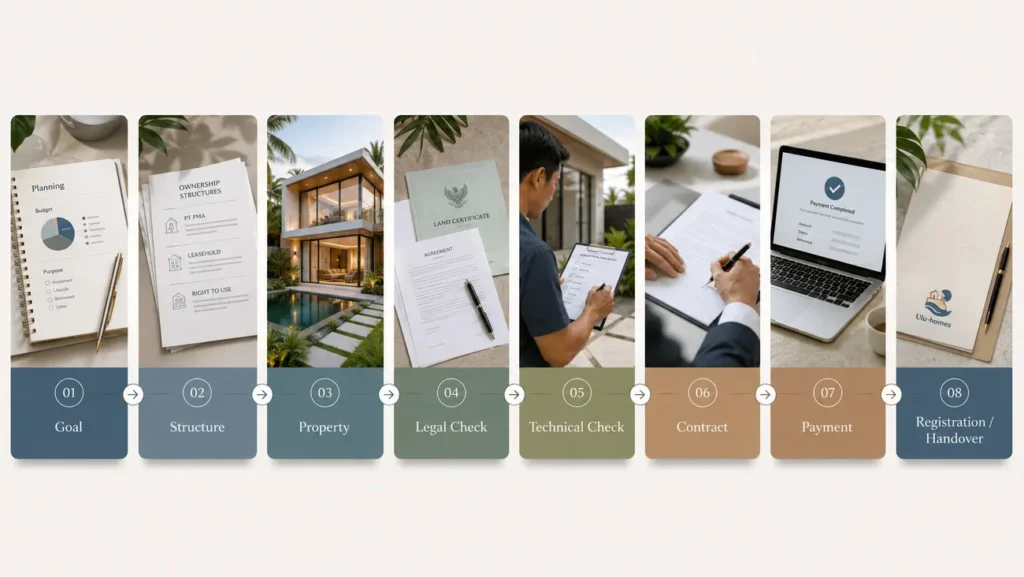
1. Define purpose and budget. Before evaluating specific properties, be clear about whether this is for personal use, rental income, resale, or a combination. Your intended use will determine which legal structure is viable, which locations are relevant, what zoning you need, and what licences may be required. Budget should account for total acquisition cost — not just the asking price.
2. Select the legal structure. Based on your purpose, eligibility, holding period and risk tolerance, work with a qualified Indonesian PPAT or lawyer to determine which structure is appropriate before shortlisting properties. Some properties may only be available as leasehold. Others may be structured through a developer’s PT PMA. Understanding the structure before you fall in love with a specific villa prevents late-stage complications.
3. Shortlist locations and properties. Once the structure is clear, identify properties that are eligible for that structure, located in an appropriate zone for your intended use, and within realistic budget range including all acquisition costs.
4. Check the seller or developer. Verify the identity of the party selling or leasing. For a private resale, confirm the owner of record matches the person you are dealing with. For a developer, review the company’s legal standing, track record of completed projects and existing land control documentation.
5. Review the land title and zoning. Obtain and verify the land certificate through the National Land Agency (ATR/BPN). Check that the certificate is genuine, that the parcel boundaries correspond to what is being sold, and that there are no encumbrances, disputes or liens registered against the title. Separately, confirm that the zoning and spatial-planning classification of the land permits your intended use — residential, tourist accommodation, or commercial — as applicable.
6. Conduct legal and technical due diligence. This is covered in detail in the next section. The critical point is that substantial and non-refundable payments should not be made before due diligence is substantially complete. This is not always fully possible in off-plan purchases, where the payment schedule is set by the developer — which is exactly why off-plan due diligence on the developer, land and permits is even more important.
7. Negotiate and document commercial terms. Once due diligence is satisfactory, agree on price, payment schedule, inclusions and conditions. For a leasehold, the full draft lease should be reviewed before a binding commitment is made. For off-plan, the sale and purchase agreement is the primary risk document — read it carefully, particularly the provisions on construction completion, specification changes, handover, defects and termination.
8. Sign through the relevant notarial or PPAT process. In Indonesia, transactions involving registered land rights typically require a PPAT (Pejabat Pembuat Akta Tanah, or Land Deed Official), who is authorised to prepare specified deeds relating to land rights. A notary performs a separate legal function, although the same professional may in practice hold both appointments. For a registered land right such as Hak Pakai or HGB, the relevant deed and resulting change in registered land rights must be processed through the applicable ATR/BPN registration procedure to be legally effective. A contractual leasehold does not require the same registration, but formal notarisation and proper documentation are still strongly advisable.
9. Complete payments and required administration. Follow the agreed payment schedule. Ensure that applicable taxes are paid — both the buyer’s and seller’s obligations — and that proof of payment is obtained. The specific taxes applicable to a transaction depend on the structure, the parties involved and the property type; these should be confirmed with a tax advisor before signing.
10. Obtain the complete closing-document package. At the conclusion of the transaction, collect and organise every document relating to the property. This is addressed specifically at the end of this guide, but the point is worth stating early: missing documents at closing are significantly harder to recover later.
| Stage | What Happens | Documents to Check | Do Not Proceed Until |
|---|---|---|---|
| Title review | Land certificate verified with ATR/BPN | Original certificate, boundary map | Certificate confirmed genuine and clean |
| Zoning check | Spatial-planning status confirmed for intended use | Zoning map, RTRW/RDTR | Intended use confirmed as permitted |
| Due diligence | Legal, technical and permit review | PBG, SLF, approved plans, access docs | All material issues identified and addressed |
| Agreement | Draft contract reviewed | Full draft lease or SPA | Independent legal review completed |
| Payment | Deposit and staged payments | Receipts, tax payment proof | Agreed conditions precedent satisfied |
| Registration | Registered right recorded at BPN (if applicable) | Registration confirmation, updated certificate | Applicable taxes and fees settled |
| Handover | Keys, documents, inventory | Handover certificate, snagging list | All documents received and verified |
Not sure which Bali property fits your budget, ownership structure and goals? Use the ULU Homes property selection quiz to narrow down suitable options before comparing individual projects.
Can You Buy Property in Bali Remotely?
Parts of a Bali property transaction may be completed remotely, depending on the legal structure and the documents involved. A properly drafted Power of Attorney (Surat Kuasa) may allow an authorised representative to complete specified actions on the buyer’s behalf.
However, remote purchase does not remove any of the normal due-diligence requirements. Before transferring substantial funds, the buyer should independently verify the property, seller or developer, land rights, zoning, permits and transaction documents.
The exact form of the Power of Attorney, signing formalities and whether personal attendance is required at any stage should be confirmed with the Indonesian notary/PPAT handling the transaction.
Who Should Be Involved in a Bali Property Purchase?
| Specialist | Role |
|---|---|
| Independent property lawyer | Reviews structure, contracts, seller/developer documentation and legal risks |
| PPAT | Handles specified deeds and registered land-right transactions |
| Notary | Handles notarial documentation where required |
| Technical inspector | Checks the physical condition of completed property |
| Tax adviser/accountant | Confirms transaction and ongoing tax obligations |
| Property agent/adviser | Searches and compares properties and coordinates the commercial process |
The lawyer reviewing your interests should be independent of the seller or developer.
Due Diligence Before You Pay
Due diligence is the process of verifying that the property, the seller’s rights over it, and its permitted uses match what has been represented to you. It should be completed — or at least substantially advanced — before material, non-refundable payments are made. This is an important point that buyers can overlook once they are already emotionally committed to a specific property.
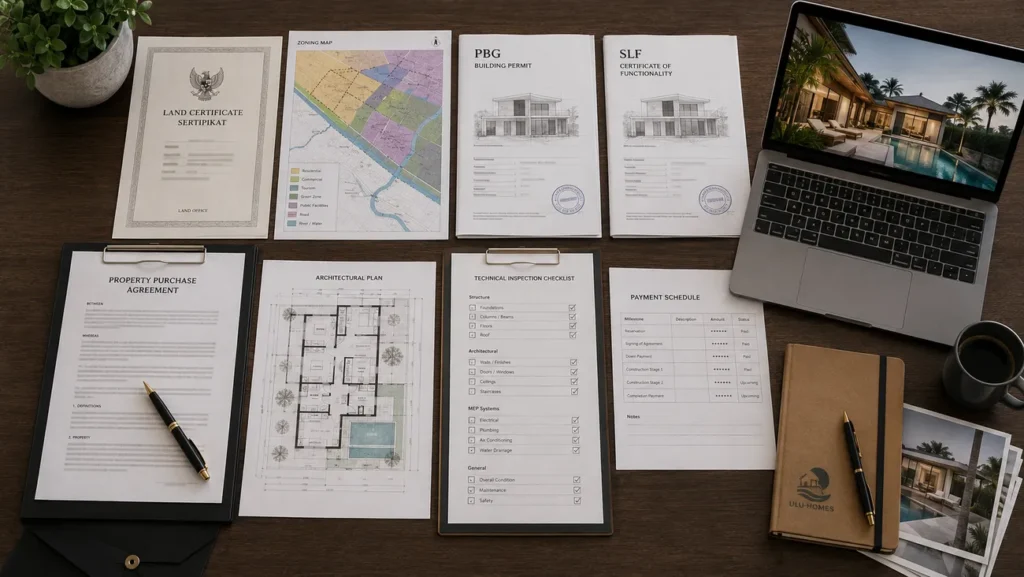
Land and Ownership
The starting point is the land certificate. Verify its authenticity with ATR/BPN directly or through a PPAT. Confirm that the person or entity offering the property has the legal authority to sell, lease or transfer it. For a private owner, this includes checking whether the land is held individually or jointly — a spouse or co-heir may need to be party to the transaction. For inherited land, check whether the inheritance process was properly completed and documented. Confirm that there are no registered mortgages, disputes or encumbrances on the title.
The stated boundaries of the parcel should match the physical boundaries on the ground. Discrepancies between the certificate and actual occupation can create significant problems, particularly where a neighbouring property or a road is involved.
Zoning and Permitted Use
Bali’s spatial planning divides land into zones — agricultural, residential, tourism, conservation and others — each with rules about what can be built and how land can be used. The relevant zoning and spatial-planning classification for a specific parcel is recorded in official documents (RTRW at provincial level, RDTR at district level).
Do not rely solely on a seller’s assurance that “this area is rental zone.” The zoning position should be confirmed against official spatial-planning records and, where necessary, the competent local authority. A villa that has been operating as a short-term rental does not by itself prove that the land is correctly classified for that use or that the necessary permits were obtained.
Purchasing a property affected by zoning or permitting non-compliance can leave the buyer with an asset that cannot lawfully be used as intended and may require remediation, additional approvals or changes to its operation.
Building Documentation
Check whether the existing building holds a valid PBG (Persetujuan Bangunan Gedung — Building Approval), which is the permit required under current Indonesian law for new construction or significant modification, subject to the requirements applicable to the particular building and works. For buildings constructed or modified before the current regulatory framework was introduced, the predecessor IMB (Izin Mendirikan Bangunan) may be the relevant document. Additionally, check whether an SLF (Sertifikat Laik Fungsi) has been issued — this is the certificate that confirms a completed building satisfies the applicable functional-worthiness requirements for its approved function. The Ministry of Public Works administers these permits through the SIMBG system, which can be consulted to check permit status, ideally with appropriate professional assistance.
Check that the approved building plans match the actual construction. Additions, extra floors or structural changes made without permit amendments can create legal exposure and complicate future sales or licence applications.
Access
Confirm that the property has legal road access — a documented right of access to a public road, not merely physical access across land that may belong to a third party. Check the practical access: road width, whether it accommodates the vehicles you need, and whether shared access exists and is documented by agreement. Unclear or undocumented legal access can create significant practical and resale problems and may also affect financing or insurance availability, depending on the provider.
Utilities and Infrastructure
Verify the source of water supply (municipal network, private well, or tanker delivery), the capacity and connection status of electricity (check the installed capacity in kVA against the property’s needs), drainage arrangements, waste management, and internet connectivity if that is relevant to the intended use. For rental properties, utility adequacy is an operational issue, not just a comfort matter.
Technical Inspection
For a ready or resale property, a physical inspection by a qualified inspector is advisable. In Bali’s tropical climate, specific areas deserve close attention: roof integrity and waterproofing, signs of damp or mould, structural condition, pool equipment and hydraulics, drainage and sewage, electrical systems, plumbing, air conditioning capacity, and the condition of finishes. An inspection report provides a baseline and can inform price negotiations or a list of pre-handover repairs.
Developer Checks (Off-Plan)
For an off-plan purchase, due diligence centres on the developer rather than the physical building. Verify the developer’s legal entity, its control over the land (not just a purchase option or an informal arrangement), the status of any required construction permits, and a realistic assessment of the construction timeline based on current progress or comparable projects. Review the sale and purchase agreement carefully: what is the definition of completion? What are the handover conditions? What are the provisions for delay, specification changes, defects and refund if the project does not proceed?
Due Diligence Checklist — Documents and Checks to Request Before Signing:
- Original land certificate (verified with ATR/BPN)
- Boundary map and survey
- Zoning and spatial-planning confirmation for the specific parcel
- Seller identity documents and authority to transact
- Encumbrance search (mortgages, liens, disputes)
- PBG (Building Approval) for existing structures
- SLF (Certificate of Functional Worthiness), where applicable
- Approved architectural plans vs. as-built condition
- Documented road access right
- Utility connection documents (electricity, water)
- For off-plan: developer’s land control documents and construction permits
- For off-plan: developer’s track record, company registration, and existing completed projects
- Draft lease or sale agreement reviewed by independent counsel
- Evidence that applicable taxes from prior transactions have been settled
Already found a property in Bali?
Before comparing only the price, check its ownership structure, remaining lease term, zoning, building documentation and intended use.
Get Help Comparing Bali Properties
Before You Transfer a Deposit or Purchase Payment
Before transferring a material amount, confirm that:
- the recipient’s identity and bank-account details match the contractual counterparty or approved payment arrangement;
- the land title has been independently checked;
- the seller or developer has authority to transact;
- zoning and permitted use have been verified;
- material building documentation has been reviewed;
- the payment is clearly identified in the signed agreement;
- refund conditions are written down;
- off-plan instalments correspond to defined contractual milestones where possible;
- you will receive written confirmation or receipt for every payment;
- your independent lawyer has reviewed any conditions that make the payment non-refundable.
Never rely only on payment instructions sent through messaging apps. Independently confirm any change of bank details with the authorised counterparty before transferring funds.
Zoning, PBG and Rental Use
The existence of a physical villa does not mean that the villa was built with proper permits, that it is classified for the use you intend, or that operating it commercially is legally permitted. This is not an abstract legal concern — it is a practical and financial one.

Bali’s land use is governed by spatial planning regulations at the provincial and district level. These plans designate zones for different purposes: residential, tourism, agriculture, conservation and others. A property developer cannot legally build a tourist villa on agricultural land without the appropriate zoning or conversion approval. However, properties built without full compliance do exist in the market, and some have been operating informally for years.
A buyer who purchases a property with undocumented or non-compliant construction may acquire an asset that cannot lawfully be used as intended and may face restrictions, remediation requirements or complications when trying to sell or obtain certain types of insurance.
The PBG (Persetujuan Bangunan Gedung — Building Approval) is the current regulatory instrument governing construction authorisation in Indonesia. Prior to the regulatory changes that introduced the PBG framework, the equivalent document was the IMB (Izin Mendirikan Bangunan). Depending on when a building was constructed or modified, one or both documents may be relevant. The SIMBG platform (simbg.pu.go.id) is the official system through which PBG status can be checked, ideally with professional assistance for the specific property. The SLF (Sertifikat Laik Fungsi) confirms that a completed building satisfies the applicable functional-worthiness requirements for its approved function.
For rental use specifically: operating a villa as short-term tourist accommodation in Bali is a commercial activity that may require business licensing and other approvals appropriate to the activity, property and business structure. Indonesia’s current risk-based business licensing framework is governed by Government Regulation No. 28 of 2025 and administered through the OSS (Online Single Submission) system. For a property intended for short-term accommodation, the relevant factors include the applicable KBLI business classification, the zoning and spatial-planning status permitting the intended accommodation activity, the building documentation, and the specific licensing pathway for the ownership structure involved. Buyers should verify these requirements before completing the purchase, not after. The rental income projections in a developer’s marketing materials are not a substitute for confirming that the licensing pathway is actually available for that specific property.
A property that physically exists is not automatically a property that can legally be operated in the way you intend.
This is particularly relevant when evaluating off-plan developments marketed on the basis of rental yield projections. The projections may assume commercial short-term rental operation. Before treating those projections as a planning assumption, confirm that the zoning and spatial-planning status permits the intended accommodation activity, that the developer will deliver a PBG for the relevant use classification, and that the buyer’s intended ownership structure supports the necessary business licensing under the current framework.
How Much Does It Cost?
Typical Costs When Buying Property in Bali
| Cost | Typical rule / amount | What the buyer should check |
|---|---|---|
| Property or lease price | Agreed purchase or lease price | What is included: furnishing, fit-out, taxes, management setup |
| BPHTB acquisition duty | Generally up to 5% of the taxable acquisition value after the applicable non-taxable threshold, where BPHTB applies | Whether the transaction creates a taxable acquisition of a land/building right; applicable local NPOPTKP |
| PPAT fee | Regulated maximum based on transaction value; up to 1%, with lower maximum percentages for higher-value transactions | Obtain a written quotation for the specific deed |
| Notary fee | Statutory maximum depends on the economic value of the deed; for values above IDR 1 billion, agreed by the parties but capped at 1% | Not every transaction or document attracts the same fee |
| Independent legal due diligence | No single statutory percentage | Obtain a written scope and fee before paying a non-refundable deposit |
| VAT | May apply to qualifying taxable supplies, including certain developer transactions | Confirm whether VAT applies and whether the advertised price includes it |
| BPN registration | Applies to registered land-right transactions | Confirm the official charges for the specific registration |
| PT PMA formation and compliance | Applies where a PT PMA structure is used | Setup, licensing, accounting and ongoing compliance costs |
| PBB-P2 | Local land and building tax, where applicable | Current local assessment and contractual allocation |
| Rental/business licensing | Depends on intended activity and structure | Applicable KBLI, OSS and other licensing requirements |
Always ask whether the quoted property price includes taxes, notarial costs, furnishing, management setup and any licensing costs. Two villas advertised at the same price can have materially different all-in acquisition costs.
PPAT fees are capped, not fixed. Under Ministerial Regulation ATR/BPN No. 33 of 2021, the maximum fee for preparing a PPAT deed depends on the transaction value: up to 1% for transactions up to IDR 500 million, 0.75% above IDR 500 million to IDR 1 billion, 0.5% above IDR 1 billion to IDR 2.5 billion, and 0.25% above IDR 2.5 billion. These are maximum permitted fees rather than mandatory rates, so buyers should request a written quotation.
Example: How to Calculate Your Real Purchase Budget
Suppose a buyer is considering a leasehold villa advertised at $250,000. The $250,000 asking price should not be treated as the final acquisition budget: legal work, notarial documentation, currency conversion, inspection, furnishing, licensing and other transaction-specific costs may sit outside the advertised price.
The investment decision should not be based on $250,000 alone. The buyer should create a separate acquisition budget for:
- property or lease price;
- legal due diligence;
- notarial documentation;
- technical inspection;
- bank transfer and currency-conversion costs;
- furnishing or fit-out if not included;
- repairs or snagging;
- licensing and business setup if the property will be operated commercially;
- initial property-management setup;
- a reserve for maintenance and unexpected work.
For an investment property, a second budget should then calculate annual operating costs separately.
Purchase price + acquisition costs + setup costs = actual capital required before the property starts operating.
The asking price of a Bali property — whether a leasehold villa or an off-plan unit — is the starting point, not the total cost. The advertised price is not necessarily the buyer’s total acquisition cost. Depending on the legal structure and transaction type, additional costs may include taxes, PPAT/notarial and legal fees, registration costs, company setup, currency conversion, furnishing, permits and technical due diligence. These should be calculated for the specific transaction with professional assistance before signing — the variables differ significantly between a simple leasehold and a PT PMA acquisition.
The categories below apply to varying degrees depending on the structure and transaction type. Not every cost applies to every purchase; a qualified adviser should confirm which apply to your specific situation.
Acquisition costs (one-time):
- Purchase or lease price
- Applicable transaction taxes (the specific taxes, rates and which party bears them depend on the transaction structure and should be confirmed with a tax professional before signing)
- PPAT / notarial fees
- Legal due diligence fees (independent lawyer)
- Land registration fees (for registered rights)
- Company incorporation and setup costs (for PT PMA)
- Currency conversion costs (bank transfer fees, exchange rate spread)
- Technical inspection fee
- Any building permit costs or compliance remediation
Establishment costs (often one-time but variable):
- Furnishing and fit-out
- Snagging repairs and pre-opening works
- Initial utility deposits and connections
- Permit applications and business licence fees (for rental operation)
- Property management setup
Ongoing costs (annual or periodic):
- Land and building tax (PBB-P2, where applicable, under relevant local rules)
- Property management fees (often structured as a percentage of revenue or under another agreed fee model)
- Maintenance and repairs (in a tropical climate, wear on buildings, pools and finishes is a material cost)
- Pool and garden maintenance
- Utility costs (electricity, water)
- Staff costs (if applicable)
- Insurance
- Company accounting and compliance (for PT PMA)
- Licence, certification and compliance renewals where applicable
- Leasehold extension costs (a future one-time cost that should be modelled from the outset for leasehold buyers)
| Cost | When It Arises | One-Time / Ongoing | What to Verify |
|---|---|---|---|
| Purchase / lease price | Completion | One-time | Agreed in contract; confirm inclusions |
| Transaction taxes | Completion | One-time | Confirm applicable taxes, rates and which party bears them with a tax advisor |
| PPAT / notarial fees | Completion | One-time | Obtain written estimate before signing |
| Legal due diligence | Pre-completion | One-time | Engage before making non-refundable payments |
| Company setup (PT PMA) | Pre or at completion | One-time + ongoing | Confirm capital requirements and compliance obligations |
| Land and building tax (PBB-P2) | Periodically | Ongoing | Confirm applicable assessment under relevant local rules |
| Property management | Monthly / annual | Ongoing | Review contract terms and fee structure |
| Maintenance and repairs | As required | Ongoing | Budget conservatively; tropical climate accelerates wear |
| Leasehold extension | End of initial term | Future one-time | Model cost before purchase; do not assume nominal fee |
| Compliance renewals | Periodically | Ongoing | Confirm which licences apply and renewal conditions |
Advertised price ≠ total acquisition cost ≠ annual ownership and operating cost.
For leasehold properties specifically, the economics of extension are a distinct future expense that should be modelled at the time of purchase. A lease with 25 years remaining and a clearly defined, enforceable extension mechanism is a materially different asset from a lease with 25 years remaining and an open renegotiation clause. If you cannot model the extension cost, treat it as an unquantified liability.
Can Foreigners Get a Mortgage in Bali?
Foreign buyers should not assume that the same mortgage options available to Indonesian citizens will be available to them.
Financing possibilities depend on factors such as:
- residency status;
- ownership structure;
- property title;
- lender eligibility requirements;
- income and source-of-funds documentation;
- loan-to-value limits;
- currency and repayment terms.
Some buyers therefore purchase with cash or use financing outside Indonesia, while others may qualify for Indonesian lending products.
If financing is required, obtain lender approval before paying a non-refundable property deposit. Do not assume that a property being legally purchasable means it is also acceptable collateral to a particular bank.
Choosing the Right Property
Property selection should follow structure selection, not precede it. Once the legal framework is established, the choice of specific property depends on what you actually plan to do with it.
For Personal Residence
A property bought for personal use should place different weight on criteria than a rental investment. The relevant factors include: practical commute and access to the areas you use regularly; noise levels at different times of day and during the tourism high season; proximity to services, healthcare and schools if relevant; the quality of surrounding infrastructure; and the stability of the immediate neighbourhood in terms of planned development or construction. A villa that looks ideal in a brochure may be adjacent to a hotel development site that will significantly alter the character of the area within a few years.
For Rental Investment
A property intended for short-term rental must first clear the legal threshold: its zoning and spatial-planning status must permit the intended accommodation activity, the building documentation must support that use, and a viable business-licensing pathway must exist under the current regulatory framework. Only after those are confirmed does the investment analysis become meaningful.
Beyond legality, the relevant variables include: demonstrated rental demand in the specific location (not only the broad area), seasonality and the impact of low season on occupancy, the depth of property management options, the quality and level of competition in the immediate vicinity, realistic average daily rate assumptions (tested against comparable properties in the same location, not developer projections), and operating expense estimates that include management, maintenance, staff, utilities and compliance costs.
Remaining lease term is a significant variable in rental investment analysis. A property with 15 years remaining on the lease is not the same investment as one with 28 years, even if the purchase price is similar. The shorter the remaining term, the more the extension cost and uncertainty need to be reflected in the price.
Bali Properties for Rental Investment


 Bali,Nusa Duafrom 32м²
 Bali,Canggufrom 44м²
For Resale or Capital Preservation
A buyer who intends to eventually resell or assign their interest should focus on: the remaining legal term and its adequacy for a future buyer, the transfer or assignment rights explicitly stated in the lease, the documentation condition of the property, the marketability of the location over time, the quality of construction, and the realistic supply of comparable properties entering the market. A leasehold with only a few years remaining will generally face a smaller pool of prospective buyers and may require a substantial pricing adjustment unless a commercially viable extension can be secured.
Submarkets like Canggu, Seminyak, Uluwatu/Bukit, Ubud and Sanur each have distinct buyer profiles, price ranges and demand characteristics. The right location depends on your target market or personal priorities — not on a generic “best area” ranking.
| Buyer Goal | What Matters Most | Main Risks | What to Prioritise |
|---|---|---|---|
| Personal residence | Access, lifestyle fit, infrastructure | Noise, construction nearby, lease remaining | Physical inspection; long initial lease with clear extension |
| Short-term rental | Zoning/spatial-planning status, licences, location demand | Legal non-compliance, occupancy shortfall | Permit and licensing verification before ROI modelling |
| Long-term rental | Stable demand, operating cost, management | Vacancy, lease expiry | Lease term; management quality; tenant profile |
| Resale / capital preservation | Documentation, remaining term, assignability | Short lease, transfer restrictions, supply | Assignment rights; building quality; documentation completeness |
Bali Areas to Consider by Buyer Goal
| Area | Often considered by buyers looking for | What to check carefully |
|---|---|---|
| Canggu / Berawa | Rental demand, restaurants, lifestyle infrastructure | Traffic, construction density, competition and entry price |
| Uluwatu / Bukit | Villas, tourism demand, lower-density lifestyle | Road access, water, infrastructure and zoning |
| Seminyak | Established tourism market and central location | Older stock, congestion and remaining lease terms |
| Ubud | Wellness, nature and longer-stay demand | Access, seasonality, humidity and location-specific demand |
| Sanur | Residential lifestyle and longer stays | Property supply, pricing and target tenant profile |
These are broad area characteristics, not investment-return forecasts. Property-level demand, legal status and economics must still be checked individually.
Not sure which Bali area fits your budget and goal?
Tell us whether you’re buying for personal use, rental income or resale and your approximate budget. We’ll narrow the search to suitable areas and properties.
Take the 4-Question Property Quiz
Buying Off-Plan vs Ready Property
Both off-plan and ready properties are available in Bali’s foreign buyer market, and neither is categorically superior. The right choice depends on your priorities, risk tolerance and intended use.
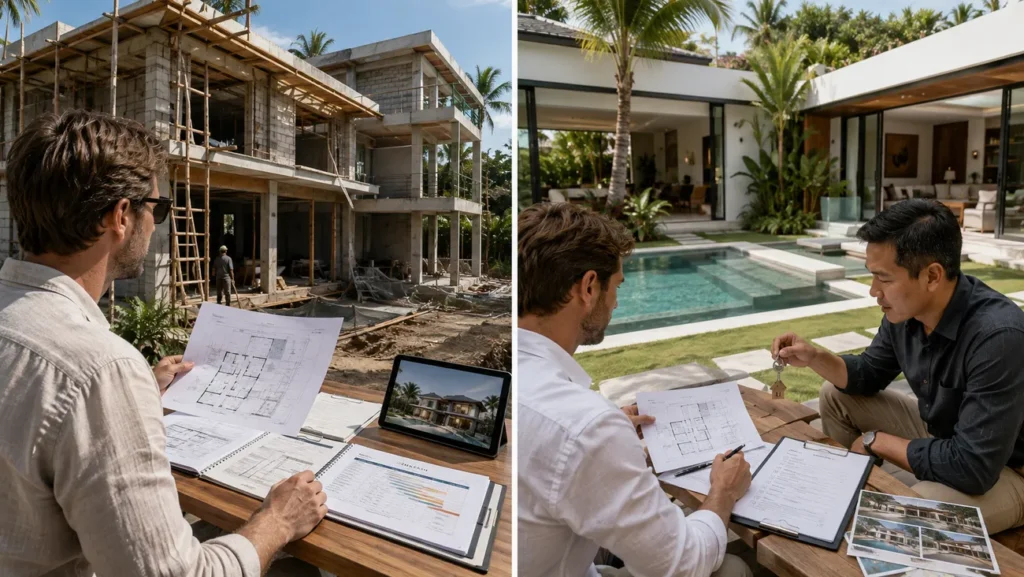
Off-Plan
Buying from a developer before or during construction may offer a lower initial price or a staged payment structure compared with completed units, depending on the development and market conditions. The trade-off is dependency on the developer and exposure to construction risk.
Off-plan buyers do not know with certainty what the finished product will look like, how the immediate surroundings will develop, or whether the project will be completed on time and to specification. The contractual protections — or lack of them — become the primary risk management tool. A well-structured sale and purchase agreement will define completion clearly, set out what happens if the specification changes, ideally establish measurable milestones for the payment schedule, and provide reasonable remedies for delay or non-delivery.
Ready / Resale Property
A ready property can be physically inspected before commitment. You can see the actual construction quality, the real surroundings, the access, the condition of the infrastructure. If the property has been operating as a rental, actual performance data may be available, though it should be reviewed sceptically.
The key considerations for a resale leasehold are the remaining lease term and the quality of the extension clause — these directly affect value and liquidity. An existing property may also come with documented operational history: licences, tax filings and management records that inform the investment case.
Before buying off-plan, verify:
- The developer’s legal entity is registered and in good standing
- The developer has documented control of the land (a title search, not just a claim)
- Required construction permits (PBG) are in place or there is a documented path to obtaining them
- The payment schedule is ideally tied to measurable construction milestones
- The sale agreement clearly defines completion, handover standards and defect liability period
- There is a provision for delay — including a refund or compensation mechanism if the project does not complete
- The developer has a track record of delivering comparable projects
Common Mistakes to Avoid
The following are common risk patterns identified in Bali property transactions involving foreign buyers. Each can be avoided with the right sequence of advice and verification.
1. Treating leasehold as freehold. A lease is a time-limited contractual right. It is not equivalent to ownership of the land. Instead: Read and understand exactly what the lease grants, for how long, and what happens at the end of each term.
2. Assuming extension is automatic. An extension clause may be no more than a right to renegotiate at future market conditions — or it may be a well-defined enforceable mechanism. The difference is significant. Instead: Have Indonesian counsel review the extension clause and confirm its legal enforceability before signing.
3. Using a nominee to simulate freehold ownership. A nominee arrangement — where an Indonesian citizen holds title on behalf of a foreigner — is not a recognised or legally safe pathway. The registered Hak Milik remains in the nominee’s name, and private side agreements do not give the foreign party registered ownership. Instead: Use one of the legitimate structures (leasehold, Hak Pakai or PT PMA) and take proper legal advice on which applies to your situation.
4. Paying before due diligence. Non-refundable deposits or large initial payments made before legal and technical checks create leverage for the seller and remove it from the buyer. Instead: Structure any preliminary payments to be refundable if due diligence reveals material issues, and complete due diligence before making non-refundable commitments where at all possible.
5. Ignoring zoning. Buying a property whose zoning and spatial-planning status does not permit your intended use — particularly commercial short-term accommodation — can result in inability to operate legally, difficulty obtaining licences, and complications on resale. Instead: Confirm the zoning and spatial-planning classification for the specific parcel against official records before placing a deposit.
6. Assuming a villa can automatically be rented short-term. Short-term tourist accommodation is a commercial activity requiring specific licensing and compliance under Indonesia’s current risk-based framework. Instead: Confirm the licensing pathway for your intended rental structure before completing the purchase.
7. Not checking road access. Physical access to a property does not mean legal access. Instead: Verify that legal road access is documented, not merely assumed from the physical approach.
8. Ignoring remaining lease term when comparing prices. A property with fewer years remaining on its lease should generally cost less than a comparable property with more years — all else equal. Instead: When comparing two leasehold properties, adjust for remaining term and evaluate the extension mechanism before comparing prices directly.
9. Buying off-plan without assessing the developer and contract. Developer quality and contract terms are the primary risk factors in off-plan, not the renders or the projected yields. Instead: Investigate the developer’s track record and have the sale agreement reviewed by an independent lawyer before signing.
10. Calculating ROI from gross rental revenue. A projected rental income figure, before management fees, maintenance, utilities, taxes, compliance costs and vacancy, can look very different from net returns. Instead: Build a realistic operating expense model before making any investment decision.
11. Ignoring maintenance and management costs. Tropical climates accelerate wear on buildings, pools and finishes. Instead: Budget conservatively for ongoing maintenance and use actual management fee quotes from operators in the relevant area.
12. Assuming property ownership gives residency rights. Owning or leasing property in Indonesia does not automatically grant a visa, a KITAS (temporary residence permit), a KITAP (permanent residence permit) or any other immigration status. Instead: If residency is a goal, address it through the appropriate immigration pathway, separately from the property transaction.
Never evaluate a Bali property only by its purchase price. Evaluate the legal rights, remaining term, permitted use, operating costs and exit options together.
Documents to Keep After Closing
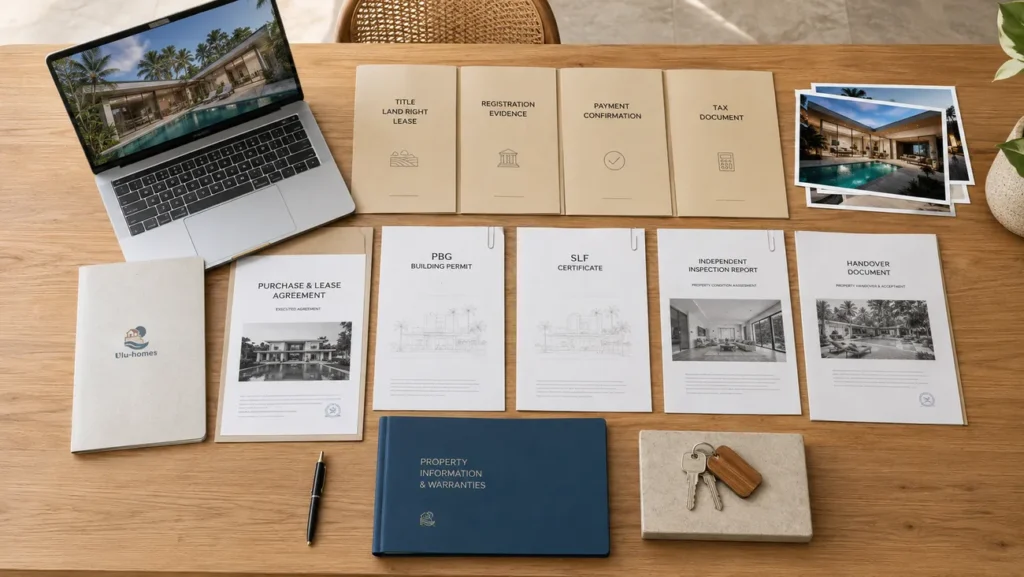
A complete, organised post-closing document file is something many buyer guides do not address in detail — and yet the absence of a specific document can become a serious problem years later when you want to sell, renew a lease, apply for a licence or resolve a dispute.
The documents relevant to any specific transaction will vary depending on the legal structure, the property type and the parties involved. The list below is illustrative — not every item applies to every transaction:
- Executed agreements: signed and notarised lease agreement, sale and purchase agreement, or other primary transaction document
- Land certificate copy: the most recent version of the relevant land certificate (Hak Milik, Hak Pakai, HGB or other), together with any registration confirmation
- Payment confirmations: receipts for all payments made, including any tax payments
- Tax documents: evidence that applicable transfer taxes and other transaction taxes were paid by the relevant parties
- PBG and SLF: building approval and certificate of functional worthiness, together with the approved plans they relate to
- As-built and approved plans: architectural drawings showing what was approved and how the building was actually constructed
- Company documents (for PT PMA): articles of association, NIB, relevant licences, and any share documentation
- Licences: business licences, rental operation licences and any other permits needed for your intended use
- Technical inspection report: the results of any pre-purchase building inspection
- Handover certificate: signed confirmation of the condition at handover, including any agreed snagging items
- Utility information: electricity and water account details, connection documents, installed capacity confirmation
- Inventory list: if the property was purchased furnished, a documented inventory of what is included
- Extension-related documents: any correspondence, agreements or options relating to lease extension
Keep all of these in a single organised property file — physical and digital copies. This file will matter when you sell or assign the property, when you negotiate a lease extension, when you file tax returns, when you make an insurance claim, and if any dispute arises. Documents that are difficult to locate under normal circumstances become very difficult to locate under pressure.
Key Takeaways
- Select the legal structure before the property. The structure — leasehold, Hak Pakai or PT PMA — determines what rights you actually hold, what you can do with the property and how long you can hold it. The property selection follows from that.
- Hak Milik is not available to foreign individuals. Hak Pakai and Hak Sewa/leasehold are distinct legal mechanisms, not substitutes for freehold ownership. PT PMA gives a corporate entity certain land rights — it does not give the individual shareholder personal land ownership.
- Lease extension is a separate provision, not a guaranteed continuation. Every leasehold buyer should have the extension clause reviewed by Indonesian counsel. If the extension price is not pre-agreed or formula-determined, it is a negotiation that has not yet happened — and should not be assumed to be nominal.
- Zoning and permitted use must be verified independently. A seller’s description of a property as “rentable” or “in a tourism zone” requires confirmation against official spatial-planning records — not marketing materials.
- Price must be evaluated alongside remaining lease term and permitted use. Two leasehold properties with the same price but different remaining terms, different extension terms and different zoning classifications are not equivalent assets.
- Rental legality must be confirmed before any ROI calculation is meaningful. If the property cannot legally be operated as short-term tourist accommodation under the current licensing framework, any yield projection based on that use is not a reliable planning assumption.
- Due diligence must precede non-refundable payments. The sequence matters. Conducting due diligence after committing capital removes the practical ability to act on what due diligence reveals.
- Total cost of ownership is the relevant metric — not asking price. Acquisition taxes, legal fees, furnishing, management, maintenance, compliance renewals and eventual lease extension all belong in the analysis. The advertised price is the starting point, not the full picture.
Bali Property Terms: Quick Glossary
| Term | Meaning |
|---|---|
| Hak Milik | Freehold land ownership reserved primarily for Indonesian citizens |
| Hak Sewa | Contractual right to lease |
| Hak Pakai | Registered Right to Use |
| HGB | Hak Guna Bangunan — Right to Build |
| PT PMA | Indonesian company with foreign investment |
| PPAT | Land Deed Official authorised for specified land transactions |
| ATR/BPN | Indonesia’s land administration authority |
| PBG | Building Approval |
| SLF | Certificate of Functional Worthiness |
| RTRW / RDTR | Spatial-planning instruments used to determine permitted land use |
| OSS | Online Single Submission business-licensing system |
| KBLI | Indonesian business activity classification |
| PBB-P2 | Local land and building tax |
Buying Property in Bali with Confidence
The path to a successful Bali property purchase follows a clear sequence: clarify your goal → select the appropriate legal structure → identify suitable properties → conduct proper due diligence → review and negotiate the contract → make staged payments against verified milestones → complete registration where applicable → collect and organise all closing documents → prepare the property for its intended use.
Each stage depends on the one before it. Skipping steps — particularly due diligence and legal structure selection — does not accelerate the process; it shifts risk onto the buyer without reducing it.
Bali offers a range of legally available pathways for foreign buyers, from well-documented long-term leases to registered use rights to corporate land structures. None of them is risk-free, and none of them is suitable for every buyer or every property. What makes a transaction solid is not the structure itself but the quality of the documentation, the condition of the underlying title, the clarity of the permitted use, and the accuracy of the buyer’s understanding of what they are acquiring.
Understanding the rights you are actually purchasing — and confirming that the property matches how you plan to use it — is the foundation of every sound Bali property decision. A beautiful villa with unclear documentation, incomplete permits or a short remaining lease is not the same asset as an equivalent villa with a clean, well-documented title and appropriate permits in place. The price should reflect that difference, and the buyer’s analysis should too.
The information in this guide is provided for general informational purposes. Indonesian property law, land rights, zoning, business licensing and tax rules depend on the specific transaction, legal structure, property and applicable regulations at the time of the transaction. This guide does not constitute legal, tax or investment advice. Readers should obtain independent advice from a qualified Indonesian lawyer, PPAT and tax adviser before entering into any property transaction.
 Real estate in Georgia
 Real estate in Cyprus
 Real estate in the UAE
 Real estate in Montenegro
 Real estate in Thailand
 Real estate in Spain
 Real estate in Saudi Arabia
 Real estate in Turkey
 Real estate in Zanzibar
 +62 895 001 924 667
 hello@ulu-homes.id
 Tibubeneng, Canggu, Kuta Utara, Badung Regency, Bali 80361, Indonesia



 Get catalogue of TOP-7 objects