
 +62 895 001 924 667




Legian occupies a stretch of Bali’s southwest coast between two of the island’s best-known areas: lively Kuta to the south and more upscale Seminyak to the north. This location largely defines its character. The area is developed enough to offer a full range of tourist infrastructure, yet it is generally less hectic than central Kuta and more affordable than Seminyak’s most prestigious addresses.
For visitors, Legian is first and foremost about Legian Beach, surfing, sunsets, and a vibrant evening scene. For property buyers, however, its appeal lies elsewhere: Legian sits within one of Bali’s longest-established tourism areas, has strong destination recognition, and offers a central location between Kuta and Seminyak. At the same time, it is a mature and densely developed market, so individual investment performance depends heavily on the property, micro-location, legal structure, management model, and acquisition price.
This guide takes a practical look at how Legian is structured, what everyday life is like, the types of property available, and the main factors that influence prices. It also examines the area’s investment case, the legal ownership structures available to foreign buyers, and a practical step-by-step approach to selecting a property. Finally, Legian is compared with neighboring areas of Bali to help determine how well it fits a particular lifestyle or investment objective.
Where Legian Is Located
Legian lies on the west coast of southern Bali, within Badung Regency and administratively part of Kuta District. On the map, it forms a narrow coastal strip roughly two kilometres long, stretching from the border with Kuta in the south to Jalan Arjuna—also known as Double Six—in the north, where Seminyak begins.
Ngurah Rai International Airport is approximately 5–7 kilometres to the south. The distance may seem short, but actual travel time depends heavily on traffic, which during peak hours in southern Bali can turn a brief drive into a 30-minute journey. This is typical of many areas in this part of the island, and Legian is no exception: distances on the map rarely translate directly into predictable travel times.
A handful of key streets define the neighbourhood’s layout. Jalan Legian runs parallel to the coastline and serves as its main commercial artery, lined with shops, cafés, small hotels, and souvenir stores. Jalan Padma and Jalan Padma Utara connect Jalan Legian with the beach, forming the dense network of narrow streets and lanes that is characteristic of the area. Along the coast, Legian Beach stretches the full length of the neighbourhood, merging into Kuta Beach to the south and the beaches of Seminyak to the north.
Administrative boundaries between neighbourhoods in southern Bali are often somewhat fluid in practice. On tourist maps, in everyday usage, and in property listings, Legian may partially overlap with neighbouring areas—particularly in the north, where it gradually blends into Seminyak. For property buyers, this means it is important to assess the exact address and physical location of a property rather than relying solely on the neighbourhood name.
How the Area Is Structured
Legian is far from uniform, and the specific part of the neighborhood you choose can significantly shape both the lifestyle experience and the appeal of a property.
Beachfront — the narrow strip running along the beach — is the most sought-after area for tourist rentals. It is home to hotels, several villa complexes, and properties with direct or near-direct access to the sea. Prices reflect this proximity, while opportunities for new development in this zone are limited.
Jalan Padma and Padma Utara are arguably the most balanced parts of Legian for both living and rental purposes. These streets are relatively quieter than Jalan Legian, the beach is typically a 5–10-minute walk away, and the surrounding café and restaurant infrastructure is well developed. A number of smaller villa complexes are also concentrated in this area.
Jalan Legian is the neighborhood’s main commercial artery. Traffic remains heavy for much of the day, noise levels are higher, and parking can be difficult. For short-term rental properties, proximity to Jalan Legian can be convenient for guests, but it does not necessarily translate into a comfortable environment for long-term living.
The northern part of Legian, closer to Jalan Arjuna, also known as Double Six, and toward Seminyak, feels more like a transitional zone. The atmosphere is somewhat calmer and more reminiscent of Seminyak, with less mass-tourism traffic and a slightly different mix of restaurants, cafés, and other venues. Property prices in this part of Legian are often higher than in the central area.
The inner streets — lanes extending inland away from the beach — generally offer lower noise levels and more accessible property prices, although walkability to the beach becomes less straightforward. For rental properties in these locations, it is important to assess realistically how convenient and pleasant the actual route from the property to the shoreline is.
In practice, three factors can create a substantial difference between properties in Legian even when their locations appear similar on a map: the width of the access road, the availability of parking, and the actual walking route to the beach.
Life in Legian
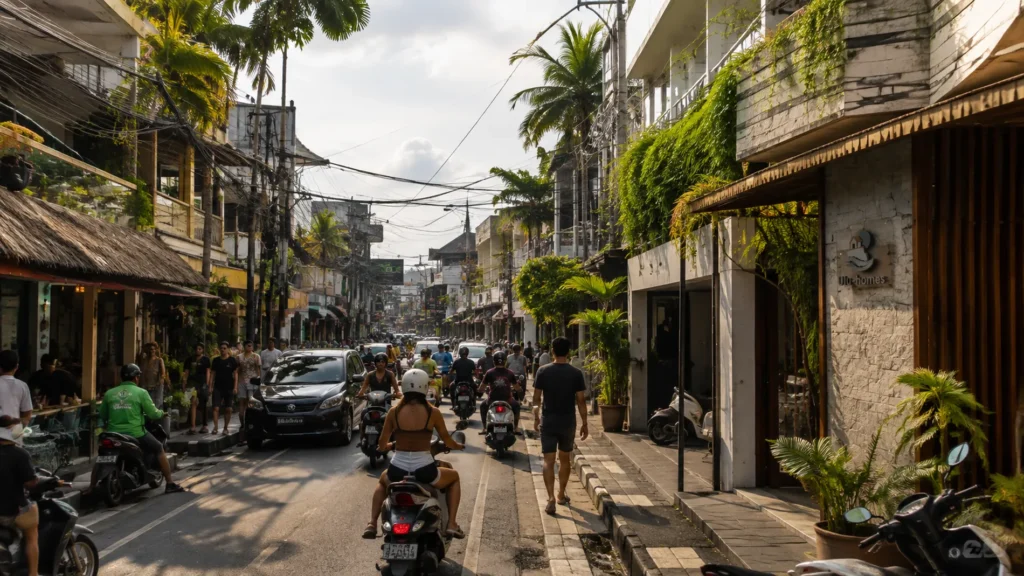
Legian is a well-established resort area with a dense concentration of tourist infrastructure. It is neither a quiet seaside village nor a secluded residential enclave: the streets are consistently busy, bars stay open late, motorbikes remain part of the soundscape well into the night, and most shops and cafés cater primarily to visitors.
The beach is the area’s main asset. Legian Beach is wide and known for the kind of waves that attract surfers of varying skill levels. Sunsets here are not just a tourism cliché but a genuine part of the evening routine: people deliberately head to the shore to watch the sun disappear over the ocean. The beach is unfenced and officially open to the public, although some stretches are effectively serviced by nearby hotels and restaurants.
Legian’s restaurant and café scene covers a broad spectrum, from simple warungs serving Indonesian food to international restaurants with reliably good cuisine. The highest concentration of venues is along Jalan Padma and the surrounding side streets. You will find everything from inexpensive local meals to cafés serving Western-style menus and good coffee. In the evening, Jalan Padma becomes noticeably livelier: restaurants fill up, and parts of the street begin to feel almost pedestrian, even though they are not officially closed to traffic.
Jalan Legian has a completely different pace. It is the area’s main commercial artery, with heavy traffic, surf shops, pharmacies, currency exchanges, street food, and souvenir stores packed along the road. It is convenient for everyday errands, but less pleasant for long walks. Its character changes very little throughout the day: from morning until late evening, it remains consistently active.
Spas in Legian are very much a mass-market service. Small studios can be found on almost every street and are designed primarily for tourists coming back from the beach, offering traditional Balinese massage, reflexology, and treatments lasting anywhere from 30 to 90 minutes. This is generally not the luxury spa model that requires advance booking, but rather an accessible, walk-in service that thrives precisely because demand is steady.
There is less difference between weekdays and weekends in Legian than in non-tourist districts. Visitor numbers are not tied to the working week, so the area tends to operate at roughly the same pace seven days a week. The more noticeable changes are seasonal. During high season, particularly in July, August, and December, the beach, restaurants, and streets become significantly busier, and some businesses raise their prices. In the lower season, especially from February to April, the area feels quieter, some tourist-oriented shops reduce their opening hours, and there is noticeably more space on the beach.
For long-term living or relocation, Legian offers clear advantages as well as obvious limitations. On the positive side, the beach is within walking distance, there is a wide choice of cafés, and basic everyday services are easy to access. On the other hand, traffic is intense, the surrounding population is heavily tourist-oriented, and there are relatively few genuinely quiet residential pockets. For someone considering long-term living, the main trade-off is straightforward: Legian offers convenient access to the beach and tourist infrastructure, but relatively few areas provide the privacy and quiet associated with more residential parts of Bali.
Getting around without a motorbike or car is possible within the coastal part of Legian. The beach, most cafés on Jalan Padma, and the main local shops can all be reached on foot. Once you move beyond this zone, however, transport becomes much more useful for reaching larger supermarkets, medical facilities, and coworking spaces.
What makes everyday life convenient:
- The beach is within walking distance, typically 5–15 minutes from most properties
- A wide choice of cafés, restaurants, and street food for almost every budget
- Spas, massage studios, and yoga facilities within easy walking distance
- Clothing stores, surf shops, souvenir shops, and basic everyday retail within the area itself
- Easy access to Kuta and Seminyak, either on foot or within a few minutes by motorbike
- Straightforward day-to-day infrastructure, including ATMs, currency exchanges, pharmacies, and minimarkets
- A compact layout that is easy to understand and navigate even during the first few days
Pros and Cons of the Area

An honest assessment of Legian means acknowledging that many of its defining characteristics can work both ways: what makes the area attractive to a short-term rental investor may be a drawback for someone planning to live here permanently.
Its central location is a major advantage in terms of tourist appeal. Legian is familiar to visitors, widely recognized, and offers easy access to Kuta, Seminyak, and the airport. For permanent residents seeking peace and quiet or quick, convenient access by car, however, that same density can become a source of frustration.
Legian operates within one of Bali’s established tourism areas, which provides a sizeable potential guest market. That does not make demand predictable for an individual property: occupancy still depends on price, reviews, property quality, distribution, seasonality and the exact micro-location. At the same time, it also means intense competition between hotels, villas, and guesthouses. A strong tourism market does not automatically guarantee high occupancy for any individual villa.
The shortage of large land plots is a structural feature of a mature, densely developed area. For an investor looking for a completed, liquid property, this is largely a neutral consideration. For someone hoping to build a large villa on a 2,000 m² plot with extensive grounds close to the beach, however, it represents a serious limitation.
| Factor | Advantage | Potential Drawback |
|---|---|---|
| Proximity to the beach | Established tourist demand and broad buyer recognition of the beachside location | Higher entry prices and competition with hotels |
| Dense infrastructure | Everything is close by and easy for tourists to navigate | Noise, traffic, and a heavily tourist-oriented atmosphere |
| Central location | Convenient access and strong area recognition | Difficult driving conditions during peak hours |
| Mature market | Established infrastructure and an existing tourism market | Limited upside from the area being “discovered” or newly developed |
| Nightlife and restaurants | Attractive for short-term rental guests | Noise for permanent residents living near bars and nightlife venues |
| Limited supply of new land | Helps support the stability of an established market | Less choice and greater difficulty finding new developments |
| Walkability | Many everyday amenities can be reached without transport | Not every part of the area is equally pedestrian-friendly |
Legian is better understood as an established tourism district than as an emerging development location. Its investment case is therefore tied more closely to existing visitor activity, proximity to the beach, the quality of the individual asset and its operating economics than to expectations that the surrounding neighbourhood will be transformed by future development.
Real Estate in Legian
Legian’s real estate market reflects the character of a mature, well-established tourist district with limited room for new development. Unlike Canggu or Uluwatu, where new projects continue to emerge on previously undeveloped land, most of the inventory in Legian consists of existing properties: villas, small residential complexes, guesthouses, and commercial real estate. New construction does take place, but it is heavily constrained by both the limited availability of land and its high cost.
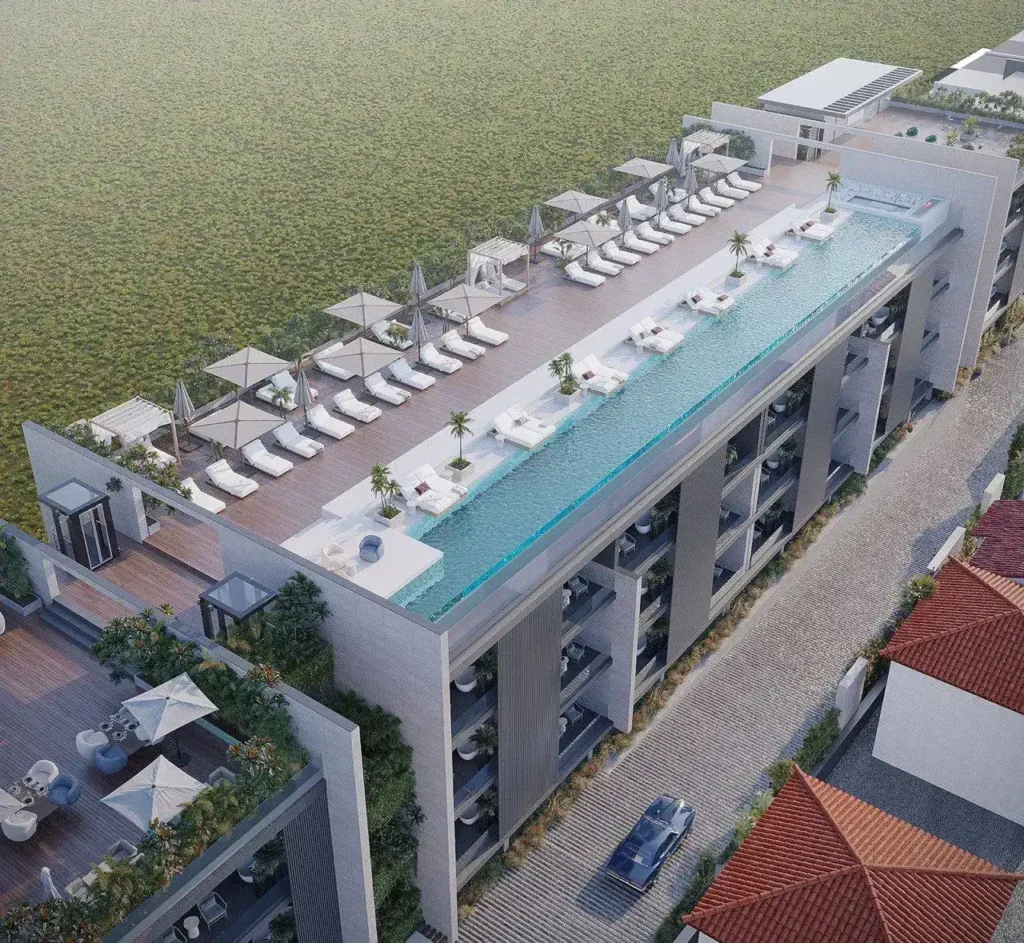
Villas form a visible part of Legian’s current property inventory, alongside guesthouses, hospitality assets, commercial premises and a smaller selection of apartments or serviced residences. Many villa listings are relatively compact because of the area’s dense urban fabric, but the mix changes over time and should be checked against current inventory.

 Bali,Cemagi
 from 48,5м²
 Bali,Batu Balongfrom 90м²
 Bali,Berawafrom 71м²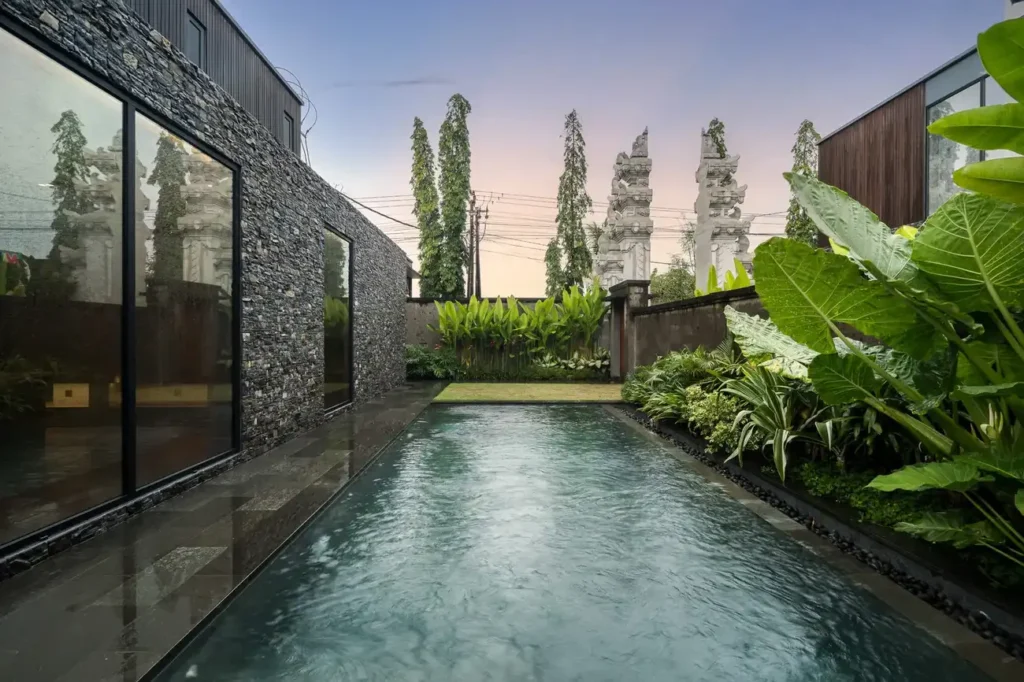
Small villa complexes usually consist of several units on a single plot, with shared facilities such as a swimming pool, reception area, and property management service. This format can be particularly convenient for investors: the entry threshold is lower, professional management is often already in place, and the property can be compared more easily with competing rental products in the area.
Apartments and serviced residences represent a less prominent segment in Legian than in some other parts of Bali. Some properties operate under a hybrid model, with a portion of the units managed as hotel accommodation while others are sold to individual investors.
Hotels and other hospitality properties include guesthouses, boutique hotels, and small lodges. Acquiring an operating hospitality business requires a different level of due diligence and operational expertise. Buyers need to assess not only the property’s legal status, but also the underlying business model, operating performance, and financial viability.
Land is available, but high-quality plots close to the beach are extremely scarce and expensive. Most undeveloped parcels are located farther inland.
Commercial properties include retail units, restaurants, and premises suitable for spas and other service businesses. This part of the market requires separate analysis, particularly in relation to permitted use, licensing, and zoning regulations.
There are also two practical considerations that buyers in Legian often underestimate:
Access and road width. In such a densely developed urban environment, a property may be accessible only via a narrow lane. This can affect guest arrivals, deliveries, property management operations, and the overall experience of the property. Narrow access is not necessarily a deal-breaker, but it should be factored into the valuation and investment assessment.
Parking. Parking is genuinely difficult in central Legian. A property with its own dedicated parking is relatively rare and therefore carries tangible market value, particularly for tenants or guests who use a car.
What Affects Property Prices
Property prices in Legian are shaped by a combination of factors, none of which should be considered in isolation.
Distance from the beach is one of the most important pricing factors. Properties with direct beach access or located within a five-minute walk of the shoreline command substantially higher prices than comparable properties tucked away in inland lanes. The difference can be significant.
Legal title and the remaining leasehold term have a direct impact on value. From an investor’s perspective, a leasehold property with 10 years remaining and the same property with 25 years left on the lease are fundamentally different assets. Lease extension terms must therefore be reviewed separately for each individual agreement.
Zoning and land-use designation determine what can legally be done with a property. A buyer planning to generate rental income should verify separately whether the property’s zoning, approved building function and intended operating model are compatible. Short-term tourist accommodation may also trigger business-licensing and operational requirements that are different from those relevant to an ordinary residential lease. The required approvals depend on the type of accommodation and operating structure and should be checked through the applicable local and OSS licensing framework. A mismatch between a property’s actual use and its zoning is a common issue across the Bali property market.
Permits and compliance documentation also matter. Building documentation should be verified as part of due diligence. Under the current framework, PBG is the approval used for building construction and specified alterations, while SLF certifies that a building is fit for its approved function. For older completed buildings, a valid IMB issued before the introduction of PBG may remain relevant under the transitional rules, so the required documentation should be assessed according to the building’s age, construction history and any subsequent modifications.
The number of bedrooms, the condition of the property, and the size of the land plot influence pricing in the expected way: more bedrooms generally mean a higher price, but also a higher entry point for buyers. Compact two-bedroom villas generally require a lower entry budget than larger properties and may appeal to buyers seeking a manageable property for personal use or rental. Their resale potential still depends on location, remaining tenure, legal documentation, condition, access, and asking price.
The management model is particularly important for investment properties. An established management company, a proven occupancy history, and a strong reputation on OTA platforms can all add value when a property is being sold as an operating rental business.
Noise levels are another factor that rarely appears in property listings but can have a real impact on guest appeal and, ultimately, value. Proximity to a nightlife or bar street may be a drawback for guests seeking a quiet stay, while potentially being an advantage for a younger audience looking to be close to the action.
Real Estate Prices
Property prices shown in Bali real estate listings are asking prices—the prices sellers are seeking. They should not be treated as equivalent to actual transaction prices, which are generally not disclosed publicly. The final sale price may differ from the advertised figure, sometimes significantly.
Property prices in Legian span a wide range and depend on a combination of factors, including property type, the exact location within the area, legal structure, remaining leasehold term, physical condition, and the availability of the required permits and documentation. For this reason, it is impossible to provide a single “average price per square metre” that would serve as a meaningful benchmark. Such a figure would obscure fundamental differences between, for example, a beachfront villa with a long remaining leasehold and a compact apartment on an inland lane with only 10–12 years left on the lease.
One of the most important—and often overlooked—factors affecting value is the remaining leasehold term. A leasehold property is not ownership in the conventional sense; it is a right to use the property for a defined period. Two otherwise similar properties with eight years and 25 years remaining on their leases are fundamentally different assets. For an investor, this is more than a legal technicality: a short remaining term means that a substantial portion of the value originally paid for the leasehold right has already been consumed, which will also affect the property’s resale value. A simple example illustrates the point: if a villa is worth X with 25 years remaining on the lease, the same villa with only 10 years left—and no confirmed extension terms—should not be valued at X, even though the physical property itself is identical.
Proximity to the beach is an important pricing consideration in Legian, but the premium cannot be reduced to a fixed percentage or walking-time rule. Two similarly sized properties can differ substantially in asking price because of their exact location, remaining tenure, legal structure, road access, parking, condition, and rental suitability. This is driven not only by stronger tourist rental demand, but also by basic liquidity: Proximity to the beach can broaden the property’s appeal to tourism-oriented buyers and guests, but resale speed still depends on asking price, tenure, legal status, property condition and market conditions at the time of sale.
Bali’s tourism activity recovered strongly after the pandemic, but this alone does not establish how much property values in Legian have changed. Current asking prices should therefore be assessed through recent comparable listings and, where available, completed transaction evidence rather than inferred from tourism growth. This makes comparison especially important: an asking price should be tested against recent comparable listings, the property’s tenure and documentation, physical condition, and any reliable evidence of completed transactions that is available.
Based on current market listings, the picture can be broadly summarised as follows:
| Property type | What is typically offered | Main price drivers | Best suited to |
|---|---|---|---|
| 2-bedroom leasehold villa | Compact property, usually with a pool and moderate distance from the beach | Remaining lease term, access, condition, noise levels | Short-term rental, personal use |
| 3–4-bedroom leasehold villa | Larger plot or a beachside location | Proximity to the beach, parking, management setup | Premium rentals, value-add strategy |
| Unit within a villa complex | Part of a managed development with shared facilities | Management model, occupancy history, OTA rating | Passive rental investment |
| Operational hospitality property | Existing guesthouse or boutique hotel | Financial track record, zoning, staff, licences | Operating business or restructuring |
| Land plot | Relatively rare in strong locations | Distance from the beach, plot size, access, zoning | New development, long-term holding |
Current asking prices in USD vary considerably—from several hundred thousand dollars for a compact leasehold property to several million dollars for a large villa or commercial asset in a prime location. Fixed price ranges can become outdated quickly and may conceal major differences in tenure, legal structure, location and property condition. Current listings are useful for understanding seller expectations, but they should not automatically be treated as evidence of completed transaction prices.
If a specific price range is critical to the decision-making process, the most reliable approach is to request up-to-date market information from professionals who work with actual transactions rather than relying on outdated aggregated data or screenshots of old listings.
Investment Potential of Legian
Legian is a mature tourism market. The investment case here is not based on expectations of future infrastructure development or the area suddenly being “discovered,” but on an already established tourist flow, strong destination recognition, and proximity to the beach. This fundamentally distinguishes Legian from emerging areas, where part of a property’s value is tied to anticipated future growth.
According to BPS-Statistics Indonesia for Bali Province, Bali recorded 572,668 direct international tourist arrivals in December 2025, up 18.48% from November. This illustrates the scale of tourism activity at island level, but it should not be used as a proxy for the occupancy or revenue of a particular villa in Legian. Property-level performance must be assessed using the asset’s own operating history and relevant comparable accommodation data.

Seasonality is a genuine factor that directly affects the investment model. Bali’s accommodation market is seasonal, but the pattern varies by year, property type and guest segment. BPS data show strong hotel occupancy during July and August 2025, while December also recorded substantial international arrivals. For an individual Legian villa, however, seasonal assumptions should be built from its own booking history and relevant comparable properties rather than from a fixed island-wide “high season/low season” calendar. An annual financial model should therefore use full-year assumptions rather than extrapolating the strongest weeks across all twelve months. Where historical property-level data are available, occupancy and ADR should be analysed month by month so that seasonal fluctuations are reflected in the projection.
Competition from hotels is a structural feature of the Legian market. Unlike more residential areas, villas here compete not only with other villas but also with a broad range of hotels, from budget guesthouses to small boutique properties. Hotels invest heavily in marketing, often have established review profiles, and sell inventory across multiple distribution channels at the same time. For properties that rely heavily on OTA bookings, review scores, listing quality, pricing and professional management can materially influence their ability to compete for guests.
The exit strategy in a mature market also differs from that of a developing area. The exit strategy in an established district such as Legian should be assessed at property level rather than based on assumptions about future area-wide appreciation. Resale prospects depend on factors such as the remaining lease term, legal structure, property condition, access, asking price, buyer demand and prevailing market conditions at the time of exit. This is not inherently a disadvantage, but it requires a different approach to planning the investment horizon.
Legian is a long-established tourism destination with strong international recognition. That familiarity may support repeat visitation, but property-level demand should still be evaluated from actual booking history and comparable accommodation data rather than assumed from the area’s reputation. The area also appeals to a broad range of guests, including surfers, couples, families with children, and independent travellers in the mid-market segment.
The return on an investment property cannot be assessed solely on the basis of its nightly rental rate. Gross revenue is only the top line. The investor’s actual return is determined after all operating costs have been deducted and real occupancy levels, including the low season, have been taken into account.
What to verify in the investment model:
- Actual occupancy — not the figure quoted by the management company, but occupancy supported by booking history and OTA platform data, including low-season performance
- OTA commissions and platform fees — calculate them using the actual commercial terms of Airbnb, Booking.com or any other distribution channel used by the property. Fee structures differ by platform, account and operating model, so a generic percentage should not be assumed.
- Management fees — use the percentage or fixed fee stated in the actual management agreement and check exactly which services are included. Contracts may differ significantly in how they treat marketing, OTA management, housekeeping, staffing, maintenance and owner use.
- Operating expenses — electricity, particularly for air conditioning and pool equipment, as well as water, cleaning, consumables, and internet
- Staffing and service costs — depending on the operating model, these may include housekeeping, guest support, pool and garden maintenance, security or other services. The financial model should use the actual staffing arrangement and contracts planned for the property
- Maintenance — pool servicing, equipment upkeep, and routine repairs; tropical conditions generally accelerate wear compared with temperate climates
- Taxes — rental income in Indonesia is taxable, while applicable rates and payment procedures depend on the ownership structure and the landlord’s legal and tax status
- Remaining leasehold term — a shorter remaining term changes the economics of the investment and can narrow the potential buyer pool at resale. The asset should therefore be evaluated over the actual remaining contractual period, including any documented extension rights and costs.
- Periods of downtime — scheduled maintenance, seasonal vacancies, and force majeure events; The model should include a separate allowance for vacancy, scheduled maintenance, repairs and other periods when the property cannot be rented. The appropriate number of downtime days should be based on the property’s own operating history or conservative assumptions supported by comparable assets, not on a universal fixed figure.
An illustrative scenario, without using specific figures that would be inappropriate without verified market data, might look as follows: if a property is rented for a certain number of nights per year at a given average nightly rate, this produces gross revenue of X. Once management fees, OTA commissions, staffing costs, utilities, maintenance expenses, and taxes are deducted, the investor’s actual net income will be substantially lower. It is this net figure that should form the basis of an investment decision, rather than an advertised “gross yield.”
Which Strategies Is Legian Best Suited For?
| Strategy | Why Legian Works | Main Risk | What to Focus On |
|---|---|---|---|
| Short-term tourist rentals | Consistent tourist demand, proximity to the beach, and strong destination recognition | Intense competition and the need for active management | Micro-location, access, and the management model |
| Personal use + rental income | Strong day-to-day infrastructure and the ability to rent the property while you are away | Reduced income potential when the property is partly reserved for personal use | Legal status and permission for commercial rentals |
| Buying an operating property | Verified income history and an established customer base | The purchase price already reflects the value of the operating business, while existing issues may be inherited | Financial track record, documentation, and property condition |
| Value-add / renovation | Opportunity to improve the property and increase achievable rental rates | Difficulty finding suitable assets, plus renovation and permitting risks | Improvement potential, current zoning, and access |
| Long-term ownership of a high-quality asset | Exposure to an established tourism location with existing infrastructure and visitor activity | Future capital appreciation cannot be assumed | Location quality, remaining tenure, and legal due diligence |
Each of these strategies calls for a different type of property, a different entry budget, and a different level of involvement in day-to-day management. The key question is not, “Is Legian a good place to invest?” but rather, “Does this particular property in Legian align with my specific investment goals?”
How Foreigners Can Legally Hold Property in Indonesia
Indonesian law distinguishes between several forms of land and property rights. Foreign nationals cannot directly hold Hak Milik, Indonesia’s strongest form of freehold land title, but they may obtain certain residential property rights through structures permitted by law, including Hak Pakai in qualifying cases. The appropriate structure depends on the property, the buyer’s immigration status, intended use, and other regulatory requirements.
Hak Milik (Freehold) is the strongest form of land ownership under Indonesian law. It is available exclusively to Indonesian citizens. A foreign national cannot register Hak Milik directly in their own name, regardless of the purchase price or how long they have lived in Indonesia.
Hak Sewa (Leasehold) is a long-term lease and, in practice, one of the most common ways for foreigners to secure rights to property. The duration of a private leasehold arrangement is determined by the agreement between the parties rather than by a universal statutory 25- or 30-year term. Long leases and contractual extension mechanisms are common in Bali’s foreign-buyer market, but the initial term, extension rights, future extension price and conditions should be checked in the individual agreement. Leasehold does not transfer ownership of the land; it grants the right to use the property for an agreed period.

This is also where many buyers encounter problems. Extension terms may be missing or vaguely worded, the future extension price may not be fixed, and the agreement may fail to specify what happens if the landowner sells the property to a third party. Every leasehold agreement therefore needs to be reviewed individually. There is no universal “standard” lease agreement on the market that provides the same level of protection to every buyer.
Hak Pakai (Right of Use) is one of the land-right structures that may be available to foreign nationals for qualifying residential property. Under Government Regulation No. 18 of 2021, foreigners eligible to own residential houses or residences must hold immigration documents in accordance with Indonesian law. The permitted property type, underlying land right, applicable minimum purchase value and other restrictions must also be checked for the specific transaction. Because these requirements can change and depend on the asset and buyer, eligibility should be confirmed with an independent PPAT/notary or Indonesian property lawyer before signing.
HGB (Hak Guna Bangunan) is the right to construct and use buildings on land. It is available to legal entities registered in Indonesia, including foreign investment companies known as PT PMA. It is not directly available to an individual foreign national.
PT PMA is an Indonesian limited liability company established under Indonesia’s foreign-investment framework and involving foreign shareholding. Depending on its licensed business activities and the specific property structure, a PT PMA may qualify to hold certain land rights such as HGB. Establishing a PT PMA solely to acquire property should not be treated as a universal solution: investment, licensing, corporate, reporting, tax and permitted-business requirements must be assessed separately.
Common leasehold mistakes that can be avoided include failing to verify whether the agreement has been properly recorded or registered where required, failing to define the extension price or a clear pricing mechanism at the time of signing, failing to establish what happens if the land is sold to a third party, and failing to confirm who the actual legal rights holder is and whether the land is subject to mortgages, claims, encumbrances, or other restrictions.
Nominee arrangements require particular caution. Registering property in the name of an Indonesian citizen while the purchase is actually financed and controlled by a foreigner is neither a standard nor a secure way to circumvent ownership restrictions. Such arrangements can expose the foreign buyer to substantial legal risk, including the possibility of losing the asset without effective legal protection. They should not be treated as normal practice, regardless of how a seller, intermediary, or agent presents them.
The appropriate legal structure in any individual transaction depends on the type of property, its intended use, whether a legal entity is involved, and the legislation in force at the time of purchase. Independent legal due diligence should be carried out before entering into any transaction.
Documents and issues to verify before signing an agreement:
- The land certificate and the current underlying right, including its type, number, validity period, and registered rights holder
- Zoning and permitted land use, including whether they are consistent with the property’s current or intended use
- PBG (Persetujuan Bangunan Gedung), the applicable building approval for the property
- SLF (Sertifikat Laik Fungsi), the certificate confirming that the building is fit for its approved functional use
- The width and legal status of the access road, including whether it is private or public and whether any easement or access right exists
- Any encumbrances, restrictions, claims, mortgages, or other limitations affecting the property or land
- The exact leasehold term, including the commencement and expiry dates, as well as the extension conditions and extension price or pricing mechanism
- The tax treatment of the transaction should be established before signing. Depending on whether the transaction involves a transfer of registered land/building rights, a lease, a company structure or another arrangement, different Indonesian taxes may apply to the parties. Do not assume that BPHTB, final PPh or any particular rate applies identically to every Bali property transaction; the tax treatment should be confirmed for the specific structure.
- Any permit required for commercial use or short-term rental, where applicable; such permission is separate and does not arise automatically from the underlying right to use the land
- The history of previous agreements, transfers, and changes in rights relating to the property
Legian vs Other Areas of Bali

There is no universal answer to the question, “Which area is best?” The right choice depends entirely on what matters most to the individual buyer. The comparison below looks at Legian alongside neighboring and alternative locations to help identify where a buyer’s priorities and a particular area align most effectively.
Kuta is Legian’s closest neighbor to the south. Its infrastructure is more mass-market and geared toward the broadest possible tourist audience, with large shopping centers, skate parks, dense rows of souvenir shops, and heavy traffic. Noise levels and development density are generally higher in Kuta than in Legian. Historically, the entry price for real estate has also been lower, although the rental market tends to attract a less demanding audience. For a closer look at the local market, see the complete guide to Kuta.
Seminyak, to the north, has a distinctly different character. It attracts a more mature and affluent crowd, with higher-end restaurants and boutiques and less of the mass-tourism intensity associated with Kuta. Property prices are generally higher than in Legian, reflecting both the status of the location and the profile of its visitors. Investors may be able to command higher rental rates in Seminyak, but the cost of entry is also higher. For a detailed overview, see the Seminyak area guide.
Canggu, north of Seminyak, has undergone significant development in recent years and has attracted a strong community of digital nomads, surfers, and expatriates. The supply of newly built properties is broader here, and part of the investment case is based on expectations of continued area growth. Traffic in some parts of Canggu has become comparable to that of Bali’s established southern resort districts. Infrastructure is also more dispersed than in Legian. For more information, see the complete guide to Canggu.
Uluwatu, on the Bukit Peninsula south of the airport, offers an entirely different setting: dramatic cliffs, ocean views, world-class surfing, and more widely dispersed infrastructure. The area is developing rapidly, and several locations across Bukit are attractive from an investment perspective. However, both the lifestyle and the target audience are fundamentally different from those in Legian. For a full analysis, see the Uluwatu area guide.
Sanur, on Bali’s quieter east coast, appeals more strongly to families and expatriates and offers convenient access to Nusa Penida. The beach is calmer, without the surf breaks found on the west coast, and the overall atmosphere is less intensely tourist-oriented. The property market is developing, but the reasons for choosing Sanur are quite different from those that typically lead buyers to Legian. For more information, see the complete guide to Sanur.
| Area | Atmosphere | Main Demand | Real Estate | Investment Profile |
|---|---|---|---|---|
| Legian | Active resort area with a strong tourism focus | Surfers, couples, families, leisure travelers | Villas, residential complexes, hotels; mature market | Established tourism market; asset selection and competition are key |
| Kuta | Mass tourism, younger crowd | Budget travelers, groups | Guesthouses, aparthotels, commercial property | Mature mass-tourism market with strong accommodation competition |
| Seminyak | More mature and affluent | Couples, higher-spending tourists | High-end villas, boutique hotels | Higher-end tourism positioning with typically higher acquisition costs |
| Canggu | Expat, digital-nomad, and surf-oriented | Long-term tenants, tourists | Broad range of new developments and property formats | Extensive recent development; supply and micro-location require careful analysis |
| Sanur | Quiet, family-oriented, popular with expatriates | Families, long-term residents | Villas, houses, selected residential complexes | More residential and long-stay-oriented market profile |
| Uluwatu | Surf destination with natural scenery and ocean views | Surfers, luxury travelers | Cliff-top villas, cliffside properties | Rapidly developing market with significant differences between micro-locations |
Who Is Legian Best Suited For?
Legian is not the right choice for everyone, and acknowledging that is important. Understanding who the area suits—and who may be better served elsewhere—can help buyers avoid purchasing a property that does not match their real expectations.
Best suited for:
Short-term rental investors considering an established tourism destination. Legian already has substantial accommodation infrastructure and broad destination recognition, although the performance of an individual property still depends on its micro-location, pricing, condition, management and competitive positioning.
Buyers who prioritize walking distance to the beach. If proximity to the sea is a requirement rather than a bonus, the number of suitable areas becomes much smaller. In this respect, Legian remains highly competitive.
Those who value established infrastructure. Cafés, restaurants, spas, convenience stores, and everyday services are already in place and operating. There is no need to wait for the neighborhood to “mature.”
Buyers looking for an existing, operational property who would prefer to acquire a functioning business or income-producing asset rather than build one from scratch.
Those who value Legian’s position between Kuta and Seminyak. For some buyers, this balance is precisely the attraction: less intense than Kuta, yet generally more accessible in price than Seminyak.
May not be suitable for:
Anyone looking for peace, privacy, and seclusion. Legian is an active tourist district, and that is an inherent part of its character. Quiet lanes do exist, but they remain close to the area’s main tourism corridors.
Investors whose strategy depends entirely on the future transformation of an emerging district. Legian is not waiting for a new beach to open or for a major developer to arrive and redefine the area. It is already a mature market.
Buyers seeking a large plot near the beach at a relatively low entry price. Legian’s dense development means such opportunities are limited, and buyers should compare current inventory rather than assume that suitable plots will be readily available.
Those for whom easy, free-flowing car travel is essential to everyday comfort. Traffic across southern Bali can be challenging, and Legian is no exception.
How to Choose a Property in Legian

Buying property in Legian requires a structured due diligence process rather than a decision based on photographs or a first viewing. The practical framework below helps bring discipline and clarity to the evaluation process.
1. Define your objective. Short-term rentals, personal use, long-term ownership, and operating a hospitality business each call for a different type of property. This is the first step; without a clear objective, comparing properties becomes largely meaningless.
2. Choose the right micro-location. Beachfront areas, Jalan Padma, and the quieter interior streets all offer different trade-offs in terms of noise, traffic, walkability, and investment appeal. Walk the route from the property to the beach yourself and assess how convenient it actually is in real-life conditions.
3. Assess traffic and noise at different times of day. Visit the property in the morning, during the day, and in the evening. Night-time noise from a bar in the next block is not a minor inconvenience; for a rental property, it is an operational factor that can directly affect guest satisfaction and performance.
4. Verify the legal status. Check the ownership or usage-right structure, the remaining leasehold term, extension conditions, zoning compliance, and the availability of PBG and SLF permits. Without legal clarity, the rest of the analysis has little value.
5. Evaluate physical access. Consider the width of the access road, whether a car can reach the property, and whether parking is available. A narrow lane with no parking is not necessarily a deal-breaker, but it must be reflected realistically in the financial model.
6. Study the competitive environment. Identify nearby rental properties, the rates they charge, and their occupancy levels based on whatever data is available through OTAs. This is genuine market intelligence, not the marketing narrative provided by a management company.
7. Build a conservative financial model. Use realistic occupancy assumptions, include all operating expenses, and avoid overly optimistic projections. If the investment only works under near-maximum occupancy and unusually low costs, that should be treated as a clear risk factor.
8. Review the management structure. If the property is intended to be operated through a management company, examine the management agreement, fee structure, termination provisions, and the company’s operating track record.
9. Commission an independent legal review. Do not rely solely on documents supplied by the seller or the seller’s agent. Engage independent legal counsel and, where the transaction requires a land deed or land-right registration, an appropriately authorised PPAT. The advisers should act independently of the seller and verify the transaction structure, title, encumbrances and required documentation.
10. Make the decision only after completing full due diligence. Neither the urgency of an offer nor claims such as “the best price is available only today” are valid reasons to skip any stage of the verification process.
If you are comparing Legian with other areas of Bali based on your budget, preferred property format, and investment objectives, World Estate Homes can help you structure the decision — complete our short property selection questionnaire.
Legian: A Balanced Assessment
Legian is compelling not because it is an undiscovered destination or because it promises dramatic future transformation. Its appeal lies elsewhere: in the combination of a beachside setting, consistent tourist demand, well-established infrastructure, and a convenient location between two of Bali’s better-known neighboring areas. This is a mature market where property prices already reflect the location’s established status rather than expectations of what it might become in the future.
For an investor, Legian provides exposure to an established tourism location rather than a purely speculative growth story. Short-term accommodation is one possible operating strategy, but its viability must be assessed for the individual property, including permitted use, licensing, seasonality, competitive supply, management costs, lease term and actual historical occupancy where available.
Investment performance in Legian depends on several variables working together: the property’s precise location, the legal structure under which it is held and the remaining term of those rights, the quality of management, actual rather than advertised occupancy, and whether the acquisition price was justified once all associated costs are taken into account.
Legian is best suited to buyers who understand the market and are looking neither for the lowest possible entry price nor for the most dramatic capital-growth story, but for an established location with resilient demand and a beach within walking distance. Buyers seeking something different — greater tranquility, large-scale neighborhood transformation, a sizeable plot at a low price, or the highest level of premium positioning — may find other parts of the island more suitable.
Any property purchase in Bali requires thorough due diligence on the specific asset, independent legal review, and a financial model based on conservative assumptions rather than optimistic projections. Legian is no exception; these principles are just as important here as they are anywhere else on the island.
 Real estate in Georgia
 Real estate in Cyprus
 Real estate in the UAE
 Real estate in Montenegro
 Real estate in Thailand
 Real estate in Spain
 Real estate in Saudi Arabia
 Real estate in Turkey
 Real estate in Zanzibar
 +62 895 001 924 667
 hello@ulu-homes.id
 Tibubeneng, Canggu, Kuta Utara, Badung Regency, Bali 80361, Indonesia



 Get catalogue of TOP-7 objects