
 +62 895 001 924 667


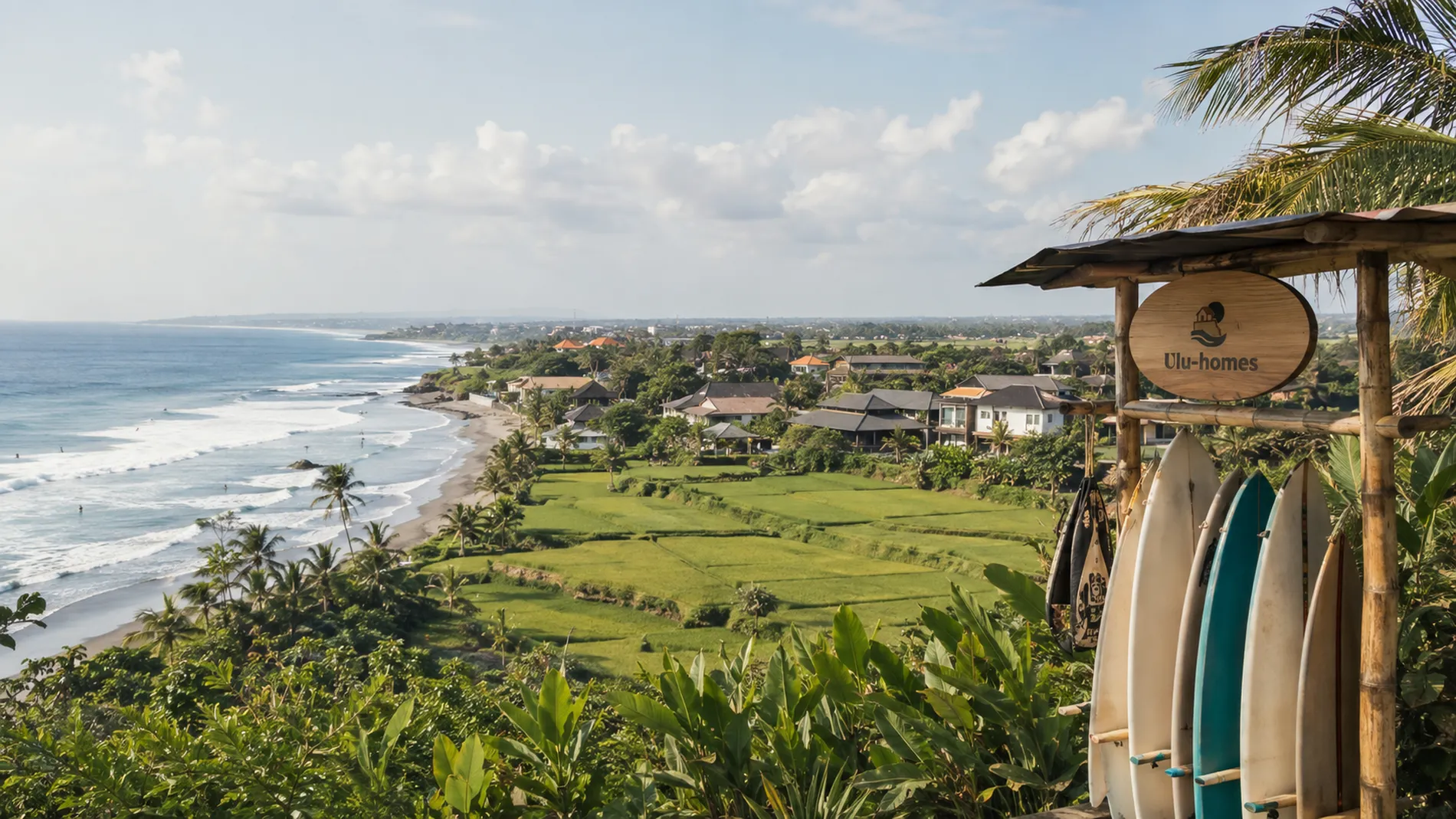

Pererenan sits at the northwestern edge of what residents and real estate professionals often call the “Canggu corridor” — the stretch of Bali’s west coast that, over the past decade, has developed into one of the island’s densest concentrations of villas, cafés, yoga studios, and surf spots. Administratively, the area lies within Badung Regency (Kabupaten Badung), with Pererenan Village (Desa Pererenan) forming part of the Mengwi subdistrict. It is not a separate tourist zone with sharply defined boundaries, but rather a residential area with its own beach, a rapidly expanding commercial scene, and a growing supply of modern villas.
Just a few years ago, Pererenan was still commonly described as the “quiet end of Canggu” — the place people moved to when they had grown tired of Batu Bolong’s noise and central Canggu’s rising prices. That description is now outdated. The area has developed enough of its own infrastructure — cafés, restaurants, wellness concepts, and small independent shops — for residents to live comfortably without having to travel into Canggu every day. At the same time, development has become denser, property prices have risen, and the real estate market has developed its own internal logic, with different micro-locations, property formats, and investment models depending on the specific site. All of this makes Pererenan worthy of being analyzed as a destination and property market in its own right rather than simply as an extension of Canggu.
Key Takeaways
- Pererenan lies at the northwestern edge of the Canggu corridor and is administratively part of Mengwi in Badung Regency.
- The area combines convenient beach access with a relatively residential atmosphere and a growing café and restaurant scene.
- Modern villas are the dominant property format, while the land market remains active and the supply of off-plan projects continues to expand.
- Micro-location within Pererenan is critically important: distance from the beach, access-road width, and the character of surrounding development can significantly affect both property values and rental potential.
- Foreigners cannot directly acquire Indonesian property under freehold title (Hak Milik); structures potentially available to foreign buyers include contractual leasehold arrangements, Hak Pakai for qualifying foreign individuals, and corporate structures in which an Indonesian foreign-investment company (PT PMA) holds an eligible registered land right such as HGB, subject to the applicable legal requirements.
- Gross yield and net yield are fundamentally different metrics: net returns can be substantially lower once operating expenses are included.
- Comprehensive due diligence is essential before purchasing, including checks on zoning, building permits, land-use designation, and the legality of commercial operation.
Pererenan Property Market: Quick Answer
Pererenan is now a relatively mature part of the wider Canggu property corridor rather than a low-cost alternative to it. Asking prices vary substantially by micro-location, remaining lease term, property format, zoning, access, and construction quality. Compact leasehold villas can still enter the market below larger premium properties, but there is no reliable public database of completed Pererenan transactions from which to calculate a single official average price or yield. Investors should therefore compare current asking prices property by property and model returns using realistic occupancy, operating costs, taxes, management fees, and the exact lease structure.
Where Is Pererenan Located?
Pererenan is on Bali’s west coast, northwest of central Canggu and approximately 13–15 kilometers from Ngurah Rai International Airport. Administratively, it is a village in the Mengwi subdistrict of Badung Regency. In practice, Pererenan is often perceived as part of the broader “Canggu corridor,” although its infrastructure, development pattern, and pricing increasingly set it apart as a distinct area.
The main focal point is Pererenan Beach, a black volcanic-sand beach that connects southward with Echo Beach and the wider Canggu coastline. To the north, the coast continues toward Munggu and Seseh, where infrastructure is more limited and development density is lower. To the south, Pererenan blends almost seamlessly into the Echo Beach area, one of Canggu’s best-known clusters for surf cafés and beachfront restaurants.
Geographically, Pererenan is well positioned for reaching many of the key destinations in western Bali within a reasonable driving time — provided you are not traveling during peak hours. Traffic in Bali is highly unpredictable: a journey of only a few kilometers may take 10 minutes or 40, depending on the time of day, day of the week, and congestion on the main roads.
| Destination | Approximate Travel Time | What to Keep in Mind |
|---|---|---|
| Canggu / Batu Bolong | 5–15 minutes | Traffic on Jl. Batu Mejan and Jl. Pantai Batu Bolong can significantly increase journey times during peak periods |
| Berawa | 10–20 minutes | The route passes through densely developed parts of Canggu, where afternoon congestion is common |
| Seminyak | 20–40 minutes | The distance is relatively short, but cumulative coastal traffic can easily double travel time |
| Ngurah Rai Airport | 25–50 minutes | Depends heavily on the route and time of day; during peak periods, the journey can take closer to 50–60 minutes |
| Ubud | 60–90 minutes | The route is longer and more inland; congestion may be less intense in places, but travel times remain substantial |
Transport accessibility has a direct impact on the appeal and value of individual properties. A villa located 300 meters from Jalan Pantai Pererenan with convenient road access is a fundamentally different asset from a property 1.5 kilometers inland along a narrow gang — the local term for a small lane or alley.
Narrow access roads can reduce the property’s appeal to tenants, complicate guest logistics, and may also create additional insurance or legal due-diligence considerations. When assessing property in Pererenan, road access should not be treated as a secondary detail. It is one of the factors that can directly influence both marketability and price.
How Pererenan Is Laid Out
It would be a mistake to think of Pererenan as a single, uniform location on the map. Even though the village itself is relatively compact, micro-location has a major impact on both the living experience and a property’s investment profile. A villa with direct views of Pererenan Beach and a house set farther inland among the rice fields differ not only in price, but also in target tenant profile, noise levels, walkability, and potential resale liquidity.
“Pererenan” in a property listing is not a sufficiently precise description. Two villas in the same area can have very different investment profiles depending on the street, distance from the beach, bedroom views, and the width of the access road.
The coastal strip along Jalan Pantai Pererenan is generally positioned at the premium end of the local asking-price market, particularly where properties combine beach proximity with convenient road access Villas here are typically positioned for short-term rentals: proximity to the beach allows a property to be marketed as being within walking distance of the sea, which can be an important positioning advantage in the short-term rental market. Land in this area is expensive, plots tend to be smaller, and new supply is limited. The trade-off is greater exposure to noise from beachfront cafés and traffic, along with lower levels of privacy.
The streets 200–600 meters from the coast form Pererenan’s main residential belt. This is where much of the new villa stock is concentrated, ranging from compact one-bedroom units to larger family properties with three or four bedrooms. Walking to the beach is realistic, typically taking around five to ten minutes. Traffic is lighter than directly along the waterfront, and evening noise from the coastal strip is generally much less noticeable. This is also one of the most actively developed parts of Pererenan, which means buyers benefit from greater choice but also face the risk that views and surroundings may change as neighboring plots are developed.
The inland streets around the rice fields offer a very different lifestyle. Views over sawah — the local term for rice fields — are a meaningful marketing advantage, particularly for long-term rentals and buyers looking for a quieter setting. These properties are often less convenient to access, more dependent on private transport, and more vulnerable to losing their views if adjacent land is developed. Agricultural zoning, often referred to as zona hijau or “green zone,” should not be treated as an absolute guarantee against future construction; this requires separate verification during due diligence.
The direction toward Munggu and Seseh forms the northern edge of the area, where commercial infrastructure is considerably more limited and the atmosphere becomes increasingly rural. For buyers seeking maximum peace and quiet and who are comfortable relying more heavily on transport, this can offer an option with less pricing pressure. For short-term rental strategies, however, these locations require a more careful assessment of actual demand.
Properties closer to Canggu and Echo Beach benefit from easier access to more developed infrastructure, but sacrifice some of the calm that defines Pererenan. The boundary between Pererenan and Canggu can feel blurred in practical terms, and some properties marketed as being “in Pererenan” are effectively located in areas with the traffic patterns and overall character of central Canggu.
Micro-location clearly affects noise, traffic, and walkability. What is less obvious is that it can also directly shape rental rates, occupancy, and resale liquidity. A villa overlooking rice fields 1.2 kilometers from the beach and a property just 250 meters from Pererenan Beach may be similar in size and construction quality, yet operate under fundamentally different financial models.
Everyday Life
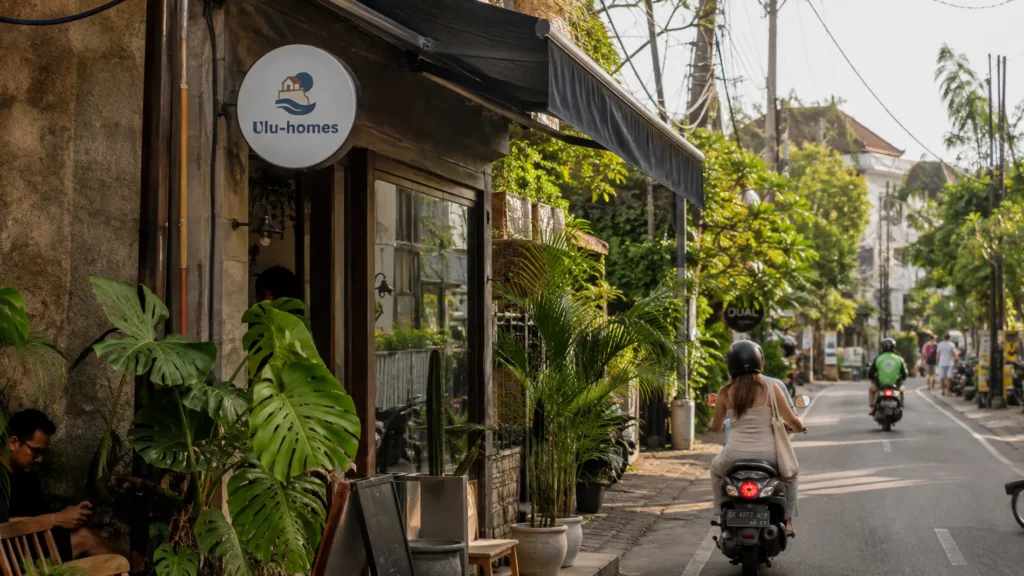
Daily life in Pererenan is shaped by several overlapping rhythms: an early surf session or time at the beach, coffee at an independent café before lunch, working from home or a nearby coworking space, and dinner at one of the area’s growing number of good restaurants. It is a lifestyle that appeals to a particular type of resident — digital nomads, remote professionals, freelancers, and couples looking for a quieter version of the Canggu lifestyle. But everyday reality is somewhat more complex than the Instagram image of the area suggests.
Beach and Surfing
Pererenan Beach is a long stretch of black volcanic sand, typical of Bali’s west coast. As elsewhere along this side of the island, sunset is one of the defining daily rituals. The beach itself is not highly resort-oriented: there are very few sun loungers and the infrastructure remains relatively minimal, something many residents see as part of its appeal.
Surfing is one of the main reasons people choose Pererenan. Pererenan is an established surf area, but conditions vary considerably by tide, swell, and the specific section of the beach. The main reef and beach-break sections are generally better suited to surfers with some experience; complete beginners should seek local instruction and choose a break appropriate to the conditions on the day. Compared with some of Canggu’s busiest surf spots, such as Old Man’s and Echo Beach, it can feel less crowded, although that changes during the high season from June to September. Describing it as an “empty beach” would no longer be accurate as a consistent characteristic: both the beach itself and the lineup have become noticeably busier in recent years.
Cafés and Restaurants
Pererenan’s dining scene has changed significantly. Four or five years ago, the choice was relatively limited; today, the area has a growing selection of notable cafés and restaurants aimed at an international audience, with specialty coffee, healthy food, Asian cuisine, and European-style concepts all represented. The scene continues to evolve, with new venues opening and others closing. For residents and rental demand, what matters most is the existence of a functioning café culture rather than any fixed list of establishments, which can change from year to year.
There are no full-scale European-style supermarkets in Pererenan itself. Instead, the area has local warungs — small neighborhood cafés or shops — along with several minimarkets. For a wider range of groceries, residents typically travel into Canggu or use local delivery services such as GoFood and GrabFood, as well as delivery from larger stores.
Fitness, Wellness, and Remote Work
Yoga studios, Pilates spaces, and wellness-focused businesses are present in the area and continue to open. There are relatively few full-scale coworking spaces in the strict sense of the term, so many remote workers use cafés with reliable Wi-Fi or rent private office space. Those who need a more developed work infrastructure can reach Canggu in around 10–15 minutes by scooter.
Pererenan’s gym infrastructure is more limited than in central Canggu, but there are still options, ranging from smaller local gyms to functional training studios.
Everyday Practicalities
This is one of the most important considerations for anyone looking at Pererenan as a place to live rather than simply somewhere to stay on holiday. A scooter or car is close to essential here: pedestrian infrastructure is limited, and many streets either have no sidewalks or only very narrow ones. Without personal transport, everyday errands can quickly become a logistical challenge.
Medical infrastructure within Pererenan itself is limited. Basic clinics are available nearby, while more comprehensive medical care can be found in Canggu, Seminyak, or Denpasar, including facilities such as BIMC Hospital and Kasih Ibu. International schools, an important consideration for families with children, are generally located in Canggu or farther afield, which should be factored into any decision about living in the area long term.
Utilities and internet generally function in line with what is typical for Bali. Connection speeds in most villas are sufficient for video calls and remote work, although reliability can vary. Occasional power outages are part of everyday life, and many villas are equipped with backup generators.
Who Is Pererenan Best Suited For?
Pererenan is not a one-size-fits-all destination. It is best considered with a clear understanding that different lifestyle and investment scenarios work very differently here.
Digital nomads and freelancers can find a good balance between quality of life and cost. There are cafés with reliable enough Wi-Fi, yoga studios, and surf spots within easy reach, all in a quieter setting than central Canggu. That said, the remote-work infrastructure is more limited. Anyone with a demanding work schedule may need to set up a proper home office or travel into Canggu for coworking facilities and a wider range of work-oriented spaces.
Couples without children looking for a lifestyle-focused place to live are likely to find much of what they want in Pererenan: easy beach access, cafés, relatively quiet evenings, and a solid selection of private pool villas available for long-term rent.
Families with children may face more practical limitations. International schools are located outside Pererenan, while limited walkability and relatively little child-focused infrastructure make the area a less obvious choice than Canggu or Berawa. Families who already live here comfortably typically have well-organized transport, their own vehicle, and a clearly planned school commute.
Surfers who prioritize proximity to the waves above almost everything else are likely to feel at home in Pererenan. The Pererenan break is a well-established option for experienced beginners progressing beyond their first lessons and for intermediate or more advanced surfers, depending on conditions.
Second-home buyers are among the profiles for whom Pererenan can make particular sense. Owning a villa for personal use for several weeks of the year and renting it out while away can be a workable model, provided the property is chosen carefully, professionally managed, and held under an appropriate and clearly understood legal structure.
Short-term rental investors need to assess the competitive landscape realistically. The villa rental market along Bali’s west coast is crowded, and performance depends less on the district name alone than on the individual property, its micro-location, positioning, and the quality of its management.
Long-term rental investors may find steady demand from expatriates and longer-term residents who value a quieter environment while remaining close to Canggu.
Pererenan is particularly well suited if you:
- want a quieter version of the Canggu lifestyle without giving up access to its infrastructure;
- are considering a private pool villa for your own use or for rental;
- want to be able to walk from home to a surf break;
- are comfortable getting around by scooter and do not require fully walkable infrastructure;
- are considering a hybrid model in which you live in the property for part of the year and rent it out for the rest.
The area may be less suitable if you need:
- a well-developed nightlife scene;
- international schools within walking distance;
- a dense network of coworking spaces;
- the ability to live comfortably without personal transport;
- upscale beachfront infrastructure with full-service amenities such as sun loungers and beach bars.
Real Estate in Pererenan
Pererenan’s real estate market has taken shape relatively recently, and its structure reflects the broader development pattern of the Canggu corridor: first came standalone villas built on land owned by local families, followed by professionally developed projects, boutique villa complexes, and increasingly sophisticated investment products. Today, the market is far more diversified, although villas remain by far the dominant property type.
A detailed analysis of the neighboring market and how it differs from Pererenan can be found in our complete guide to Canggu.
Property Types
Compact 1–2 bedroom villas are the most common investment format. These typically sit on relatively small plots of around 100–200 m², include a private pool and contemporary finishes, and are designed primarily for the short-term rental market. They are generally easier to position as income-generating properties, but competition in this segment is also high. Construction and finishing quality can vary significantly from one project to another.
3–4 bedroom family villas appeal both to owner-occupiers and to groups renting larger properties. These homes require more land and a higher budget, but with effective management they may achieve a higher ADR, or average daily rate.


 Bali,Batu Balong
 from 90м²
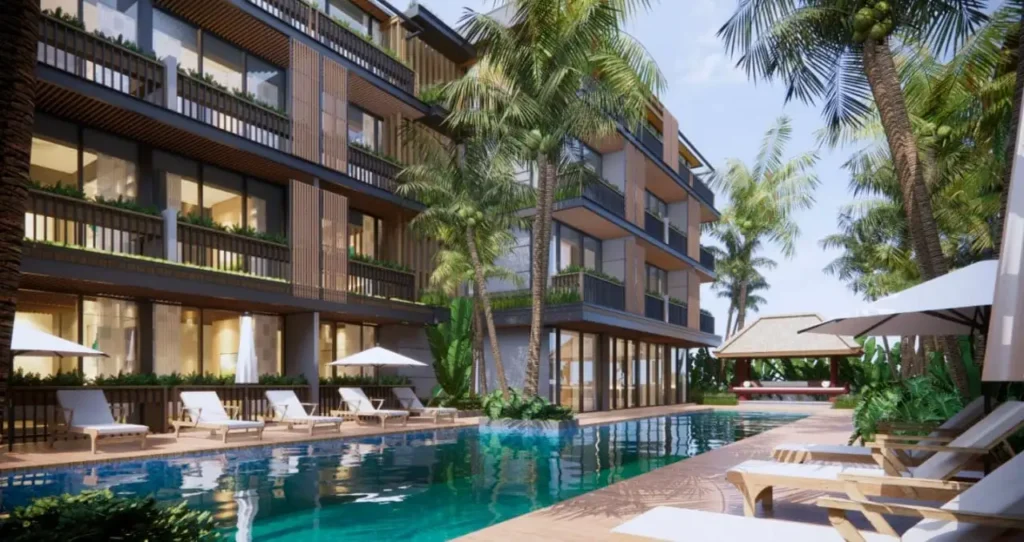
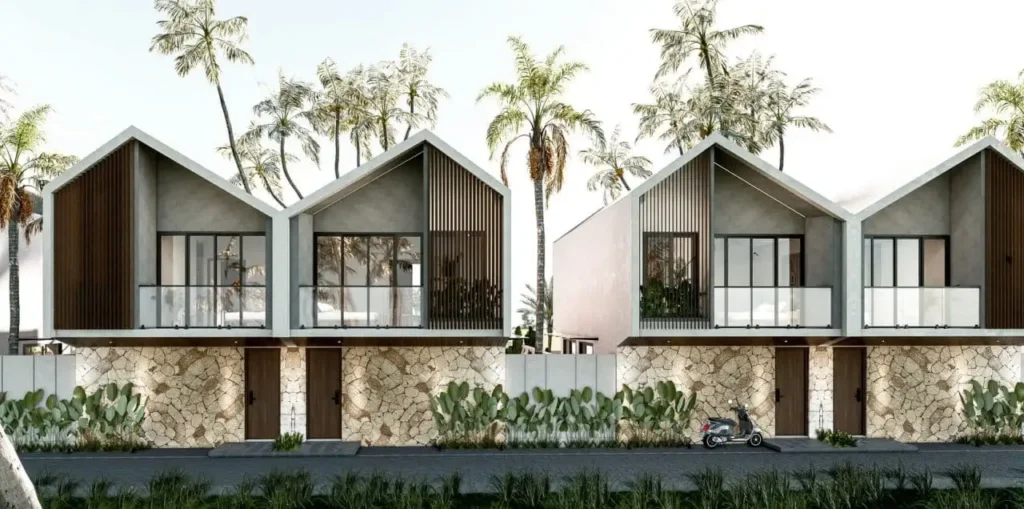

Boutique villa complexes are small-scale developments, typically comprising four to ten villas, with professional management, a shared reception area, and a more structured marketing approach. For investors who do not intend to manage the property themselves, this can be a relatively convenient format, provided that the management agreement is reviewed carefully and in detail.
Land plots and development lots form a separate segment for buyers prepared to build. Land is still available in Pererenan, although well-positioned plots close to the beach are becoming increasingly scarce. Buying land for an independent construction project requires its own due diligence process, including verification of zoning, permitted development parameters such as site coverage and building height, and the full chain of required permits and approvals.
Off-plan properties are offered by developers during the design or construction stage. They may provide a lower entry price and more attractive transaction terms, but they also involve construction risk, including delays, deviations from the promised specifications, and the need to examine construction guarantees and the developer’s track record carefully.
Apartments in the conventional Western sense — multi-unit residential buildings with individually owned flats — are not a typical format in Pererenan. The market remains primarily focused on villas and small-scale villa complexes.
What Affects Property Prices
The main pricing factors in Pererenan tend to follow a clear hierarchy. Distance from the beach and the quality of road access come first. The remaining leasehold term — in other words, the amount of time left on the land lease — is the second critical factor and is often underestimated by buyers. Construction quality, finishes, and furnishing form the third major layer of value. Beyond that, pricing is influenced by views, surrounding development, and the availability of professional property management.
| Property Type | Best Suited For | Main Price Drivers | Key Risks |
|---|---|---|---|
| 1-bedroom villa | Short-term rental investor, solo resident | Location, remaining leasehold term, quality of finishes | High competition within the segment, unstable occupancy |
| 2-bedroom villa | Couples, investors targeting families, lifestyle + rental use | Distance from the beach, access, views | Higher entry cost, more complex management |
| 3–4 bedroom villa | Families, group rentals | Plot size, pool, parking, infrastructure | Higher entry threshold, narrower target audience |
| Boutique villa complex | Passive investor | Management company reputation, leasehold term, location | Dependence on management quality, terms of the management agreement |
| Land / development plot | Experienced investor or developer | Zoning, development parameters, access | Construction risk, zoning issues, changes in regulations |
| Off-plan | Investor with a 1–3 year horizon | Developer reputation, escrow terms | Construction risk, delays, discrepancy between expectations and final delivery |
The key takeaway from the table is that buying a property without understanding the remaining leasehold term is one of the most common mistakes investors make. Two villas with the same floor area and similar finishes can be priced very differently if one has 20 years left on its leasehold and the other has 40. Comparing such properties purely on headline price, without adjusting for the remaining term of the underlying rights, is misleading.
Property Prices
There is no single official average property price for the Pererenan market. Transaction prices are not published in an open public registry, there is no aggregated market data for the village itself, and listings on online platforms reflect asking prices rather than the prices at which deals are actually completed. For that reason, it is more accurate to discuss asking-price ranges and the factors that influence pricing than to rely on fixed market averages.
The figures below are indicative asking-price ranges observed across the current Pererenan and wider Canggu–Pererenan market. They are not official transaction averages and should not be used to value a specific property without checking current comparable listings with similar lease terms, location, size, and legal status. The actual price of a specific property will depend on its micro-location, the remaining leasehold term, construction quality, and the terms of the individual transaction. All figures should be treated as market guidance rather than guaranteed transaction prices.
Because there is no public transaction database providing a reliable Pererenan-wide average, the ranges below should be treated as indicative asking-price observations rather than transaction benchmarks. The ranges should therefore be read as indicative asking-price observations rather than verified transaction averages. Meaningful comparisons require similar lease terms, bedroom counts, property condition, and micro-locations. Properties with materially different remaining lease terms should not be compared as though they were equivalent.
| Segment | Indicative Budget | Typical Format | Main Price Drivers |
|---|---|---|---|
| Compact 1-bedroom villa | From $120,000–200,000 (leasehold) | Approx. 1 bedroom, pool, up to 150 m² | Leasehold term, location, finishes |
| 2-bedroom villa | From $180,000–350,000 (leasehold) | 2 bedrooms, pool, 150–300 m² | Distance to the beach, views, management |
| 3+ bedroom villa | From $300,000–600,000+ (leasehold) | 3–4 bedrooms, pool, 300+ m² | Plot size, location, construction quality |
| Premium / boutique property | $600,000+ | Distinctive architecture, high-end finishes | Project brand, uniqueness of location |
| Land (leasehold) | Pricing varies substantially by micro-locationlease duration, zoning, road access, and proximity to the coast. | Development plot | Zoning, road width, distance to the beach |
Land in Pererenan is traditionally priced in are, with 1 are equal to 100 m². Prices per are vary considerably: coastal plots can command a substantial premium over land farther inland near the rice fields. When leasing land for development, the priority is not only to secure a fair price but also to confirm that the zoning permits the type of construction you intend to carry out.
Leasehold and value: a property with a 25-year leasehold and one with a 50-year leasehold are fundamentally different assets in terms of both value and investment profile. Leasehold, or Hak Sewa, is a temporary right of use rather than ownership of the land itself. As the remaining term becomes shorter, the economic value of the property generally declines, while resale and access to financing may become more difficult. A leasehold property advertised without clearly stating the remaining term and the extension conditions provides incomplete information and may give buyers a misleading impression of its true value.
When comparing two leasehold properties, record at minimum the asking price, remaining lease years, extension mechanism, land area, building area, zoning, road access, construction status, and permitted use. A lower headline price may simply reflect a shorter remaining lease or weaker legal and operational characteristics.
Investment calculations should reflect the currencies actually used in the transaction and operations. For a foreign investor, it can be useful to model the investment both in IDR and in the currency in which the investor holds or evaluates capital, while explicitly accounting for exchange-rate risk. Indonesian rupiah, or IDR, is commonly used for local payments, utility bills, and operating expenses. For investors whose capital is held in euros or another currency, exchange-rate exposure is an additional factor that should be incorporated into the financial model.
Pererenan or Canggu?
This is one of the most common questions buyers ask when choosing property on Bali’s west coast — and one where the simple answer, “Pererenan is quieter and cheaper,” no longer reflects reality. Both areas continue to develop, the price gap has narrowed, and Pererenan has established a lifestyle identity of its own rather than simply feeling like a smaller version of Canggu.
For a better sense of how the two areas differ, see our guide to what to see and do in Canggu, which helps illustrate the atmosphere of central Canggu compared with its quieter extension to the north.
| Criteria | Pererenan | Central Canggu |
|---|---|---|
| Atmosphere | Quieter, more residential | Lively and cosmopolitan |
| Development density | Lower, though increasing | High |
| Nightlife | Limited | Well developed, especially around Batu Bolong |
| Dining scene | Growing, with an expanding choice | Mature and highly diverse |
| Beach | Generally less crowded | Echo Beach and the Old Man’s area are highly popular |
| Surfing | Pererenan break is easily accessible | Several surf spots, with more competitive lineups |
| Traffic | Moderate, but increasing | Heavy, especially during peak hours |
| Property supply | Predominantly villas, with fewer options overall | Villas plus boutique developments, with a broader selection |
| Pricing | Highly dependent on micro-location, lease term, and development quality | Also highly variable, with established prime locations commanding significant premiums |
| Rental demand | Established demand, with increasing competition as new villa supply expands | High demand, but also strong competition |
| Resale market | Developing; liquidity varies significantly by property and remaining lease term | More established, although liquidity still depends heavily on price, property type, location, and legal structure |
| Development outlook | Still in an active growth phase | Already densely developed |
Who is Pererenan better suited to? Buyers who value relative peace and a slower pace of life while still having access to Canggu’s infrastructure; those who are comfortable with a smaller selection of restaurants and venues; and those looking for a slightly more accessible entry point into the market — or for properties with rice-field views and more space around the villa.
Who is central Canggu better suited to? Buyers who want established infrastructure — restaurants, coworking spaces, and nightlife — immediately at hand; those who prioritize a more mature and liquid property market; and people who value being able to walk to cafés and the beach without relying on a scooter.
Both can be good choices. The real question is not which area is “better,” but which lifestyle and investment model is the better fit for your specific goals.
Investment Potential

Pererenan’s investment appeal is driven not by any single factor, but by a combination of several: its proximity to Canggu and the resulting spillover demand from a more saturated market; a beach-oriented lifestyle with a relatively more accessible entry price; a growing restaurant and wellness scene; and a limited supply of high-quality coastal properties amid continued interest from international buyers.
Bali as a whole continues to attract a strong flow of visitors. According to official statistics from the Bali Government Tourism Office (2025 Tourism Statistics), tourist arrivals to the island remain at high levels. The west coast has historically been one of Bali’s most sought-after areas for short-term villa rentals.
Rental Demand
Rental demand in Pererenan comes from several distinct groups.
Short-term rentals primarily target tourists and surfers staying for one to four weeks. Peak periods typically fall in July–August and December–January, while occupancy tends to soften during the shoulder months. Competition in this segment is high: similar properties are available in Canggu, Berawa, and across Bali’s west coast, and all else being equal, guests may often choose a better-known location.
Medium-term stays, generally ranging from one month to three or even six months, are popular with digital nomads, freelancers, and couples looking for a seasonal base. Medium-term rentals use a different operating model from nightly stays: booking turnover is lower and individual stays are longer, while achievable monthly rates and annual income depend on season, property quality, lease terms, and current tenant demand
Long-term rentals, usually for one year or more, appeal to expatriates, residents, and families. Long-term rentals involve fewer guest turnovers and a different cost structure from nightly accommodation. They may reduce some operating complexity, but achievable rent, vacancy risk, maintenance obligations, and net returns still need to be assessed for the specific property.
Even villas within the same part of Pererenan can produce very different results depending on micro-location, property quality, marketing, management, and seasonality.
How to Verify a Rental Projection
Do not assess a villa using the developer’s projected occupancy and ADR alone. Ask for actual operating data from the property where available, then compare it with several genuinely comparable villas in the same micro-location and bedroom category. Check nightly rates across different months rather than only peak dates, review how many nights are actually available versus blocked for owner use, and distinguish booked occupancy from projected occupancy. The final model should include management, OTA fees, staffing, utilities, maintenance, insurance, taxes, vacancy, and a replacement reserve.
Gross vs. Net Yield: A Crucial Distinction
Gross yield is the ratio of annual rental income to the property’s purchase price before any expenses are deducted. This is the figure most commonly highlighted in marketing materials.
Net yield, by contrast, reflects the actual return after operating expenses. A realistic net-yield model should account for:
- property management fees based on the actual management agreement
- OTA commissions based on the platform and fee structure applicable to the listing
- utilities, including water, electricity, and gas;
- staffing costs, such as housekeeping, security, gardening, and, where relevant, a private chef;
- maintenance and repairs;
- a reserve for replacing furniture, appliances, and equipment;
- insurance;
- taxes, including PPh income tax and PPN VAT where applicable;
- vacancy periods when the property is not rented;
- marketing expenses.
The gap between gross revenue and net income can be substantial once management, platform commissions, utilities, staffing, maintenance, taxes, vacancy, and replacement reserves are included. The size of that gap must be calculated from the operating model of the individual property rather than assumed from a market-wide percentage. An investor comparing “15% gross” on one property with “8% net” on another is comparing two fundamentally different metrics.
Purely hypothetical calculation — the figures below are chosen only to demonstrate the difference between gross and net yield and should not be interpreted as current Pererenan market benchmarks. Assume, for illustration only, a two-bedroom leasehold villa purchased for $250,000, with hypothetical occupancy of 65% and a hypothetical ADR of $180, potential annual revenue would be approximately $42,700 before expenses, equivalent to a gross yield of around 17%. The gross figure should then be reduced by the actual management fee, OTA commissions, utilities, staffing, maintenance, taxes, vacancy allowance, insurance, and replacement reserves applicable to that specific villa. Only after those property-specific costs are known can a meaningful net yield be calculated. This is purely an illustrative example; actual performance will depend on the specific property, management quality, and market conditions.
What Is a Realistic Rental Yield in Pererenan?
There is no reliable official Pererenan-wide yield benchmark. Published market estimates vary considerably because different sources use different property types, occupancy assumptions, management costs, lease terms, and definitions of gross and net yield. For that reason, a credible investment assessment should start with the actual expected ADR and occupancy of comparable properties and then deduct the full operating cost stack. Any advertised yield should be treated as a scenario to verify, not as an expected return.
Capital Appreciation
Several factors may support future price growth in Pererenan:
- limited availability of attractive coastal plots and land bordering rice fields;
- continued expansion of the restaurant and commercial environment;
- improving quality among new development projects;
- spillover demand from Canggu, where many of the most desirable sites have already been developed;
- broader international interest in Bali as a property and lifestyle destination.
At the same time, there are important countervailing factors to consider:
- increasing new supply, as more villas mean greater competition and potential pressure on rental rates;
- worsening traffic and growing pressure on local infrastructure;
- the risk of losing rice-field views if neighboring plots are developed;
- inconsistent quality among new projects;
- possible changes to short-term rental regulation;
- potential oversupply of compact investment villas within certain price segments.
A good investment in Pererenan is not simply a villa in a popular area. The outcome depends on the micro-location, the duration and terms of the land rights, the permitted use of the site, the quality of the product, and a realistic assessment of operating costs.
Recent asking-price growth in parts of Bali should not be extrapolated into a guaranteed long-term appreciation rate. Future values will depend on supply, tourism demand, infrastructure, regulation, lease duration, property quality, and broader economic conditions. The market is cyclical, sensitive to tourism demand, and influenced by broader global economic conditions.
How Foreigners Can Own Property
The legal overview below reflects the framework reviewed as of August 2026. Indonesian land, investment, zoning, tax, and business-licensing rules can change, so the structure applicable to a specific transaction should be confirmed again before signing.
This is one of the most legally sensitive sections and requires particular precision: misunderstanding the ownership structure can be extremely costly. Indonesian land law places strict limits on the rights available to foreign individuals, and none of the available structures is an exact equivalent of the Western concept of buying property outright in full ownership.
The legal framework is set out in Government Regulation of the Republic of Indonesia No. 18 of 2021, which covers land rights, land registration, and rights over property. An official English translation is available through the Ministry of Agrarian Affairs and Spatial Planning / BPN.
Hak Milik (Freehold)
Hak Milik, the fullest form of land ownership, is available only to Indonesian citizens. A foreign individual cannot hold Hak Milik directly. Any arrangement involving the purchase of freehold property through a local nominee carries significant legal risk and is not officially recognized as a secure ownership structure.
Leasehold / Hak Sewa
In practice, one of the most common structures used by foreigners is a contractual leasehold arrangement, or Hak Sewa, under which the land is leased for an extended period. The duration of a contractual lease is determined by the agreement between the parties rather than by a universal 25- or 50-year statutory term. Long leases in Bali are often structured for several decades and may include extension provisions, but the exact term, extension mechanism, price formula, transfer rights, and form of the agreement must be reviewed for each transaction.
A leasehold is not ownership. If the lease expires without being extended, the right to use the land ends and control reverts to the landowner. For that reason, the remaining lease term and the extension provisions are critical factors when assessing any property.
The term, mechanism, and cost of extending the lease should be clearly and comprehensively set out in the agreement before it is signed. Verbal assurances and vague extension clauses create substantial legal risk.
Hak Pakai
Hak Pakai is a registered right of use that may, subject to statutory conditions, be available for residential property held by qualifying foreign nationals. Government Regulation No. 18 of 2021 requires foreign owners of qualifying residential property to hold the immigration documentation prescribed by Indonesian law and also applies restrictions relating to the type of property and other statutory limits.
It is a more formalized legal right than a contractual leasehold and is registered with the land authority, BPN. Eligibility requirements and restrictions must be reviewed in relation to the specific property, as the regulations include, among other things, requirements relating to property value and permitted use.
HGB Through a PT PMA
HGB (Hak Guna Bangunan), or the right to build, may be held by a legal entity incorporated in Indonesia. A PT PMA (Penanaman Modal Asing) is an Indonesian company with foreign investment. It can be used to conduct permitted business activities in Indonesia, but the company must comply with the applicable foreign-investment rules, KBLI business classification, OSS licensing requirements, capital requirements, and ongoing corporate and tax obligations.
Acquiring property through a PT PMA under an HGB title is a viable legal structure, but it comes with its own requirements, including company registration, compliance with capital requirements, corporate reporting, and the tax obligations applicable to a legal entity. It is not automatically more advantageous than a leasehold structure; the appropriate option depends on the circumstances of the transaction.
It is important to distinguish between the following:
- Contractual leasehold — a contractual right to use the property for an agreed period; unlike Hak Pakai or HGB, it is not itself a separately registered land title. The buyer’s rights therefore depend heavily on the wording of the lease, the underlying land title, the contracting party’s authority, and the enforceability of the agreement.
- Hak Pakai — a registered right of use available to an individual under qualifying conditions, offering a more formalized legal framework.
- HGB through a PT PMA — a corporate structure under which the company holds a registered right to build; the most complex of the three and accompanied by ongoing corporate obligations.
None of these structures removes the need for qualified legal due diligence on the specific property. The appropriate ownership structure depends on your residency status, the purpose of the acquisition, the type of property, and the legal status of the land itself. It is advisable to work with an independent notary (notaris) and/or a lawyer experienced in Indonesian land law who is not affiliated with the seller or the agency.
Where the transaction involves the creation or transfer of a registered land right, confirm whether a PPAT (Pejabat Pembuat Akta Tanah) must be involved. Notarial and PPAT functions are legally distinct even though the same professional may hold both appointments.
What to Check Before Buying

Due diligence when buying property in Pererenan is not a formality — it is essential. The market is still relatively young, transparency standards are lower than in more developed jurisdictions, and mistakes made during the verification stage can have serious financial consequences.
Below is a practical checklist covering the minimum level of due diligence:
- Legal status of the land — What is the official land title: Hak Milik, HGB, or Hak Pakai? Who is the registered legal owner?
- Owner / contracting party — Does the party named in the agreement match the actual registered owner in the BPN land records?
- Remaining leasehold term — Verify the exact number of years and months remaining on the lease. Do not rely on the original total term; what matters is how much time is actually left.
- Extension mechanism and price — How can the lease be extended, and on what terms? Is the extension price determined by a fixed formula, or will it be negotiated between the parties at the time of renewal?
- Land zoning — Which zoning category applies under the relevant RDTR/RTRW land-use plans? Is the plot designated for residential, commercial, agricultural, or another use? Zoning determines what may legally be built and how the property may be operated.
- Permitted intended use — Does the zoning allow the way you intend to use the property, such as residential occupation, short-term commercial rentals, or hospitality operations?
- PBG (Persetujuan Bangunan Gedung) — The building approval. Does the completed property comply with the issued approval in terms of floor area, number of storeys, and permitted use?
- SLF (Sertifikat Laik Fungsi) — The certificate confirming that the building is fit for its intended function, introduced under PP 16/2021. Its availability is particularly important where the property will be used commercially.
- Legality of commercial rentals — Having the correct PBG, SLF, and zoning does not automatically make short-term rentals legal. The entire licensing chain must be checked, from the permitted land use to the relevant business licence, including NIB and the appropriate KBLI classification for hospitality activities.
- Access road and legal right of access — Does the property have formal legal access via a recognised access road (jalan akses)? Is the road wide enough? Is it public, or does access cross a neighbouring parcel, and if so, on what legal basis?
- Water supply — What is the source: PDAM municipal water, a well, or delivered water? How reliable is the supply, and what is the water quality?
- Electricity — Check the connection capacity, meter type, and whether there is a valid agreement with PLN.
- Drainage and stormwater management — How is rainwater drained from the site? Has the property experienced flooding?
- Flooding history — Ask local residents and review the site’s topography.
- Future development of neighbouring plots — Investigate planned projects around the property. A view over rice fields or the ocean may disappear within one or two years if adjoining land is developed.
- Construction quality — Arrange a structural inspection by an independent civil or structural engineer, rather than relying solely on the property’s cosmetic condition.
- Construction guarantees for off-plan projects — What protection mechanisms are in place? Is there an escrow account? What happens if the developer becomes insolvent?
- Management agreement — If the property will be professionally managed, review the agreement in detail, including management fees, exclusivity provisions, and termination or exit mechanisms.
- Actual operating expenses — Request historical operating figures from the management company or seller and compare them with an independent estimate.
- Resale and assignment rules — Can the leasehold interest be transferred before the lease expires? Is the landowner’s consent required? What conditions apply?
- Tax implications — Determine which taxes apply to the specific transaction and legal structure. Depending on whether the transaction involves a registered land right, a contractual lease, an individual owner, or a PT PMA, the relevant taxes and reporting obligations may differ. Confirm any applicable BPHTB, income or transfer taxes, VAT treatment, and corporate tax obligations with an Indonesian tax adviser before signing.
Pay particular attention to zoning. An attractive property located in a zone that does not permit the intended use carries a fundamentally different risk profile from an otherwise identical property in the correct zoning category. Zoning restrictions or conflicts are not always obvious from the contract itself.
Investment Risks
An honest assessment of Pererenan would be incomplete without a clear look at the risks. The factors below are not arguments against investing; they are a framework for making a more informed decision.
| Risk | Why It Matters | What to Check Before Buying |
|---|---|---|
| Road congestion and traffic | Poor accessibility can reduce a property’s appeal to both guests and residents | Drive the relevant routes at different times of day |
| Loss of rice-field views | Neighboring land may be developed; zoning does not necessarily guarantee that a view will remain protected | Check development plans for adjacent plots with BPN and the local authorities |
| Short remaining lease term | A property with only 15–20 years left on the lease may be harder to resell | Confirm the exact remaining term and do not proceed without reviewing the extension provisions |
| Inflated rental projections | Actual performance may fall short of a developer’s forecasts | Request historical operating data from the management company |
| Seasonality | Demand and nightly rates can vary materially through the year. Review at least a full 12 months of property-level or genuinely comparable operating data rather than extrapolating from peak-season performance. | Review full-year financial performance rather than peak-season results |
| High operating costs | Management fees, OTA commissions, utilities, staffing, maintenance, taxes, vacancy, and replacement reserves can absorb a substantial share of gross revenue, so the investment should be assessed on net operating income rather than headline rental revenue. | Build a detailed net-income model before buying |
| Inconsistent construction quality | Some projects are built quickly and to a lower standard | Commission an independent building inspection |
| Off-plan risks | Delays, specification changes, or developer default can materially affect the investment | Review the developer’s track record, escrow arrangements, and contractual protections |
| Oversupply within a segment | Rising supply can put pressure on nightly rates and occupancy | Analyze competing properties within a 1–2 km radius |
| Regulatory and zoning risk | Rules governing short-term rentals may become stricter | Monitor changes in applicable regulations |
| Currency risk | Investors whose capital is held in EUR or RUB while the asset and operating cash flows are linked to USD and IDR are exposed to exchange-rate movements | Reflect currency exposure in the financial model |
| Resale difficulty | Leasehold property can be less liquid than freehold property | Assess current buyer demand before purchasing and do not assume a quick resale |
Construction noise is a specific risk in an area undergoing active development. If you are considering a property next to vacant land, an excavation site, or a project under construction, it is important to assess realistically how long nearby building activity may continue.
Traffic remains a structural issue throughout the Canggu–Pererenan corridor, and pressure on the road network is likely to increase as more villas are built and the resident population grows. This is not unique to Pererenan, but it should be factored into any assessment of accessibility.
Pererenan Compared with Other Areas of Bali

Choosing an area for investment or permanent living in Bali is a matter of strategy rather than finding one universally “best” location. Each district has its own profile in terms of lifestyle, tenant and guest demographics, pricing, and property types.
Pererenan vs Seminyak. Life and real estate in Seminyak operate at a different level: Seminyak is a more mature market with more established luxury infrastructure and a higher entry price. It is better suited to buyers targeting premium tourism, who value a dense restaurant and nightlife scene and are prepared to pay for the liquidity and recognition associated with a well-known address. Pererenan is more suitable for those looking for a more organic lifestyle environment with less pricing pressure.
Pererenan vs Uluwatu. Uluwatu offers a clifftop lifestyle, spectacular ocean views, world-class surfing, and a growing luxury segment. Its rental audience is different: more advanced surfers, travelers seeking privacy, and visitors drawn by dramatic scenery. Pererenan is closer to a broader range of established amenities, while Uluwatu offers a more striking natural setting.
Pererenan vs Ubud. Ubud represents a fundamentally different side of Bali: culture, nature, and mountain wellness, with no beach. Its audience includes wellness travelers, yoga retreat guests, and visitors looking for a stronger cultural experience. The investment models are different, the lifestyle is different, and so is the target rental market.
Pererenan vs Sanur. Sanur is a calmer, more established, family-oriented area on Bali’s east coast, with more accessible medical and school infrastructure. It has less surf and less of the lifestyle buzz associated with the west coast. It tends to suit long-term residents, retirees, and families.
In short, Pererenan makes the most sense for an active lifestyle + rental strategy built around surfing, cafés, and beach access, with exposure to a market that is still growing but has not yet reached the same level of saturation as some more established areas. For premium tourism, Seminyak is the stronger fit. For dramatic ocean views and top-level surfing, consider Uluwatu. For wellness and culture, Ubud. For long-term family living, Sanur or Berawa may be more appropriate.
Is It Worth Buying Property in Pererenan?
There is no universal answer, which is precisely why the question needs to be considered through different scenarios.
For personal use, Pererenan is a reasonable choice for people who value Bali’s west-coast lifestyle but want to live slightly away from the busiest parts of Canggu. The beach is accessible, cafés and restaurants are nearby, and surfing is within easy reach. The trade-offs include limited walkability, a greater reliance on personal transport, and relatively modest medical infrastructure within the immediate area.
For a lifestyle + rental strategy, the model can work well if the property is selected carefully. The key conditions are a strong micro-location, a sufficiently long remaining lease term, professional management, and a realistic financial model that does not rely on overly optimistic occupancy assumptions.
For short-term rentals as the primary strategy, Pererenan can work, but competition needs to be assessed realistically. The villa rental market along Bali’s west coast is already crowded. The properties that perform best tend to combine a strong location, clear positioning, and competent management; simply owning a villa in the “right” area does not automatically produce strong results.
For a long-term strategy focused on capital appreciation, Pererenan remains interesting because it is still in an active phase of development and some of its more attractive plots have yet to be built out. However, price growth is not guaranteed. It is a possibility that depends on the quality of the individual property and broader market conditions.
For speculative resale, the risk is higher. The leasehold market is generally less liquid than freehold markets in other jurisdictions, and finding a buyer for an overpriced property may take time.
Pererenan is therefore best assessed at the level of the individual plot and property rather than by the name of the area alone. Two properties in the same village can have completely different investment profiles depending on their micro-location, remaining lease term, zoning, and construction quality.
Looking for property in Bali? World Estate Homes works with properties across different parts of the island and can compare options by budget, location, ownership structure, and investment model. Complete our short property selection questionnaire to receive options tailored to your goals.
Pererenan Today
Pererenan has evolved into a distinct neighborhood with a recognizable identity of its own, rather than simply a quieter extension of Canggu. A well-defined lifestyle scene has taken shape here, supported by a strong café culture, surfing and beach access, and a growing restaurant sector. At the same time, the area is moving through an intense phase of development: density is increasing, traffic is getting heavier, parts of the rice fields are giving way to new villa projects, and the real estate market is becoming more competitive and less uniform.
For buyers and investors, this means that the area’s reputation alone is not enough to justify a purchase. “Pererenan” as an address does not, by itself, tell you whether a property is a good investment. Micro-location, the remaining lease term and extension conditions, land zoning, the availability of the required permits, construction quality, and a realistic operating-cost model are the variables that ultimately determine whether a specific deal makes sense.
Whether a property in Pererenan represents a sound investment depends on the individual asset, its micro-location, legal structure, purchase terms, operating model, and exit assumptions. The area provides the broader backdrop and supports demand, but returns and transaction security depend on the property itself, not simply on the address. Proper due diligence, a clear understanding of the legal structure, and a realistic financial model can help buyers identify and assess legal, operational, and financial risks before committing to a transaction, but they cannot eliminate market or investment risk. Those who rely primarily on advertised occupancy rates and gross-yield figures risk discovering a significant gap between projected performance and actual results.
A purchase decision should therefore be based not on the reputation of the neighborhood, but on the combination of micro-location + legal structure + property quality + a realistic rental model + exit strategy. In that order.
 Real estate in Georgia
 Real estate in Cyprus
 Real estate in the UAE
 Real estate in Montenegro
 Real estate in Thailand
 Real estate in Spain
 Real estate in Saudi Arabia
 Real estate in Turkey
 Real estate in Zanzibar
 +62 895 001 924 667
 hello@ulu-homes.id
 Tibubeneng, Canggu, Kuta Utara, Badung Regency, Bali 80361, Indonesia



 Get catalogue of TOP-7 objects