
 +62 895 001 924 667



You find a villa in Canggu or Uluwatu that looks right — the location, the layout, the price. You are in London, Sydney, Dubai or Singapore. Flying to Bali for a viewing, then again for due diligence, then again for signing, is neither practical nor necessary as a default.
A significant part of the Bali property buying process can be coordinated remotely. But the relevant question is not whether you can join a video call. It is whether the documents are verified, the payments are traceable, the representation is properly structured, and the checks happen before — not after — each material commitment of funds. Buying property remotely is best understood as a managed process, not as purchasing an asset from photographs and a brochure.
This guide covers the full remote workflow: from building a shortlist to live video inspection, legal structure, due diligence, Power of Attorney, payment controls, handover and the closing document file.
Can you buy property in Bali remotely?
Much of the process — property search, live video viewing, legal due diligence, contract review and payment — can be organised without being physically present in Bali. A qualified representative acting under a properly scoped Power of Attorney can handle certain steps on your behalf. However, the extent to which a transaction can proceed remotely depends on the legal structure involved, the specific property, and the document execution requirements of both Indonesia and your country of residence. Not every property or transaction type follows the same process. Buyers should confirm the requirements for their specific situation with an Indonesian notary or PPAT and independent legal counsel before committing funds.
Bali Remote Property Purchase at a Glance
| Question | Quick answer |
|---|---|
| Can the process be handled remotely? | Substantial parts can often be coordinated remotely; some signing or document steps depend on the transaction structure |
| Can a foreigner own Hak Milik directly? | No — Hak Milik is reserved for Indonesian citizens |
| Main structures to examine | Contractual leasehold, Hak Pakai where eligible, or HGB held by a qualifying PT PMA |
| Do you need a Power of Attorney? | Not always; it depends on which acts must be performed in Indonesia |
| What should happen before a major non-refundable payment? | Independent legal due diligence and review of the relevant transaction documents |
| Can a villa be inspected remotely? | Yes — by live video plus an independent physical inspection where appropriate |
| Can handover be remote? | Often yes, through a properly authorised representative or independent inspector |
| Biggest remote-buying risks | Unverified title or land rights, zoning/permit problems, weak contracts, payment fraud and inadequate inspection |
| Is a visit to Bali always required? | No; whether physical presence is required depends on the transaction and document formalities |
Remote buying does not remove any of the normal checks. It changes who performs them on the buyer’s behalf and how the evidence is documented.
Key Numbers for a Foreign Bali Property Buyer
| Figure | What it means |
|---|---|
| 0 | Hak Milik titles a foreign individual can directly hold — Hak Milik is reserved for Indonesian citizens |
| Up to 30 + 20 + 30 years | Potential Hak Pakai term structure in relevant cases under Government Regulation No. 18 of 2021; this is not an automatic entitlement for every property |
| 5% | General statutory BPHTB rate where a taxable acquisition applies; the taxable base and non-taxable threshold must be determined for the transaction |
| 10% | Final income tax generally applicable to gross income from rental of land and/or buildings |
| > IDR 10 billion | General PT PMA investment threshold referenced in BKPM guidance, excluding land and buildings, subject to KBLI/project-location and sector-specific rules |
| 4 June 2022 | Date the Apostille Convention entered into force for Indonesia |
| At least 2 live viewings | Practical recommendation in this guide for a serious remote candidate: one general walkthrough and one targeted follow-up |
Can You Buy Bali Property Remotely?
Depending on the transaction structure, substantial parts of the buying process may be handled without repeated visits to Bali — but “remote” means something more specific than conducting a WhatsApp call and wiring a deposit.
At each stage of the transaction, a different participant plays a different role. Your agent coordinates the shortlist and viewings. An independent legal adviser reviews the title and contract on your behalf. A PPAT (Pejabat Pembuat Akta Tanah — a Land Deed Official authorised to prepare specified deeds relating to land rights) handles the relevant deed preparation and land-registration steps where applicable. A notary performs a separate notarial function under Indonesian law. The same professional may hold both appointments, but these roles are legally distinct and should not be treated as interchangeable. And where you are not present, a representative operating under a Power of Attorney may execute certain acts in your name. None of these parties is a substitute for the others.
The practical shape of a remote transaction also depends on whether you are buying a ready resale property or an off-plan development, and on which legal structure the transaction uses. A contractual lease arrangement, a registered Hak Pakai, and a purchase through a PT PMA company each involve different documentation, registration and signing steps.
| Stage | Usually Remote? | What Protects the Buyer |
|---|---|---|
| Property search | Yes | Verified shortlist with confirmed details |
| Viewing | Yes | Live video walkthrough, not pre-recorded footage |
| Due diligence | Yes | Independent legal and technical review |
| Contract review | Yes | Independent legal counsel review before signing |
| Signing | Depends on structure and documents | Proper execution or qualified representation |
| Payment | Yes | Documented payment schedule, verified recipients |
| Handover | Yes, or via representative | Independent inspection report, inventory check |
| Final documents | Yes | Complete closing file received and organised |
The “Depends” at the signing stage is important. Some document types and notarial processes in Indonesia may require physical presence or a specifically authorised representative. The requirements depend on the transaction structure and the parties involved. This is one of the reasons that understanding your legal structure early — before you are committed to a specific property — matters considerably.
How Long Does a Remote Bali Property Purchase Take?
There is no universal closing timeline. A straightforward ready-property transaction and an off-plan purchase can have very different schedules, and document formalities for an overseas buyer can add time.
| Stage | What determines the timing |
|---|---|
| Shortlisting and live viewing | Number of properties considered and availability of documents |
| Reservation | Seller/developer terms and reservation period |
| Legal due diligence | Complexity of title, zoning, permits, corporate documents and any issues discovered |
| Contract negotiation | Number of revisions and parties involved |
| POA / overseas documents | Notarisation, Apostille or legalisation requirements in the buyer’s country |
| Payments | Contractual payment schedule and bank processing |
| Ready-property handover | Contract conditions and completion of inspection/snagging |
| Off-plan handover | Construction schedule and contractual completion milestone |
Do not choose a property on the assumption that a remote transaction will close within a fixed number of days. Ask your lawyer and transaction team for a deal-specific completion schedule before paying a non-refundable amount.
Choose the Right Legal Structure First
Before arranging a single remote viewing, it helps to understand what rights a foreign buyer can actually acquire in Bali and which structure fits your situation. This is not a bureaucratic formality. The legal structure determines what you hold, how long you hold it, what you can do with it, and what the signing process looks like — including how a remote transaction can be arranged.
Under Indonesian law, as established in Law No. 5 of 1960 on Basic Agrarian Principles, the strongest form of land title — Hak Milik — is reserved for Indonesian citizens and is not directly available to foreign nationals. Foreign buyers access property rights through other structures.
Before selecting a property, read our guide to how foreigners can legally acquire property rights in Bali for a fuller explanation of the ownership framework. The summary below focuses on what each structure means specifically for a remote buyer.
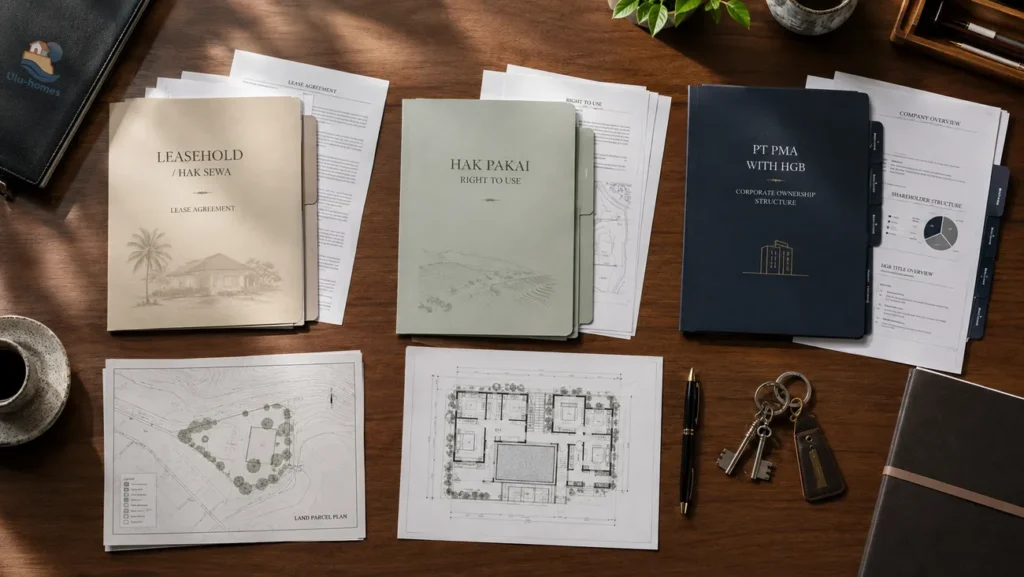
Leasehold
What is commonly marketed in Bali as “leasehold” is generally structured as a contractual right to use or lease property for an agreed term, often described in connection with Hak Sewa under Indonesian law. The exact legal form and the rights created depend on the transaction documents. The lessee does not acquire Hak Milik over the underlying land — that title remains with the party legally entitled to grant the lease.
For a remote buyer using a contractual lease structure, the terms of the lease agreement are central to defining and protecting the buyer’s rights. Under a contractual lease arrangement, the lessee does not acquire a registered land title certificate in their own name merely by entering into the lease. The quality of that contract — particularly the extension clause, assignment rights and what happens to any buildings at the end of the term — therefore becomes the central due diligence focus. A lease described as “25+25” means 25 years contracted, with a further provision whose enforceability depends entirely on how the clause is drafted. Do not assume the additional period is guaranteed without Indonesian counsel reviewing the specific wording.
Extension clauses vary considerably. Some fix the price or formula in advance. Others require a new negotiation at future market rates. For a remote buyer who may not be on the ground when the extension term approaches, the quality of that clause matters more, not less.
Hak Pakai
Hak Pakai — Right to Use — is a registered land right reflected in Indonesia’s land-registration system. Unlike a purely contractual lease arrangement, it appears on an official land certificate issued by the National Land Agency (ATR/BPN), giving the holder a different legal position from a lessee whose rights arise primarily from contract.
How long can Hak Pakai last?
Under Government Regulation No. 18 of 2021, Hak Pakai over State Land or Hak Pengelolaan land may be granted for up to 30 years, extended for up to 20 years, and renewed for up to 30 years. The rules differ depending on the underlying land and the specific right involved, so buyers should confirm the applicable term for the property rather than treating “30 + 20 + 30 years” as an automatic entitlement.
Foreign nationals may be eligible to hold Hak Pakai over qualifying residential property if they meet the immigration-document and other eligibility requirements applicable under current Indonesian law, as governed by Government Regulation No. 18 of 2021. The right is also subject to minimum property-value requirements set by applicable ATR/BPN regulations, which vary by property category and location and should be checked against the regulations in force at the time of the transaction. The eligibility and documentation requirements for a specific transaction should be confirmed with ATR/BPN or a qualified PPAT — these should not be assumed from general descriptions.
Minimum property value: Foreign ownership through Hak Pakai is subject to minimum property-value thresholds set by the applicable ATR/BPN rules. These thresholds vary by property type and location and may change. For that reason, confirm the current Bali threshold with ATR/BPN or the PPAT handling the transaction before relying on a figure quoted by a property website.
For a remote buyer, confirming eligibility early in the process avoids committing to a property or structure that is not actually available to you.
PT PMA and HGB
A PT PMA (Perseroan Terbatas Penanaman Modal Asing) is an Indonesian foreign-investment company. The company — not the individual — holds the land right, which may include HGB (Hak Guna Bangunan — Right to Build) for legitimate business purposes. The foreign buyer holds shares in the company.
This is a corporate structure, not a personal ownership path. A PT PMA may be relevant where the investor has a genuine Indonesian business activity for which the corporate structure, permitted business classification and required licences support the intended use of the property. It should not be created solely on the assumption that incorporating a company automatically gives a foreign individual unrestricted property ownership. It involves company registration, ongoing accounting, tax compliance, business licensing and other obligations that add a compliance layer a straightforward lease does not carry.
PT PMA is not a low-capital workaround for personal property ownership. Indonesian investment rules generally treat a foreign-investment company as a large-scale investment vehicle. BKPM guidance states that the required investment value is generally more than IDR 10 billion, excluding land and buildings, per relevant five-digit KBLI business classification per project location, while minimum paid-up capital requirements must also be considered. Different rules or exceptions may apply to particular business sectors, so the applicable requirement should be checked against the investor’s actual business activity before establishing the company.
| Structure | What the buyer holds | Residency/eligibility issue | Company required? | Main remote-buying focus |
|---|---|---|---|---|
| Contractual leasehold | Contractual rights for an agreed term | Depends on transaction; confirm individually | No | Lease drafting, remaining term, extension, assignment |
| Hak Pakai | Registered land right | Statutory eligibility requirements apply | No | Eligibility, property qualification and registration |
| HGB via PT PMA | Land right held by Indonesian company | Corporate/investment requirements apply | Yes | Corporate compliance, permitted business activity and land-right verification |
The structure that appears simplest to arrange remotely is not necessarily the most appropriate for your situation. Choose based on your intended use, holding period and eligibility — then build the remote workflow around that.
If You Have Already Found a Villa Online
Do not send a deposit simply because the listing looks right. A practical sequence is:
- Request the exact map location and basic property documents.
- Confirm the proposed legal structure and remaining lease term where relevant.
- Arrange a live video walkthrough of the property and its surroundings.
- Send the documents to independently appointed Indonesian legal counsel.
- Check title/land rights, zoning, access and building approvals.
- Review the reservation/refund conditions.
- Only then decide whether to reserve and proceed to the full contract.
If the seller or developer will not provide enough information for independent verification before a material commitment, treat that as a reason for further investigation.
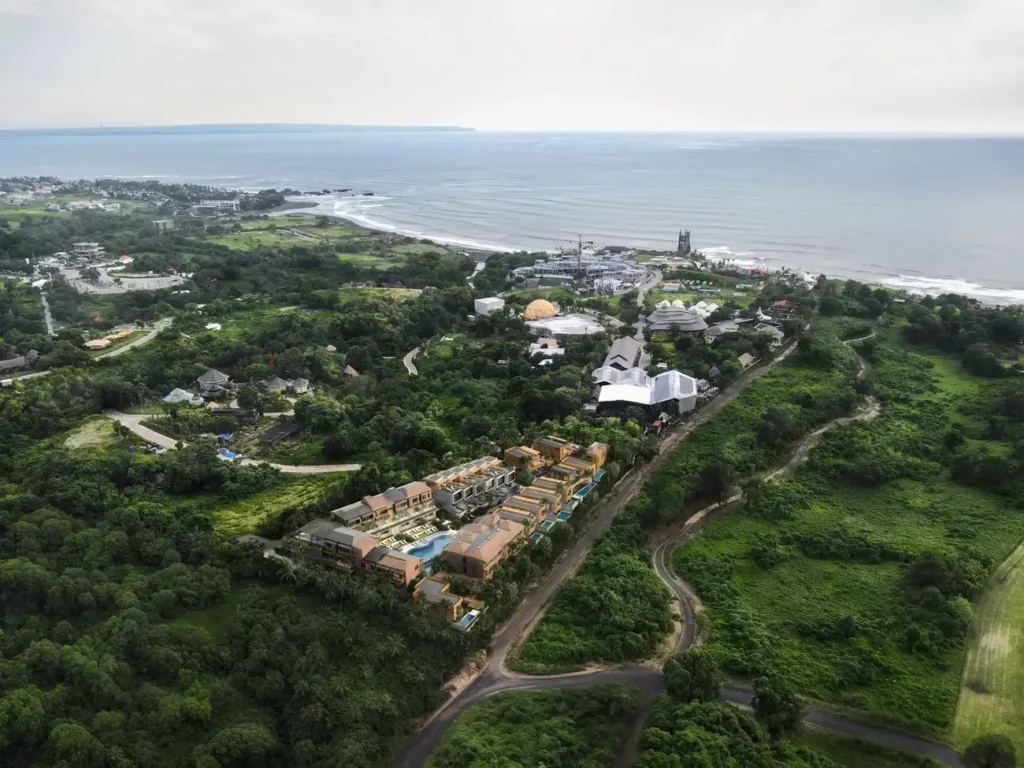
Explore Bali Properties for International Buyers


 Bali,Melasti
 from 32м²
 Bali,Canggufrom 35м²
 Bali,Batu Balongfrom 90м²
 Bali,Sesehfrom 96м²
The Remote Buying Process Step by Step
This is where a remote purchase either works or falls apart. The sequence matters as much as the individual steps.
Define the Property Brief
Before shortlisting anything, set out clearly what you are looking for and why. A useful property brief for a remote buyer covers:
- Budget, including acquisition costs beyond the asking price
- Location preference and why — lifestyle, rental demand, access
- Villa or apartment; ready or off-plan
- Intended use: personal residence, short-term rental, long-term rental, or a combination
- Expected holding period — this affects which legal structure makes sense
- Rental strategy, if applicable, including whether the property needs to be legally eligible for commercial short-term letting
- Legal structure preference, if already determined
The brief focuses your shortlist and prevents wasted time on properties that cannot meet your actual requirements. A villa that cannot lawfully be used or licensed for the short-term rental strategy you intend should not be underwritten as a short-term rental investment, regardless of how it is marketed.
Bali Properties Available for Remote Viewing
 Bali,Canggufrom 37м²
 Bali,Melastifrom 40м²
 Bali,Melastifrom 47м²
 Bali,Pererenanfrom 148м²
Build a Verified Shortlist
Remote buyers are particularly exposed to listings that look better online than they are in reality. Before arranging any live viewing, gather basic verified information on each shortlisted property:
- Exact location confirmed on a map, not just an area name
- Land/title basis and legal structure available
- Asking price and what it includes
- Lease duration and extension provisions, if applicable
- Construction status for off-plan
- Developer or seller identity
- Documents available at this stage
This stage is about elimination. The goal is to arrive at two or three genuinely viable options — not to view fifteen properties that are ultimately unsuitable.
Not sure which Bali property fits your budget, preferred area and plans? Find your Bali property and narrow the shortlist before arranging remote viewings.
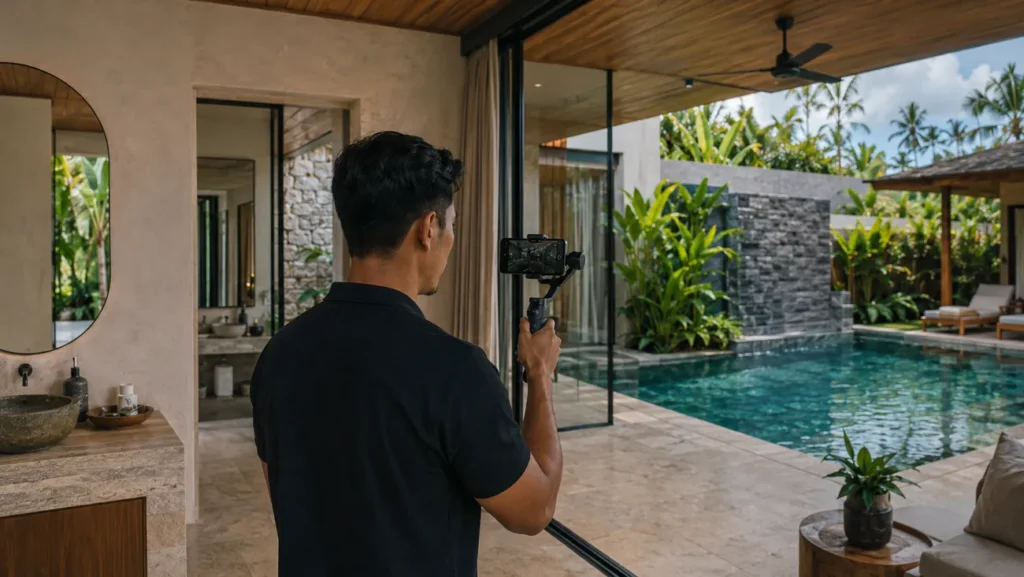
Conduct a Live Video Viewing
A pre-recorded promotional video is not a substitute for a live walkthrough. Promotional footage is selected, edited and lit to show the property at its best. A live viewing can go where you direct it.
Save this checklist and send it to the person conducting your viewing before the call.
During a live video viewing, ask the person conducting it to show you:
- The access road from the nearest main road, including road width and surface quality
- Neighbouring buildings — their proximity, height and current use
- The actual view from the property, including what is visible in all directions
- Any obvious construction activity in the immediate area
- Property boundaries, as far as they are visible
- Parking and vehicle access
- All rooms, including bathrooms and utility areas
- Walls and ceilings — look for cracks, staining or water marks
- Roof overhangs and drainage points
- Pool condition and pool equipment area
- Outdoor areas including garden, pathways and boundary walls
- Utilities: electricity meter, water source, drainage points
- For off-plan: the actual site and current construction progress
For a serious candidate, request a second live session at a different time of day where practical. Noise, traffic, construction activity and the surrounding environment may look different outside the first viewing window.
Ask the camera operator to move to the areas that promotional footage typically avoids — the service areas, the approach from the street, what is next door, the view at ground level rather than from a drone. Ask them to stand still and let you listen for a moment to ambient noise. These details matter for both personal use and rental appeal.
One live video viewing is rarely enough for a property you are seriously considering. Plan for at least two: one general walkthrough and one focused on specific areas or questions identified in the first session.
Reserve Subject to Checks
If you want to take a property off the market while due diligence proceeds, a reservation or booking arrangement may be possible. For a remote buyer, approach any reservation document carefully:
- Read the refund terms before signing anything
- Understand what conditions allow you to withdraw and recover funds
- Confirm that the property is correctly identified in the document
- Note any deadlines for completing due diligence or proceeding to the next stage
- Do not assume a reservation deposit is automatically refundable if due diligence reveals problems
Reservation terms vary significantly between sellers and developers. Never assume standard conditions exist. If the refund terms are unclear or unfavourable, that is worth negotiating before — not after — the deposit is paid.
Run Independent Due Diligence
This is the stage that most strongly protects a remote buyer. Due diligence should be substantially complete before any major non-refundable payment is made, to whatever extent the structure of the specific transaction permits.
Independent due diligence means checks conducted by a party working for you — not the seller, not the developer’s recommended notary, not the agent who introduced the property. A PPAT in Indonesia prepares specified land-related deeds and supports the registration process; a notary performs a separate notarial function. Neither automatically acts as your independent legal adviser. That role requires a separately engaged lawyer acting for you.
For a remote buyer, the following areas require investigation:
- Seller or lessor identity — confirm the party you are contracting with is who they say they are and has authority to sell or lease
- Land title and certificate — verify authenticity and status with ATR/BPN
- Registered encumbrances — mortgages or other registered third-party rights recorded against the title; separately, legal counsel should also investigate whether there are known disputes, litigation or other claims affecting the property or the contracting parties
- Boundaries — do the stated boundaries match the physical parcel on the ground?
- Access — is there documented legal access to a public road, or only physical access across third-party land?
- Zoning and permitted use — does the spatial-planning classification permit your intended use, whether residential, tourism or commercial?
- Building permits — is there a valid PBG (Persetujuan Bangunan Gedung — Building Approval) or predecessor IMB for the existing structure?
- Lease term and extension — if buying leasehold, how many years remain and what does the extension clause actually say?
- Developer verification — for off-plan, confirm the developer’s legal entity, its control of the land, and its track record on completed projects
- Construction approvals — for off-plan, what permits are in place and which are still pending?
Note that an online copy of a document is a starting point, not a completed verification. Title checks should be run against the official ATR/BPN registry, not solely against documents provided by the seller.
Documents to Request Before a Material Payment
| Document / evidence | What you need to establish |
|---|---|
| Seller/lessor identification | The counterparty is correctly identified |
| Land certificate / land-right evidence | The claimed land right exists and matches the transaction |
| ATR/BPN verification | Certificate status and relevant registered interests have been independently checked |
| Survey / parcel information | The legal parcel corresponds to the property being offered |
| Access documentation | The property has documented legal access |
| Zoning / spatial-planning evidence | Your intended use is compatible with the applicable classification |
| PBG or relevant predecessor permit | The building has the appropriate approval |
| SLF where applicable | Functional-worthiness documentation has been checked where required |
| Draft transaction agreement | Price, term, payment triggers, default, assignment and handover terms are known |
| Developer corporate documents | For off-plan: the contracting entity and authority are verified |
| Construction approvals | For off-plan: required approvals and their status are known |
Receiving a PDF is not the same as verifying a document. Relevant records should be independently checked against the appropriate official source or authority.
Review the Contract
The contract — whether a lease agreement, a sale and purchase agreement, or a combination — is the document that defines your rights. For a remote buyer who will not be present to observe the property day to day, certain clauses matter particularly:
- Are the parties correctly identified?
- Is the property described accurately and unambiguously?
- What is the payment schedule and what triggers each instalment?
- What are the handover obligations and timeline?
- What happens in the event of default by either party?
- For leasehold: what are the extension conditions and pricing mechanism?
- Are assignment and resale rights clearly stated?
- Who is responsible for maintenance, and on what terms?
- If the property is to be rented out: what does the contract say about management arrangements?
- For off-plan: what is the construction specification, and what happens if it changes?
Have the complete draft contract reviewed by independent legal counsel before signing. Do not rely solely on a summary or verbal explanation.
Arrange Signing or Representation
This is where the remote process requires the most careful planning. If you cannot be physically present for a signing step, you may be able to authorise a representative to act on your behalf under a Power of Attorney (POA). The scope of a POA must correspond precisely to the actions it is intended to authorise. A generic or overly broad POA creates risk; a narrowly scoped POA for a specific transaction, property and set of actions provides much better protection.
The formalities for a POA executed outside Indonesia depend on where the document is signed, the nature of the document, and the requirements of the Indonesian party that will rely on it. If the Hague Apostille Convention is in force between the country from which the relevant public or notarised document originates and Indonesia, the document may require an Apostille issued by the competent authority of that country of origin — not by an Indonesian authority. If the Convention is not in force between the two countries, another authentication or legalisation procedure may apply instead. The exact requirements should be confirmed for the specific document and transaction before it is executed abroad. Confirm all formalities with the Indonesian lawyer, notary or PPAT handling the transaction before signing anything overseas.
Make Payments Through a Traceable Process
Every payment should follow the payment schedule, milestones and conditions set out in the signed transaction documents. Before transferring any funds:
- Confirm the payment schedule in writing against the signed contract
- Verify the recipient’s name and account details independently — do not rely solely on details provided in an email or messaging app
- Obtain an invoice or written payment request that matches the contracted milestone or condition
- Keep confirmation of every transfer made
- Before making each instalment, confirm that any milestone or condition the contract requires for that payment has been documented and satisfied. If there is a discrepancy, obtain legal advice before withholding or releasing funds.
- Account for currency conversion costs, which can be significant on large international transfers
Before sending a large international payment, independently confirm the receiving account and match the payment milestone to the signed transaction documents.
The risk of payment redirection fraud is not unique to Bali, but it is heightened in any transaction where the buyer is overseas and communicating primarily by email or messenger. Verify bank details by phone with a known contact before any transfer, particularly if account details change or are provided for the first time close to a payment date.
Complete Handover Remotely
For a ready property, handover typically involves a physical inspection of the property’s condition at the point of transfer. A remote buyer can organise this through a qualified representative or independent inspector.
The handover process should include:
- A condition inspection with photographs and/or video
- A snagging list of any defects to be remediated before or after handover
- An inventory check if the property is sold furnished
- Utility meter readings where applicable
- Receipt and confirmation of keys and access credentials
- A signed handover certificate confirming the date and condition
For off-plan, handover follows a construction completion milestone. The inspection should confirm that the property matches the contracted specification, that the required building documentation is in order, and that the agreed snagging process is documented before the handover certificate is accepted.
Receive Your Closing File
Once the transaction is complete, you should receive — and systematically organise — the full set of documents relating to the property. These are covered in more detail below, but the principle is straightforward: every document that will matter if you sell, extend, licence, insure or dispute something in the future should be in one organised file.
What Happens After Remote Handover?
If the property is an investment rather than your own residence, the remote process does not end when the keys are handed over. Before the property begins operating, confirm:
- who holds the keys and access credentials;
- which defects remain outstanding after snagging;
- who is responsible for resolving them and by when;
- utility accounts and payment responsibility;
- insurance arrangements where appropriate;
- property-management agreement and fee structure;
- authority given to the manager;
- reporting and owner-payment schedule;
- tax/accounting responsibilities connected with rental activity;
- where originals and digital copies of the closing documents are stored.
Rental-income tax: Indonesian tax rules generally impose a 10% final income tax on the gross amount of income from the rental of land and/or buildings. The way this applies to an overseas investor, a particular management structure or a PT PMA should be confirmed with an Indonesian tax adviser before the property begins operating.
How Power of Attorney Works
A Power of Attorney (POA) is a legal document through which one person — the principal — authorises another person — the representative — to perform defined acts on their behalf. In the context of a remote Bali property transaction, a POA may allow a trusted representative to sign documents, execute a lease, attend a PPAT appointment or handle other specified steps that would otherwise require the buyer’s physical presence.
A POA does not transfer ownership and does not give the representative unlimited authority. The representative can only do what the document specifically authorises them to do. This is why the scope of the POA matters enormously. A document that authorises the representative “to do all things necessary in connection with my property affairs in Bali” gives far broader discretion than most buyers would be comfortable with on reflection. A document that specifies the property by address and certificate number, identifies the transaction, and authorises a defined list of acts provides much tighter protection.
Choosing a representative is a consequential decision. The representative may be a lawyer, a trusted agent, a property consultant or another professional — but they should be someone whose identity you have verified, whose role in the transaction is independent where independence matters, and who understands the specific steps they are being asked to perform.
For a POA signed outside Indonesia that is to be used in an Indonesian transaction, the applicable formalities depend on the country where the document is created and the requirements of the receiving party in Indonesia. If the Hague Apostille Convention is in force between the country from which the relevant public or notarised document originates and Indonesia, the document may require an Apostille issued by the competent authority of that country of origin. Indonesia became a party to the Convention on 4 June 2022. If the Convention is not in force between the two countries involved, consular legalisation or another authentication procedure may be required instead. The exact requirements for your specific document and transaction should be confirmed with the Indonesian PPAT or lawyer handling the deal before any document is prepared or executed abroad.
Practical recommendations for a remote buyer arranging a POA:
- Have the POA drafted or reviewed by a qualified Indonesian lawyer, not downloaded from a generic template source
- Define the property, the transaction and the authorised acts as specifically as possible
- Confirm whether the Hague Apostille Convention is in force between your country and Indonesia, and what formalities apply to your specific document, before executing it abroad
- Keep a signed original copy in your own records
A Power of Attorney should reduce the need for travel — not reduce the buyer’s control over the transaction.
The representative acts in your name. The decisions should still effectively be yours.
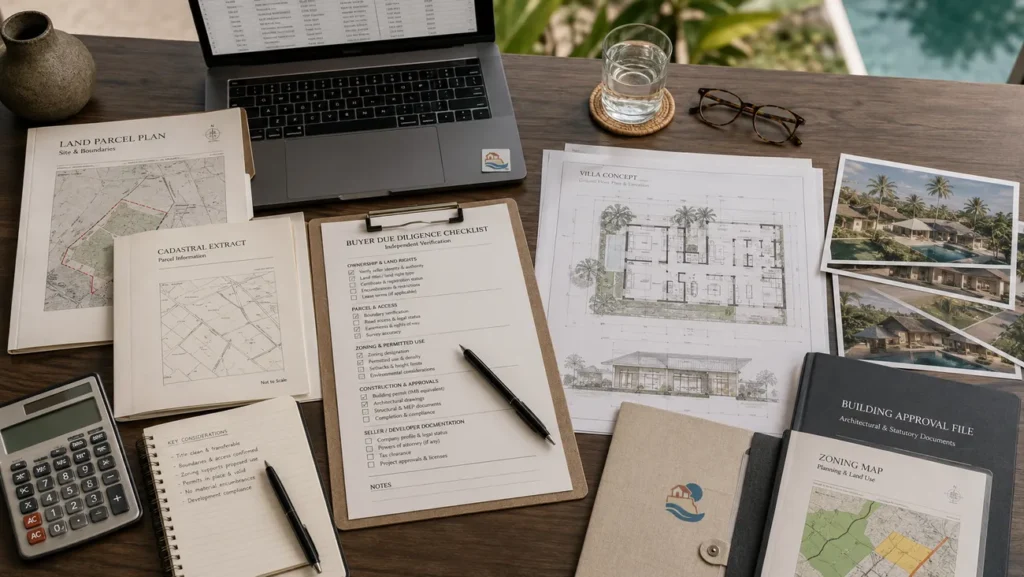
Remote Due Diligence Checklist
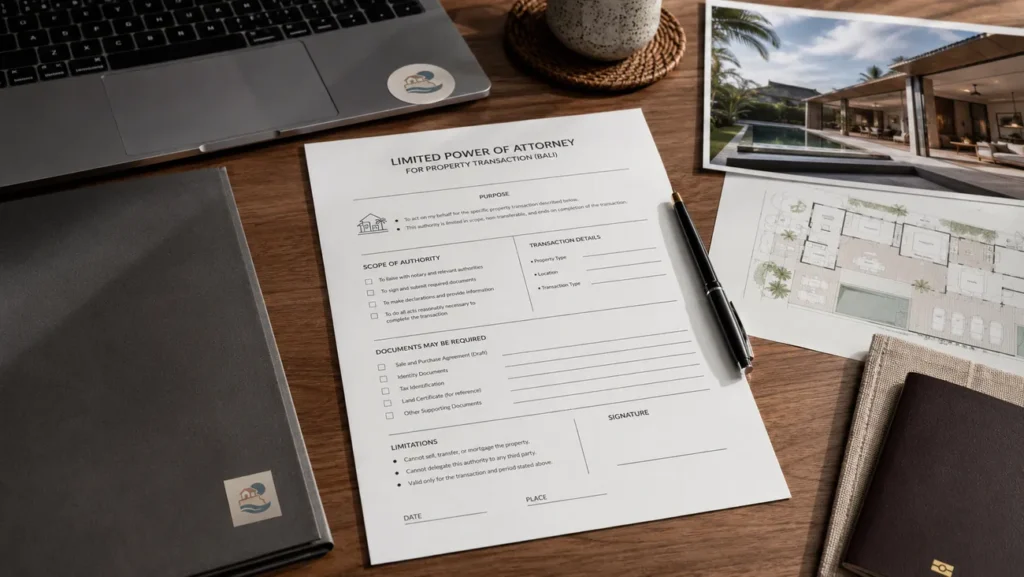
Due diligence covers everything that needs to be verified before you commit to the property. For a remote buyer, these checks are conducted by people you have appointed — your legal adviser, an independent inspector, and any specialist reviewer relevant to the transaction. The checklist below organises the key areas into four categories.
Seller and ownership
- Identity of the seller or lessor confirmed against official documents
- Authority to sell or lease — is this the registered title holder, or an agent with documented authority?
- For leasehold: is the lessor the party with the right to grant the lease?
- Any ongoing disputes, litigation or claims relating to the property or the seller — note that not all disputes appear as registered encumbrances in the land registry
Land and property
- Land certificate verified with ATR/BPN — not just visually checked from a copy
- Certificate type and whether it matches the proposed transaction structure
- Registered encumbrances — including mortgages or other registered third-party rights — checked through the relevant land records
- Boundary survey — do the registered boundaries match the physical parcel?
- Legal road access — is there a documented right of access to a public road?
- Zoning and spatial-planning classification — does the land permit your intended use?
- Building permits — is there a valid PBG (or IMB for older structures) covering the existing building?
- SLF (Sertifikat Laik Fungsi — Certificate of Functional Worthiness) where applicable
Contract
- Parties correctly identified
- Property correctly and unambiguously described
- Payment schedule tied to defined milestones or conditions
- Extension clause reviewed and assessed by Indonesian counsel
- Assignment and resale rights explicit
- Default and termination provisions reviewed
- Dispute resolution mechanism identified
Developer and construction (off-plan)
- Developer’s legal entity registered and in good standing
- Developer’s documented control of the land, not just a marketing claim
- Construction permits in place or confirmed pathway to obtaining them
- Track record of completed projects verified independently
- Completion defined clearly in the agreement
- Provisions for delay, specification changes and handover
| Check | Why It Matters | Who May Assist With Verification |
|---|---|---|
| Seller/lessor identity | Confirms you are dealing with the right party | Independent lawyer, PPAT |
| Land certificate authenticity | Prevents fraud and confirms registered status | ATR/BPN check via PPAT |
| Registered encumbrances | Reveals mortgages or registered third-party rights | ATR/BPN registry check |
| Disputes and litigation | Identifies claims not appearing in the land registry | Independent lawyer |
| Boundary survey | Confirms you are buying what is described | Licensed surveyor |
| Legal road access | Without this, practical and resale problems follow | Lawyer, site inspection |
| Zoning / permitted use | Determines whether intended use is lawful | Official RTRW/RDTR documents |
| Building permit (PBG/IMB) | Confirms construction is authorised | SIMBG system, local authority |
| Lease extension clause | Defines real tenure, not just advertised years | Indonesian legal counsel |
| Developer track record | Assesses delivery risk for off-plan | Independent research, references |
| Payment schedule vs milestones | Links money to verified progress | Contract review |
| Construction approvals | Confirms off-plan can legally proceed | Lawyer, permit review |
An online copy of a document is a starting point. The verification step — checking it against official records — is what transforms it into reliable information.
Already found a property?
Send us the project or villa you are considering. We can help coordinate a remote viewing and explain which documents and transaction steps need to be checked before you proceed.
Buying Ready vs Off-Plan Remotely
The remote experience differs significantly depending on whether you are buying a completed property or one that has not yet been built.

Ready Property
A ready or resale property has one significant advantage for a remote buyer: it exists. You can conduct a live video walkthrough. You can commission a physical inspection by an independent party. You can see the actual surroundings, the neighbouring development, the condition of the road, the views and the noise environment.
The risks are different from off-plan, not absent. A live viewing will not detect every defect. Hidden structural problems, drainage issues, electrical faults and damp behind wall finishes require a hands-on technical inspection by a qualified professional. The property’s condition may differ from its listing photographs. The inventory may not match what was described. These are manageable risks with the right inspection process — but they are risks a remote buyer needs to explicitly address.
For an existing property that has been operating as a short-term rental, ask for documented operational history: occupancy records, management agreements and utility bills. Treat verbal representations about historical income with appropriate scepticism.
Off-Plan
Off-plan purchases from developers are, in some respects, more naturally suited to remote buyers: some developers that market to international buyers offer remote communication, document-sharing and staged-payment procedures for overseas clients. These procedures should still be independently reviewed rather than treated as evidence that the transaction itself is low-risk.
Construction delay is a material risk in any off-plan transaction and should be addressed expressly in the contract. The asset you are purchasing does not yet exist, so the developer’s ability and willingness to deliver it as promised is the central question. For a remote buyer, the developer check — legal entity, land control, permits, track record — replaces the property inspection as the primary due diligence task.
How to Monitor an Off-Plan Project From Overseas
For each contractual construction milestone, request evidence appropriate to the project before treating the milestone as complete. This may include:
- dated site photographs and video;
- live site walkthroughs at agreed stages;
- construction progress reports;
- evidence relating to the contractual milestone that triggers the next payment;
- notice of material specification changes;
- updated expected-completion information;
- independent inspection at key stages where commercially justified.
Marketing progress updates and contractual milestone evidence are not necessarily the same thing. The contract should determine what evidence is required before a payment becomes due.
The contract provisions governing delay, specification changes, handover conditions and what happens if the developer cannot complete are particularly important for a buyer who will not be on-site to monitor progress.
| Factor | Ready Property | Off-Plan |
|---|---|---|
| Physical inspection | Full independent inspection possible | Limited to site visit; structure does not yet exist |
| Primary risk | Existing condition, undisclosed defects | Developer delivery, delay, specification changes |
| Documents to check | Title or land-right evidence, permits, building condition | Land control, construction permits, company standing |
| Remote monitoring | Inspection report, video walkthrough | Construction progress updates, milestone documentation |
| Handover timing | Immediate or near-term | Future milestone; contractually defined |
Neither format is inherently safer. The risks are different in nature, and the due diligence adjusts accordingly.
Payments, Costs and Currency
The agreed property or lease price is the largest single figure in a Bali transaction, but it is not the only one. A remote buyer should budget for a broader set of costs, the exact composition of which depends on the legal structure, the property type and the parties involved.
Possible categories of cost include:
- Purchase or lease price
- Independent legal due diligence fees
- PPAT-related fees where a registered land right or notarial deed is involved
- Applicable transaction taxes — the structure, rate and which party bears them depend on the specific transaction and should be confirmed with a tax professional before signing
- Company registration and ongoing compliance costs if a PT PMA structure is used
- International transfer fees from your bank
- Currency conversion costs, which can be material on larger transactions
- Independent inspection fee
- Property management setup fees if the property will be rented
No universal “total closing cost” percentage applies across all transaction types in Bali. The combination of taxes, fees and costs varies significantly between a straightforward lease and a PT PMA acquisition. Get a transaction-specific cost estimate from your legal adviser and account for it in your overall budget before you are committed.
For international payments, practical controls matter:
Currency conversion is a meaningful consideration on transactions denominated in Indonesian Rupiah or USD when your funds are in Euros, Pounds or Australian dollars. The exchange rate at the time of transfer, the spread charged by your bank or transfer service, and any transfer fees can add up to a significant sum on a property transaction. Compare options before the first substantial payment is due.
Which Additional Costs Should a Remote Buyer Budget For?
| Cost | Leasehold | Hak Pakai | PT PMA / HGB | When to confirm |
|---|---|---|---|---|
| Independent legal due diligence | Usually relevant | Usually relevant | Usually relevant | Before reservation becomes non-refundable |
| Notary / PPAT costs | Depends on documents | Relevant where PPAT acts are required | Relevant where PPAT acts are required | Before signing |
| BPHTB / acquisition-related tax | Depends on whether the transaction constitutes a taxable acquisition of a land/building right | May apply; statutory rate is generally 5% of the applicable taxable acquisition value after the relevant non-taxable threshold | May apply; statutory rate is generally 5% of the applicable taxable acquisition value after the relevant non-taxable threshold | Confirm the taxable basis, local threshold and liability before signing |
| PT PMA establishment | No | No | Yes | Before choosing corporate ownership |
| PT PMA accounting/compliance | No | No | Yes | Include in annual budget |
| Overseas POA/document formalities | If required | If required | If required | Before executing documents abroad |
| Bank/FX charges | Possible | Possible | Possible | Before every international transfer |
| Technical inspection | Recommended where appropriate | Recommended where appropriate | Recommended where appropriate | Before completion/handover |
| Property management setup | If rented | If rented | If rented | Before operation |
Important: a 5% BPHTB rate does not mean every remote Bali transaction simply adds 5% to the advertised property price. Whether BPHTB applies, the taxable base and the applicable non-taxable threshold depend on the transaction and local rules.
Ask for a written transaction-cost sheet before committing to the property. It should distinguish the property or lease price from taxes, legal fees, PPAT/notarial costs, company costs where applicable, bank charges, inspections and any management setup fees.
Remote Purchase Budget Worksheet
Before reserving a property, calculate your total budget rather than looking only at the advertised price:
Property or lease price
- legal due diligence
- notary / PPAT costs where applicable
- applicable taxes and government charges
- POA, notarisation, Apostille/legalisation and translation costs where required
- bank transfer and currency-conversion costs
- technical inspection
- PT PMA establishment and compliance costs where applicable
- furnishing or snagging budget if not included
- property-management setup if the property will be rented
- Estimated total acquisition budget
Ask your lawyer, tax adviser and transaction team to put actual figures beside every applicable line before you make a material non-refundable payment.
Red Flags When Buying From Overseas
A remote buyer is more exposed to certain risk patterns than an on-the-ground buyer. The following are situations that warrant stopping and verifying further — not automatic evidence of fraud, but reasons to slow down.
- Pressure to transfer money quickly, especially before due diligence is complete or documentation has been provided
- Reluctance to conduct a live video viewing, or insistence on pre-recorded content only
- Refusal to provide documents for independent review — title or land-right evidence, permits, company registration, draft contract
- Vague property location, such as a wide area name rather than a specific address and map pin
- Mismatching names on documents — seller identity, title holder, company registration not aligning
- Unclear or undocumented road access — the property is accessible but no one can explain the legal basis
- Promised guaranteed returns — income projections presented as certain outcomes
- “Freehold for foreigners” presented without explanation — Hak Milik is not directly available to foreign individuals under Indonesian law
- A generic or excessively broad Power of Attorney offered as a standard form without any property-specific tailoring
- Bank account details changing shortly before a scheduled payment, particularly if communicated only by email or messaging app
- No clear completion documentation or milestone definition for off-plan property
- The agent, developer and “independent” legal adviser presented as effectively one party — a referral to a lawyer who works exclusively with one developer is not independent legal advice
Each of these patterns calls for further verification, not necessarily withdrawal. But each is a reason to pause before the next payment.
Do You Ever Need to Visit Bali?
The honest answer is: it depends on the transaction. For some buyers and some deals, the entire process from shortlist to handover can be managed remotely through a combination of live viewings, independent due diligence, properly executed representation and documented payments. For others, physical presence may be required or strongly preferred at certain points.
Factors that can affect whether a visit is needed include:
- The legal structure and whether any signing steps require physical presence or a specifically constituted representative
- The document execution requirements in your country of residence for any POA, including whether the Hague Apostille Convention is in force between your country and Indonesia and what formalities apply
- The seller’s or developer’s own process and preferences
- Your bank’s requirements for international property transactions
- Your own comfort level with remote processes for a transaction of this scale
- Whether any immigration or residency steps are connected to the purchase
The most useful exercise for a remote buyer is to map out, before committing to a specific property, what can be completed remotely and what may require your presence or a specifically authorised representative. Think of it as a remote completion map:
| Can Be Completed Remotely | May Require Buyer Action or Physical Presence |
|---|---|
| Property search and shortlisting | Document execution steps requiring notarisation or personal attendance |
| Live video viewings | POA formalities in the country of signing |
| Independent legal due diligence | Certain bank requirements for large international transfers |
| Contract review | Immigration or residency linked to the transaction |
| Milestone-based payments | Buyer’s personal preference for final handover |
| Remote handover via representative | Steps the specific notary or PPAT requires in person |
Build this map for your specific transaction — not from a general assumption — with input from your legal adviser and the PPAT handling the deal.
A Well-Controlled Remote-Buying Workflow
The steps below bring the full process into a single operational sequence. This is not a guarantee of outcome — it is a structure that puts verification before commitment at each stage.
- Define your goals, budget and intended use clearly before searching
- Build a shortlist of verified properties, not a list of attractive listings
- Conduct live video viewings focused on areas promotional content avoids
- Confirm the appropriate legal structure with independent legal advice
- Reserve conditionally where possible, with refund terms reviewed before paying
- Run independent due diligence on title or land-right evidence, seller, zoning, permits and contract
- Have the complete draft contract reviewed by your own legal counsel
- Arrange signing or Power of Attorney with precise, transaction-specific scope and confirmed formalities
- Make payments against the schedule and conditions in the signed documents, with verified recipients
- Conduct or commission an independent handover inspection
- Collect and organise the complete closing document file
A well-controlled remote purchase is not defined by having the fewest steps. It is defined by putting appropriate verification, documentation and legal checks before each material commitment of funds.
Official References
- Indonesia — Law No. 5 of 1960 on Basic Agrarian Principles
- Government Regulation No. 18 of 2021
- ATR/BPN Regulation No. 18 of 2021
- SIMBG — PBG and SLF building documentation
- HCCH — Apostille Convention status and competent authorities
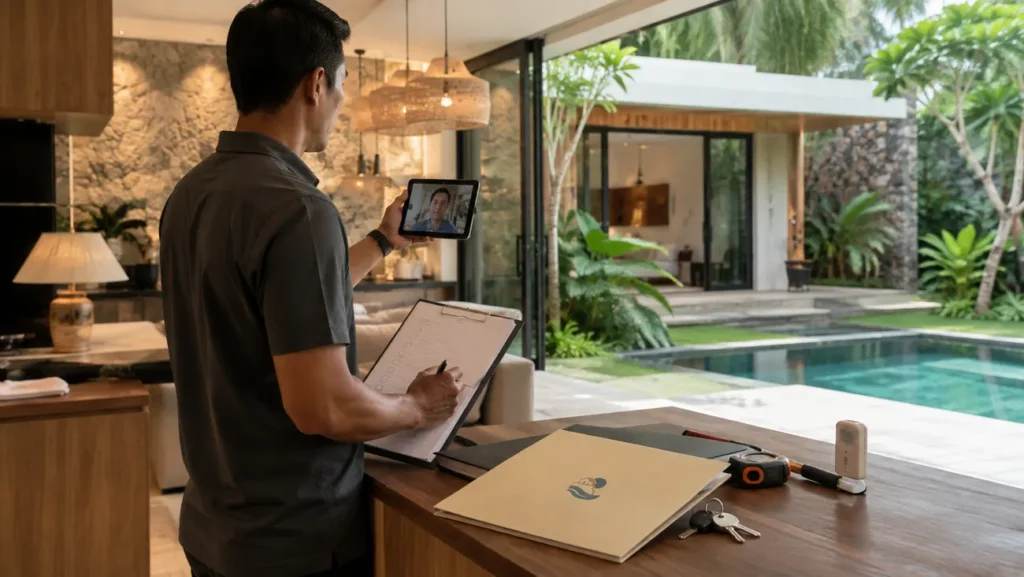
Distance does not make a Bali property transaction impossible. What it does is change which steps require the most careful preparation. When you cannot walk the property yourself, live video must work harder. When you cannot be present to sign, the scope and execution of your Power of Attorney — and the formalities required in your country of signing — become more consequential. When you cannot monitor the process day to day, the payment controls and milestone documentation do the work that physical proximity would otherwise provide.
A remote transaction built on verified documents, properly scoped representation, independent due diligence and payments made against contractual conditions is a managed process. One built on photographs, a sense of urgency and convenient trust in parties you have not independently verified is an exposed one.
The closing document file — your record of the relevant title or land-right evidence, lease or acquisition agreements, payment records, permits and handover documentation — is what you are left with when the transaction ends. It should be complete, organised and in your possession.
ULU Homes works with overseas buyers to coordinate remote viewings, verified shortlists and the buying process on the ground in Bali. The goal is to make the distance manageable — without shortcutting the verification steps that make the transaction sound.
The information in this guide is provided for general informational purposes. Indonesian property law, land rights, document execution requirements, Power of Attorney formalities and applicable regulations depend on the specific transaction, legal structure and circumstances involved. This guide does not constitute legal, tax or investment advice. Readers should obtain independent advice from a qualified Indonesian lawyer, PPAT and tax adviser before entering into any property transaction.
 Real estate in Georgia
 Real estate in Cyprus
 Real estate in the UAE
 Real estate in Montenegro
 Real estate in Thailand
 Real estate in Spain
 Real estate in Saudi Arabia
 Real estate in Turkey
 Real estate in Zanzibar
 +62 895 001 924 667
 hello@ulu-homes.id
 Tibubeneng, Canggu, Kuta Utara, Badung Regency, Bali 80361, Indonesia



 Get catalogue of TOP-7 objects