
 +62 895 001 924 667


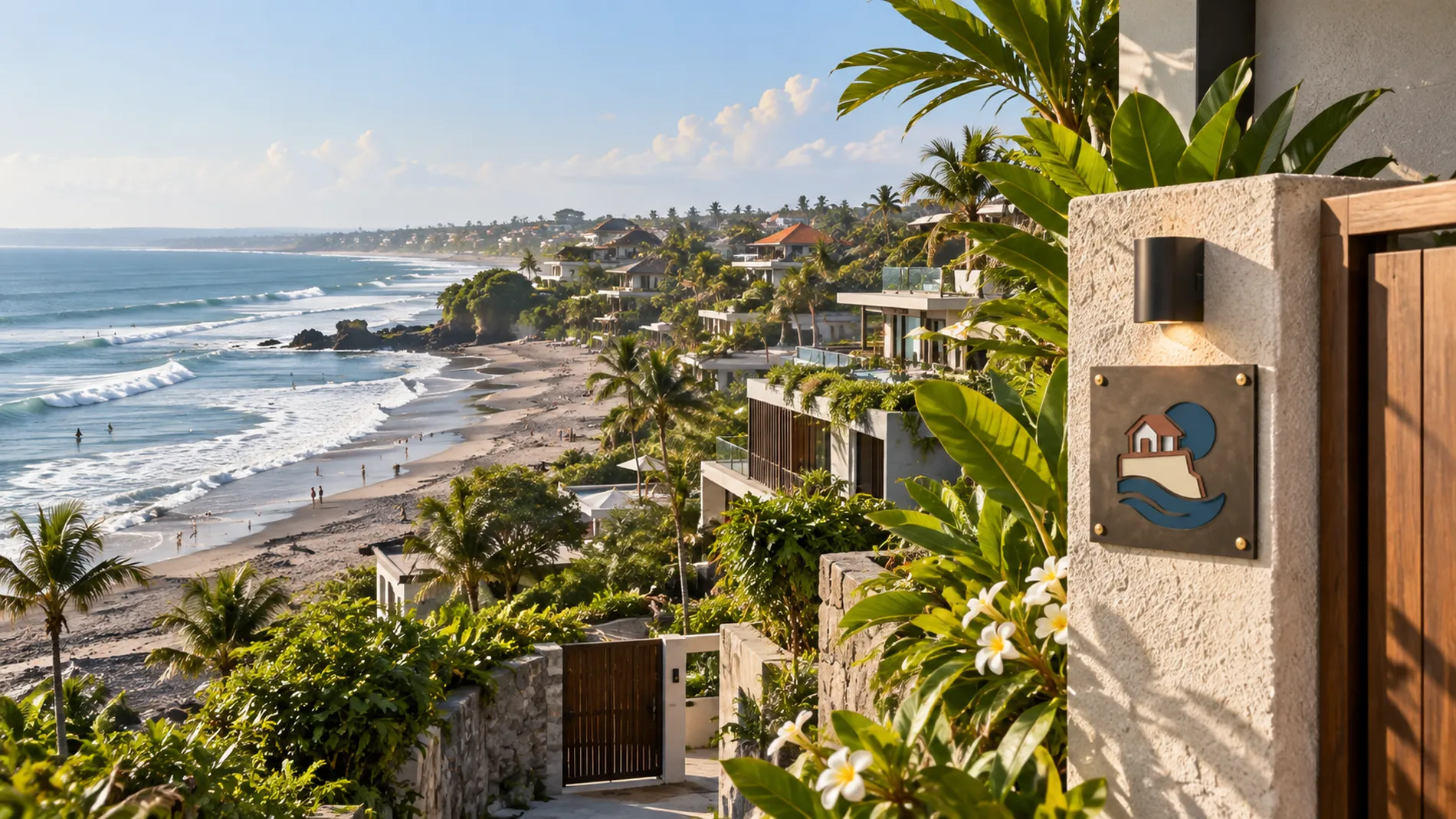

Berawa at a glance: Berawa is one of the most developed parts of greater Canggu, combining beach access, restaurants, gyms, schools, coworking spaces and a large rental market. It is also one of the more expensive areas around Canggu, with asking prices varying sharply depending on beach proximity, road access, lease term, permits and property quality. For investors, Berawa offers an established rental market but also high entry prices, growing competition and significant differences between gross and net returns.
Best for: buyers who value established infrastructure, beach access and an active rental market.
Think twice if: your priority is quiet surroundings, a low entry budget or speculative land appreciation.
Main investment risk: paying a premium for the location without verifying lease terms, permitted use and realistic net income.
Berawa in 2026: Quick Facts
| Factor | What to Know |
|---|---|
| Location | Southern part of greater Canggu, in Tibubeneng, Kuta Utara, Badung |
| Character | Dense lifestyle and residential district close to the beach |
| Property market | Premium by Canggu standards, with wide variation between streets and tenure structures |
| Main property type | Villas, plus a growing number of apartments and managed residences |
| Rental strategies | Short-term, mid-term and annual rentals |
| Main advantages | Infrastructure, beach access, international demand, established destination |
| Main drawbacks | Traffic, construction, noise, high entry prices and strong rental competition |
| Key buyer check | Lease term, zoning, permits, access road and legal rental use |
Berawa is a coastal neighborhood on the southwest side of Bali and part of the wider Canggu area. Administratively, there is no separate “town” of Berawa: the neighborhood falls within Kuta Utara District in Badung Regency and is made up of dozens of streets stretching between rice fields, the ocean, and the main thoroughfare of Jalan Pantai Berawa. In practice, however, Berawa has changed dramatically over the past decade, becoming one of the most densely developed and commercially active parts of the island. Beach clubs, restaurants, gyms, coworking spaces, schools, supermarkets, and hundreds of rental villas are all concentrated within a radius of roughly 1.5 to 2 kilometers.
That concentration is exactly what drives both demand and pricing. People do not choose Berawa for untouched nature; they choose it for the convenience of an established lifestyle ecosystem. Tenants have almost everything they need close at hand. Villa operators do not have to convince guests to stay in an unfamiliar location. And full-time residents rarely need to leave the neighborhood just to reach a gym, supermarket, or pediatrician. Berawa is already a mature, established market rather than an early-entry opportunity. The trade-off is a higher cost of entry, ongoing construction, narrow roads, evening traffic, and significantly stronger competition among similar properties.
This guide is designed to answer three questions at once: what it is actually like to live in Berawa, what the local property market looks like and what determines pricing, and what needs to be calculated and verified before considering a purchase as an investment. All figures are current as of 2026, with a clear distinction between official statistics, asking-price ranges in current listings, and expert interpretation.
Where Berawa Is Located
Berawa sits on Bali’s west coast, between Seminyak and the rest of Canggu. Administratively, the area falls within Kuta Utara District in Badung Regency—the same regency that includes Kuta, Legian, and the airport. Official statistical publications for the district are issued by BPS Badung, and this is the only reliable source to use when you need demographic or infrastructure data for the area rather than marketing estimates (Kecamatan Kuta Utara Dalam Angka 2025).
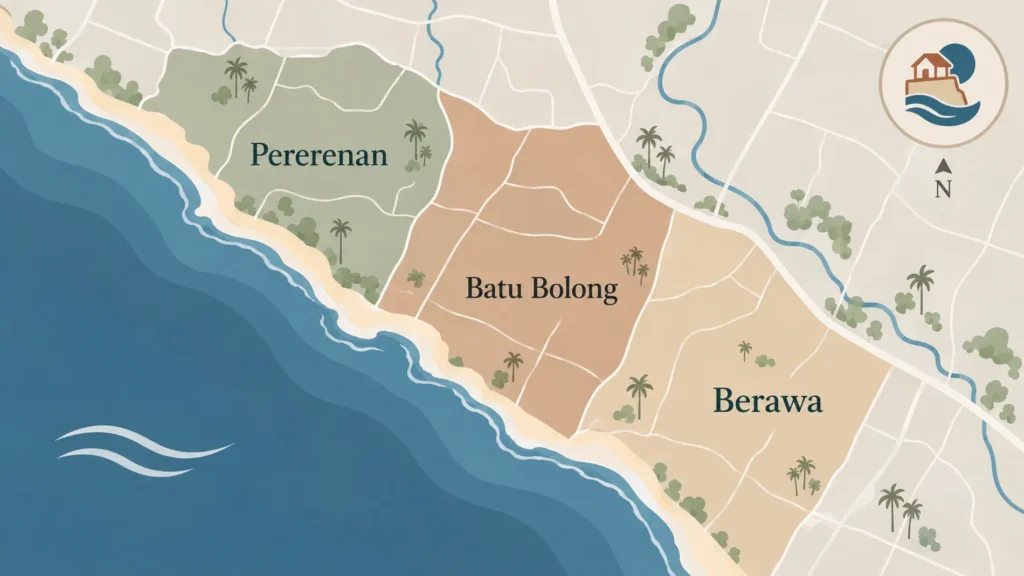
Geographically, Berawa is framed by two key reference points. To the southeast lies Seminyak, separated by the river and the Petitenget area; getting there can take anywhere from a few minutes to half an hour depending on the time of day. To the northwest is Batu Bolong, followed by Pererenan and Seseh, where some of the demand for a quieter lifestyle has shifted in recent years. Ngurah Rai Airport lies to the south, and the drive there is a classic example of why measuring distance in kilometres is largely meaningless in Bali.
The district’s main artery is Jalan Pantai Berawa, which runs from the main junction toward the ocean and ends near the beach parking areas. Most of the local commercial activity is concentrated along this road, from cafés and salons to supermarkets and a school. Narrower lanes branch off from it, and these are where most residential villas are located. There is also another important access route from Jalan Raya Canggu and Jalan Nelayan, but all of these roads have limited capacity. There is simply very little room to widen them.
This leads to one of the area’s most important practical realities: distance on a map does not equal travel time in Bali. Travel time in Berawa can vary sharply by route, vehicle and time of day, so distance alone is a poor measure of accessibility. There are very few alternative routes, and scooters, construction trucks, and taxis all compete for the same narrow lanes. Any claim that a property is “ten minutes from the beach” should be tested in person during rush hour, not accepted at face value based on a midday navigation estimate.
Another point often missed in general area guides is that Berawa is far from uniform. A street close to the ocean and a lane deeper inland can offer completely different noise levels, tenant profiles, land prices per square metre, and investment logic.
Berawa Micro-Locations
There is no official subdivision of Berawa into separate zones, and there is little value in inventing attractive-sounding neighborhood names. In practice, buyers and property management companies tend to think in terms of three broad location types.
Closer to the beach. These are streets within a few minutes’ walk of the shoreline and the area’s largest beach clubs. Land prices are highest here, tourist activity is most visible, and the noise level is also at its peak. Music from the clubs can be heard in the evenings, while parking during high season becomes a challenge in its own right. Development here is dominated by villas on relatively compact plots, many of them built specifically for short-term rental. This location works best for holiday lets and is less suitable for families with small children.
The central corridor. This includes Jalan Pantai Berawa itself and the lanes immediately surrounding it. Everyday convenience is at its highest here: shops, cafés, gyms, coworking spaces, and services are all close by. The noise is more traffic-related than nightlife-related, and on the main road it is effectively constant. Move just 100–200 metres into a side street, however, and the noise level drops quickly. This central corridor can attract a broad range of rental demand, but reliable public data comparing resale liquidity between Berawa micro-locations are not available.
Quieter inland streets. These are the lanes stretching toward the rice fields and the borders with Tumbak Bayuh and Padonan. Plots are generally larger, land prices are lower, and development is less dense. Three- and four-bedroom villas with proper gardens are more common here. The trade-off is obvious: you need to drive to the beach and cafés rather than walk, access roads can be worse, and some plots may sit next to active construction sites for several years. For long-term living, this is often the strongest option. For short-term rental, it is more challenging.
Table 1. Which Part of Berawa Suits Which Buyer?
| Location | Atmosphere | Main Demand | Advantages | Potential Drawbacks |
|---|---|---|---|---|
| Closer to the beach | Tourist-oriented, active, noisy in the evenings | Short-term rentals, holidays, lifestyle purchases | Walking distance to the ocean and beach clubs, recognizable address, strong seasonal demand | Highest land prices, music and crowds, limited parking, intense competition between rental properties |
| Central corridor | Urban, commercial, busy around the clock | Mixed demand: short-term, medium-term, and one-year expat rentals | Everyday infrastructure nearby, broad tenant appeal, dense everyday infrastructure | Traffic noise and congestion, dust, ongoing construction, views often blocked by neighboring development |
| Quieter inland streets | Calmer, more residential, closer to the rice fields | Long-term rentals, families, permanent residents | More land for the same budget, quieter, more private, fewer neighboring buildings pressed closely together | You need to drive to reach amenities, poorer road conditions in the rainy season, weaker short-term rental demand |
The practical conclusion is straightforward: choosing a micro-location in Berawa should be based on how you plan to use the property, not simply on personal preference. A villa bought “to stay in occasionally and rent out short-term the rest of the year” will usually achieve a higher average nightly rate near the beach, but it will also come with a higher entry price, faster wear and tear, and a constant flow of tourists just outside the gate.
The same budget spent farther inland will buy more space and more privacy, but it requires a different rental strategy—one focused more heavily on monthly and annual tenants. Choosing the wrong part of Berawa can only really be corrected by selling the property, and that is the most expensive way to fix a mistake.
What It’s Like to Live in Berawa
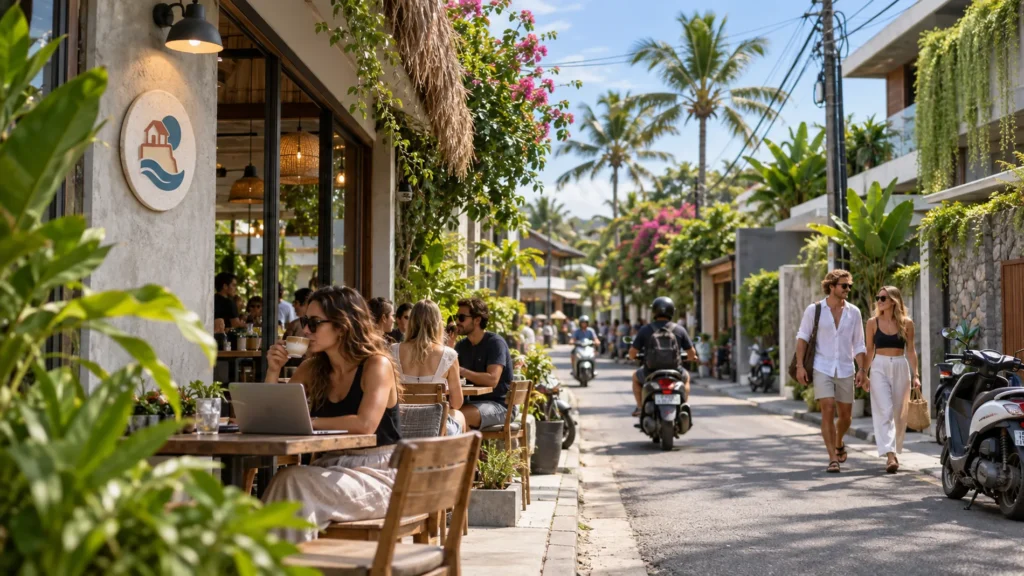
Daily life here revolves around a few hundred metres of the main road and the side streets branching off it. Breakfast, the gym, a dentist, a notary, a children’s activity studio, or a scooter repair shop can all be reached without having to travel across town. By Bali standards, that is unusual: in many parts of the island, even the simplest everyday errand can turn into a 20-minute journey each way.
Food and dining are one of the area’s biggest draws. Berawa has a dense concentration of cafés, restaurants and specialist eateries, ranging from traditional Indonesian warungs where a meal costs just a few dollars to restaurants with European wine lists.
The community is distinctly international. Australians, Europeans, Russians, Americans, a large number of remote workers, families with children, athletes attending training camps, and people who live on the island seasonally all form part of the local mix. English is widely used in businesses serving Berawa’s international residents and visitors.
Sports and wellness are the area’s second major pillar. Berawa has large fitness centres, functional training gyms, martial arts facilities, dozens of yoga and Pilates studios, and a broad ecosystem around them: massage, beauty treatments, recovery services, and aesthetic medicine clinics. Taken together, this is a strong advantage for long-term tenants who choose the area for several months or even years.
Coworking and remote work form another important layer of everyday life. Several large coworking spaces with fast internet and meeting rooms operate in Berawa and the surrounding streets, but just as importantly, almost any café effectively serves the same purpose. From an investor’s perspective, this matters because reliable work infrastructure can lengthen the average booking period and make a villa suitable not only for a week-long holiday but also for month-long stays.
Everyday practical needs are also covered reasonably well. Supermarkets carrying imported goods, pharmacies, laundries, vehicle repair shops, nurseries, and international schools are either inside the district or on nearby streets. Major hospitals are in Denpasar and Kuta, so serious medical care still requires a drive rather than a short walk. Among the best-known landmarks people use to explain the area are Sunrise School, Finns and Atlas beach clubs, and the commercial complex on Jalan Pantai Berawa. They are useful mainly as reference points on the map, nothing more.
Now for the side of Berawa that tourist guides tend to gloss over.
Traffic is the area’s biggest day-to-day frustration. In the mornings and evenings, the narrow roads fill with scooters, taxis, and trucks, while construction vehicles regularly block part of the carriageway. Pavements are far from universal, and where they do exist, they are often occupied by parked scooters or dug up for works. You can walk around Berawa, but it is not a European-style pedestrian experience: you may find yourself walking along the edge of the road, in the heat, alongside moving traffic.
Construction activity remains visible across Berawa and neighboring parts of Canggu. Buyers should therefore check surrounding plots rather than assume that current views, privacy or noise levels will remain unchanged.
Seasonality matters as well. During high season, the area becomes crowded, rental and service prices rise, and queues form around the beach clubs. In the rainy season, some side streets flood, unpaved sections of road deteriorate, and the difference between a “good access road” and a “bad one” becomes very obvious.
What to Check Before Choosing a Villa to Live In in Berawa
- Drive the actual route to the places you will use most — school, gym, supermarket — at 8:00 a.m. and 6:30 p.m., not in the middle of the day.
- Walk around the neighbouring plots and check for empty land, construction fencing, project signs, or evidence that work has already started.
- Visit the property on a weekday evening and again at the weekend to hear the actual background noise from clubs, generators, and traffic.
- Check the width of the access road: can a car get through, is there room to turn around, and does the street end in a dead end?
- Confirm the parking arrangement — private parking on the plot, shared parking, or none at all. This is critical if you plan to use a car.
- See what the road and drainage look like after heavy rain, not only on a dry day.
- Measure distances to infrastructure using the real route, not a straight line on a map.
Beach and Leisure
Berawa Beach is a wide stretch of dark volcanic sand typical of Bali’s west coast. The sand becomes extremely hot during the day, making it uncomfortable to walk barefoot around midday. The coastline is open, with no sheltered bays or breakwaters, so the landscape feels more rugged than the white-sand beaches on the east side of the island. At the same time, there are generally fewer people per square metre of sand than in Seminyak.
Surfing is the main activity. Under the right conditions, the waves can suit beginners as well as more experienced surfers, and there are surf schools and board-rental shops nearby. At the same time, the ocean along this stretch of coast needs to be treated with caution. Currents can change, the seabed shifts, and safety depends on the tide, the season, and the conditions on any given day. Berawa Beach should not be treated as a calm swimming beach for children; decisions should be based on current conditions and lifeguard warnings, not on property-listing photos.
The beach’s second major role is sunsets. Because the coast faces west, the evening is the most important time of day here. By around five or six o’clock, a noticeable share of the neighbourhood heads toward the shore, beach bars come to life, beanbags appear on the sand, and street-food vendors set up for the evening. It is a daily ritual that plays a major role in shaping Berawa’s reputation as a leisure destination.
The large beach clubs are a separate story, particularly Finns and Atlas. Their importance is less about the venues themselves and more about the effect they have on the district: a constant flow of visitors, strong name recognition, predictable evening traffic, and an easy selling point for villa renters. For property owners, that works both ways. A guest looking for accommodation within walking distance of the clubs may be willing to pay more, while an owner living nearby full-time may have to deal with music and crowds outside the window six evenings a week.
For a rental business, beach infrastructure has a measurable effect: it reduces objections during the booking process and can support higher nightly rates in peak season. But it is not a universal advantage. A property aimed at families or long-term tenants may lose more than it gains from being too close to the nightlife zone.
Transport and Infrastructure
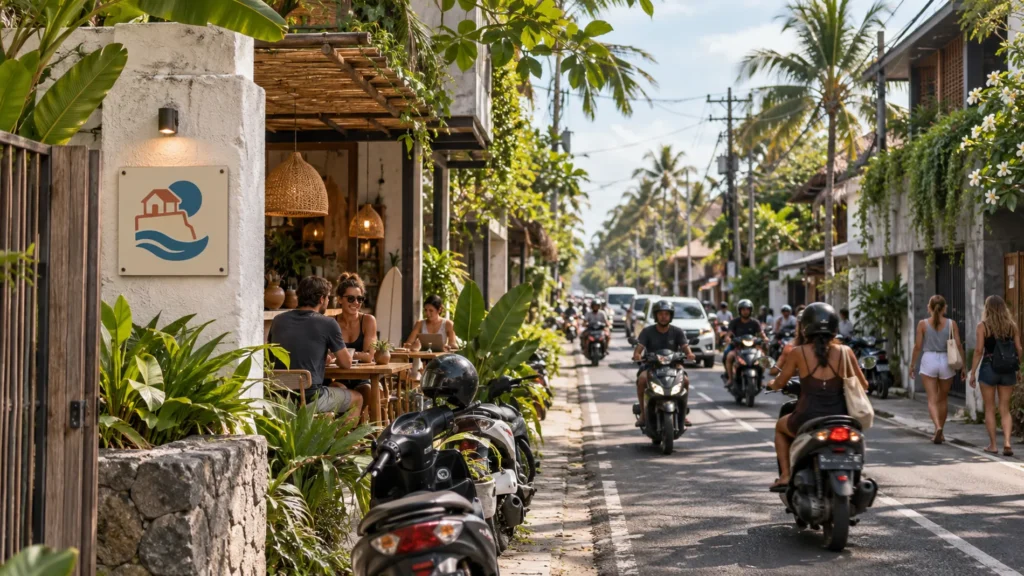
The main mode of transport in Berawa is the scooter. It solves several of the area’s everyday problems at once: narrow streets, limited parking, and traffic congestion. Scooters are also inexpensive to rent and maintain. The trade-offs are obvious, however: weather, safety, and licensing requirements. Riding without a valid licence for the appropriate vehicle category and proper insurance is a bad idea, and not only because of the risk of fines.
The main alternative is Grab and Gojek. Both operate reliably in the area and can be used for rides as well as food and goods delivery. There are, however, parts of the island where local transport groups restrict app-based services, so pickup times can occasionally be longer than the map suggests. A car makes sense in Berawa for families with children and for people who regularly travel to Denpasar or the airport, but during rush hour it is slower than a scooter and almost always less convenient when it comes to parking.
Connections with neighboring areas work roughly as follows: Batu Bolong and the rest of Canggu are a short ride away via local roads; Seminyak is reached through Petitenget; and Pererenan can be accessed either along the coast or via inland bypass routes. All three directions face the same problem in the evening: limited road capacity. For the same reason, travel times to the airport can vary dramatically, and allowing a generous time buffer is standard local practice.
Infrastructure beyond everyday needs is distributed unevenly. There are international schools both within the area and in nearby neighborhoods. General medical clinics operate in Berawa itself, while more specialized healthcare is concentrated in Denpasar. Larger shopping centers, bank branches, and government offices are also located outside the district. This is not a serious issue if you have reliable transport, but these trips are what create the real “time cost” of living in Berawa.
When choosing a property in Berawa, do not focus on the number of kilometers shown on the map. Focus on how long the route actually takes at the time of day you will be using it regularly.
The difference between one and three kilometers feels much greater here than it would in a typical European city. One kilometer often means walking distance or a two-minute scooter ride. Three kilometers may mean joining a congested main road, waiting at an uncontrolled intersection, and spending twenty minutes in traffic. Claims such as “everything is five minutes away” in property listings almost always assume empty roads outside peak hours.
Real Estate in Berawa
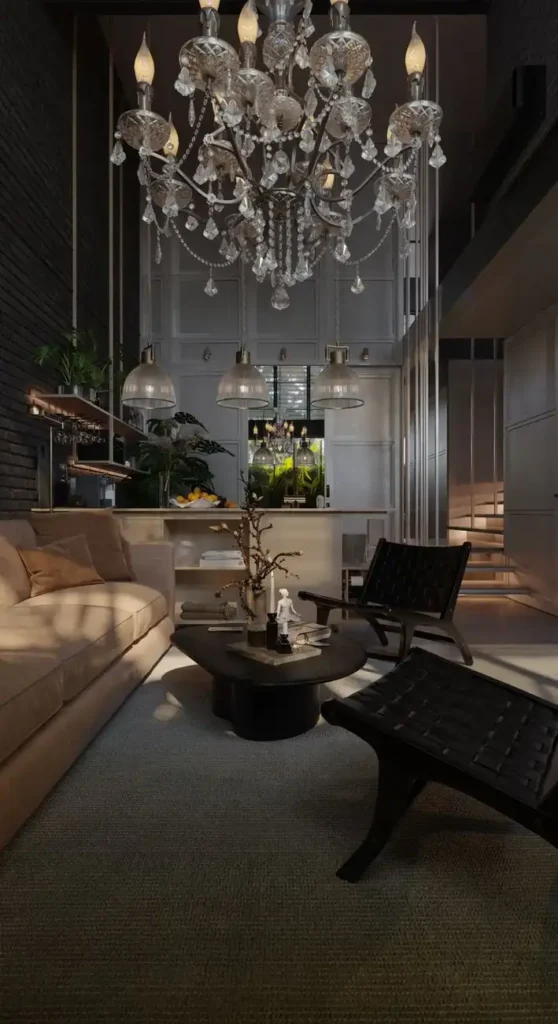
Berawa’s housing stock expanded quickly and is fairly uniform in type, but highly uneven in quality. The dominant format is the villa: a one- or two-storey house with a private pool on a plot of roughly 150 to 500–600 square metres. Traditional Balinese villas with large gardens can still be found deeper inside the area and on older plots. In the central part of Berawa, and especially closer to the beach, a different format prevails: a compact contemporary villa on a small plot, designed to fit two or three bedrooms, a pool, and a terrace onto the smallest possible footprint.
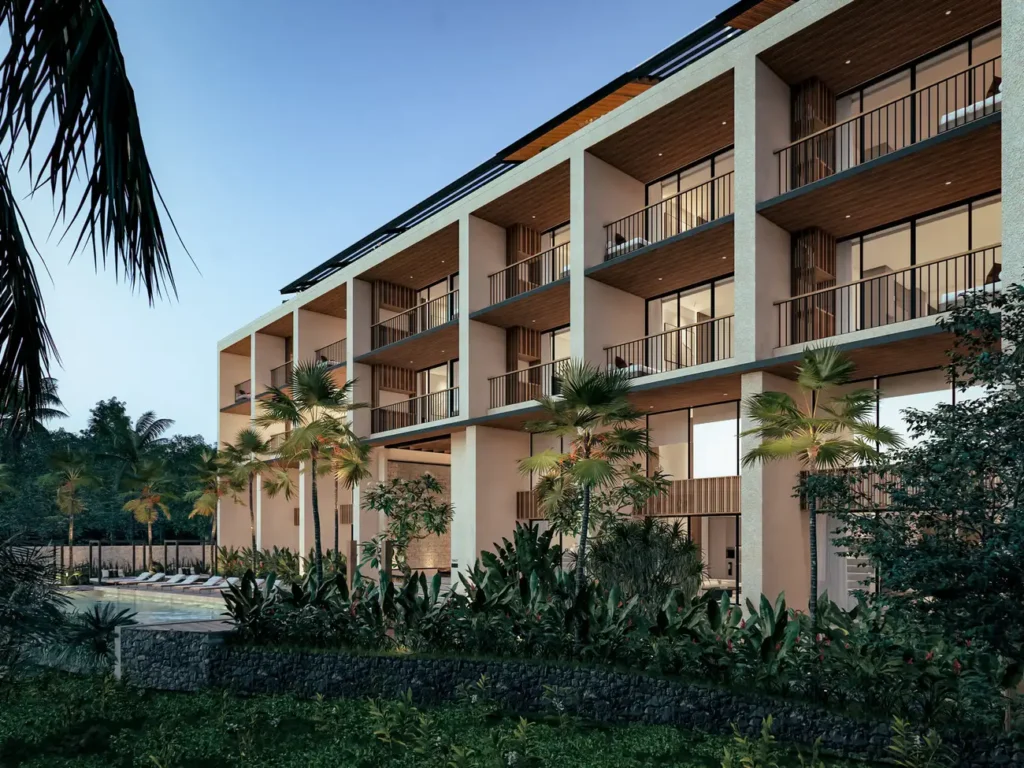
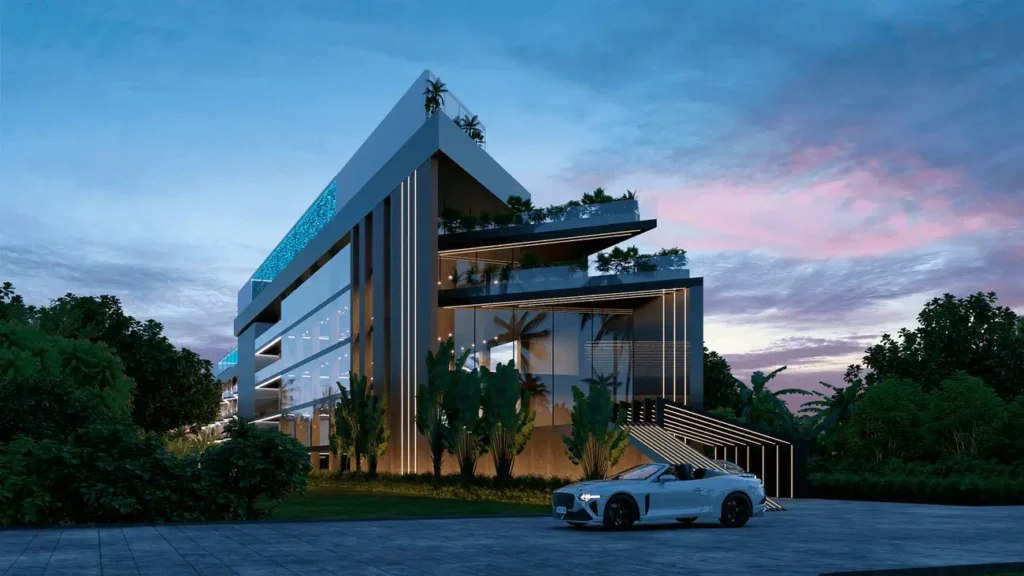
The second notable segment is apartments and managed residences. In Bali, this does not mean high-rise towers. More often, these are low-density complexes of 10 to 40 units with shared grounds, a pool, a reception area, and a management company. Projects like this appear regularly in Berawa and are aimed primarily at investors who do not want to handle day-to-day operations themselves. The entry threshold is lower than for a standalone villa, but the owner has less control and is far more dependent on the quality of management across the entire complex.
The third dividing line is stage of completion. Completed properties can be viewed, inspected, and, where there is a rental track record, assessed on the basis of real numbers. Off-plan projects are usually sold at a lower price and often come with instalment payments during construction, but they add a separate layer of risk to the deal: delivery timelines, whether the finished product will match the promised specification, and the developer’s financial resilience. A construction-stage discount is not free upside; it is compensation for risk assumed.
By use case, properties in the area fall into three categories, and they are not easily interchangeable. Villas for owner-occupation are usually set farther from the noise, with larger gardens and layouts designed for everyday living. Properties intended for short-term rental are typically closer to infrastructure, with an emphasis on visual appeal, a pool, and “Instagrammability,” often at the expense of bedroom size. Properties geared toward long-term rental sit somewhere in between, prioritising functionality, parking, and workspace.

 Bali,Berawa
 from 56.5м²
Price Benchmarks
There is no public statistical record of completed transactions in Berawa—neither in open sources nor in a form that is easy to analyse. The only data that can be used properly are asking prices, meaning the listing prices in current active listings. These reflect seller expectations, not actual closed deals, and negotiation is standard practice in the local market.
Property Price Benchmarks
Berawa does not have a transparent public database of completed residential transactions, so precise “average sale prices” should be treated cautiously. The most practical benchmark available to buyers is the range of asking prices in current listings, cross-checked against property type, location, remaining lease term and condition.
As of 2026, the market spans a very wide range. Compact leasehold apartments and managed residences can be marketed from roughly the low-to-mid US$100,000s, while modern two-bedroom leasehold villas commonly enter the several-hundred-thousand-dollar range. Larger three- and four-bedroom villas, properties close to the beach and assets with stronger land or tenure characteristics can be priced considerably higher.
Berawa Property Prices in 2026
Berawa does not have a transparent public database of completed residential transactions, so the figures below should be treated as asking-price benchmarks rather than verified average sale prices.
Property type Indicative asking-price range Typical characteristics
Apartment / managed residence from around $150,000–$250,000+ Compact units, shared amenities, professional management, usually leasehold
Compact 1–2 bedroom villa around $200,000–$400,000+ Smaller plots, private pool, commonly leasehold
Premium 2–3 bedroom villa around $350,000–$700,000+ Better location, larger plot, stronger design and rental positioning
Large / prime-location villa $700,000+ Larger land component, premium streets, beach proximity or stronger tenure characteristics
These ranges are indicative only and should not be used as property valuations. The remaining lease term, exact street, zoning, permits, plot size, construction quality and rental history can create substantial differences between apparently similar properties.
These are asking-price categories rather than recorded transaction averages. Two properties with similar bedroom counts can have very different values if one has a substantially longer lease, better access, stronger permits or a more commercially attractive location.
It is also useful to cross-check the national backdrop against official data. Bank Indonesia publishes a quarterly overview of primary residential market prices in its Residential Property Survey. This source does not describe Berawa directly, but it does help prevent buyers from mistaking developer marketing charts for official market statistics.
Table 2. The Factors That Most Strongly Affect Property Prices in Berawa
| Factor | How it affects price | What buyers should check |
|---|---|---|
| Distance to the beach and to Jalan Pantai Berawa | The closer a property is to the ocean and the area’s main artery, the higher the land value and rental rate | Walk the route yourself; assess whether access is likely to remain intact if neighbouring plots are developed |
| The specific street and access road | A narrow or unpaved approach lowers value and limits the future buyer pool | Road width, surface quality, whether a car can access the property, and what the road is like after rain |
| Plot size and shape | Land is the core store of value; an awkward shape reduces liquidity | Measurements from legal documents, not presentation materials; physical plot boundaries on site |
| Building size and construction quality | Affects both price and future costs: poor construction will require capital sooner | Roof condition, moisture, electrical systems, pool condition, and the quality of bathroom finishes |
| Age of the property | Villas in Bali wear out faster because of the climate; Bali’s humid tropical climate and intensive rental use can accelerate wear, so investors should budget for periodic refurbishment based on the property’s construction quality, maintenance history and proximity to the coast. | Renovation history, equipment condition, and the existence of service contracts |
| Design and layout | Affects rental rates more than many buyers assume | Whether the layout matches the target tenant: family, couple, or group |
| Remaining leasehold term | One of the key pricing factors; a short remaining term sharply reduces value | The exact expiry date in the contract, not a vague statement such as “about this many years left” |
| Lease extension terms | A documented extension option and its price can change the economics of the entire deal | Whether the extension is recorded in writing, who owns the land, and on what terms the extension is available |
| Zoning and permitted use | Determines what can legally be built and how the property can legally be operated | The current official zoning classification and whether the actual use complies with it |
| Permits | A property without proper permits is harder to resell and harder to operate legally | The full set of construction and operating documents, and whether the built asset matches the approved plans |
| Surroundings and development plans | Views and privacy can disappear once the next plot is built | Vacant neighbouring land, project signage, and the permitted height of future development |
| Management and rental history | A property with transparent operating history and functioning management is more liquid | 12–24 months of reports, the management contract, and the termination terms |
How we calculate these ranges: ULU Homes reviews active Berawa listings and groups comparable properties by type, location and remaining lease term. These figures represent asking prices, not completed transaction prices, and are reviewed periodically as inventory changes.
What does this mean in practice? First, properties can only be compared properly using the full picture—price, tenure, condition, documentation, and surroundings together—not on price per square metre alone. Second, a significant share of the price variation in Berawa is driven not by the quality of the house itself, but by land characteristics and the legal structure of the transaction. Third, the most expensive mistakes in this market are not overpaying by 10–15%, but buying a property that cannot be operated legally or that runs into the end of its land lease within a few years.
What Determines the Price
The phrase “property prices in Berawa” tells a buyer almost nothing. Two properties with similar floor areas can have substantially different asking prices because location, tenure, remaining lease term, access, permits, plot characteristics and condition may differ. It is simply the result of how many variables go into pricing: distance from the ocean, the specific street, plot size and shape, building size and construction quality, the age of the property, the standard of finishes and design, the width of the access road, permitted land use, the existence of construction and operational permits, the remaining lease term and the conditions for extension, the view, development plans for neighbouring plots, and whether competent management is already in place.
One factor deserves special attention: the leasehold term. If a property is being sold with, say, only 18 years remaining on the land lease, it is fundamentally a different asset from an otherwise similar house with a 30-year term and a documented option to extend. The price gap between the two can be dramatic, and any attempt to compare them purely on “price per square metre” without accounting for this is meaningless.
ars.
Buying as a Foreigner: How Property Rights Work
The first thing to understand is that Indonesia’s land ownership system works very differently from the European model. A foreign individual cannot obtain a direct equivalent of conventional freehold ownership. The highest form of land title, Hak Milik, is reserved for Indonesian citizens. What foreign buyers can access are alternative legal structures, each with its own limitations, terms, and conditions.
The most common arrangement in Bali is leasehold: a long-term lease of the land and property under an agreement with the owner. The buyer is not purchasing the land itself, but rather acquiring the right to use it for a fixed period set out in the contract. The key points to examine are the length of the lease, the mechanism and cost of renewal, the parties’ rights in the event of resale, inheritance, or early termination, and whether the agreement has been executed in the legally appropriate form for the transaction and whether any registration, recording or supporting documentation required for that structure has been completed. Buyers should not rely on verbal promises about renewal: extension rights, pricing mechanisms and deadlines should be documented clearly in the contract.

Other forms of tenure also exist. Hak Pakai, or right of use, may under certain conditions be granted to a foreign resident; eligibility depends on residency status, the type of property, and the characteristics of the land. Through an Indonesian foreign-investment company, or PT PMA, other land rights may also be available, including building and use rights. But this means establishing and operating a genuine corporate structure, with capital requirements, reporting obligations, taxes, and ongoing compliance. A PT PMA is a corporate investment structure with capital, licensing, reporting, tax and compliance obligations. It should not be treated as a simple substitute for personal freehold ownership, and its suitability depends on the buyer’s activities and transaction structure.
There are also “grey” structures involving a nominee Indonesian citizen who holds the property on behalf of the foreign buyer. These arrangements carry significant risk and should not be viewed as a legitimate way to save money.
Another issue that is consistently underestimated is that the right to hold a property and the right to rent it legally to tourists are two different things. The ability to operate short-term rentals depends on the zoning of the land, the classification of the property, and the relevant operating permits. A villa may be perfectly valid as a residential property and still not be legally permitted to function as tourist accommodation. Zoning rules in Badung also restrict development in certain agricultural, green, and coastal areas. Buying a property that was built in breach of those restrictions creates a risk that does not disappear when ownership changes.
This section provides a general overview of how the market is structured and is not a substitute for legal advice. Every individual transaction should be reviewed by an independent lawyer and a notary/PPAT who has no connection to the seller.
What to check before paying a deposit
- Land title or lease agreement — what document actually exists, who is named as the owner, and whether those details match the seller’s documents.
- Legal status of the land — whether there are any mortgages, disputes, inheritance claims, or multiple sales of the same property.
- Plot boundaries and land area — verify the physical measurements against the official plan; discrepancies are common in the Bali market.
- Zoning — which zoning category applies according to current official records, and whether it permits the existing and intended use.
- Building approvals and completion documents — verify PBG and SLF where applicable, together with valid legacy approvals for older buildings, and confirm that the completed property corresponds to the approved documentation.
- Operating licences — identify what permits or business licences are required for the intended rental model, which belong to the property and which belong to the operating entity, and whether a change of owner or operator requires amendment or a new application.
- Lease renewal terms — the exact expiry date, renewal mechanism, price, who determines that price and when, and what happens if renewal is refused.
- Tax obligations — which taxes arise on purchase, ownership, and rental income, who pays them, and how they vary depending on the ownership structure.
- Contractual rights of the parties — whether the rights can be assigned, sublet, sold, inherited, and how disputes are to be resolved.
The remaining term on a land lease is not a minor contractual detail; it is part of the property’s value. A property with a short lease remaining and no fixed renewal terms loses value with every year of ownership.
Berawa’s Investment Potential
Berawa attracts investors for entirely rational reasons. Demand does not have to be created from scratch — it already exists. An international audience arrives throughout the year; the infrastructure serves tourists, digital nomads, and families alike; the beach, dining scene, and wellness cluster all work as standalone attractions; and Canggu’s name recognition removes the need to explain the location when marketing the property. On top of that, several rental models work in parallel, giving owners fallback options if one strategy stops performing.
The drawbacks are equally clear. Berawa is generally marketed at a premium relative to many surrounding Canggu locations, which means acquisition price plays a particularly important role in the investment case. Competition among similar villas has intensified: there is a large supply of new properties, many of them developed specifically for short-term rentals. Ongoing construction, noise, and traffic affect reviews and repeat bookings. Performance depends heavily on micro-location and management quality, not simply on the amount invested. And finally, whether the property can legally be rented out directly determines whether the investment model is viable at all.
Where the Income Comes From
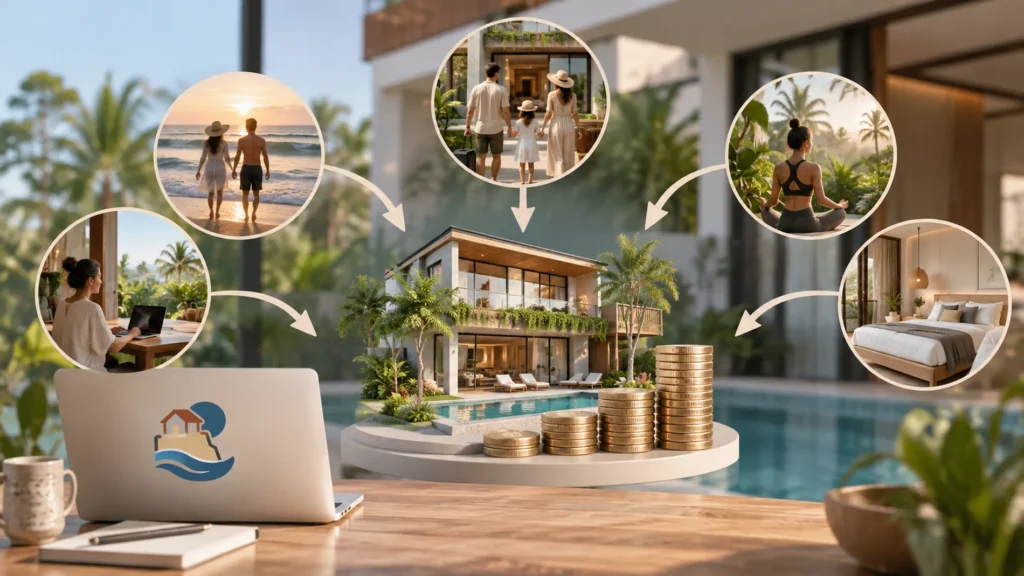
Short-term rentals mean daily and weekly bookings through platforms. They offer the highest potential nightly rate, but also the highest operational burden: cleaning between stays, guest communication, platform commissions, wear and tear on furniture and linens, and constant management of reviews. The model is sensitive to seasonality and to the quality of both photography and service.
Mid-term rentals typically cover stays of several weeks or months. They can reduce guest turnover, cleaning frequency and servicing costs compared with nightly rentals. Demand may come from remote workers, families and other longer-stay visitors, but occupancy and achievable rates still depend on the individual property and season.
Long-term rentals generally involve lower guest turnover and simpler day-to-day operations. Gross revenue potential may be lower than with successful nightly rentals, but operating costs can also be materially lower. Payment terms and lease duration vary by contract.
Choosing between these models is not a cosmetic decision. It determines the right location, layout, furnishing level, and management structure. A property designed for nightly rentals is rarely ideal for year-long tenants, and the reverse is also true.
Gross Yield and Net Yield
This is where much of the misunderstanding in the market begins.
Gross yield is a pre-expense return metric. It shows rental revenue relative to the acquisition cost before operating expenses are deducted, so it should not be confused with the investor’s actual net return. It is also the figure most commonly shown in sales presentations because it looks the most attractive.
Net yield is calculated after all operating costs and therefore cannot simply be copied from someone else’s spreadsheet; it must be modelled for the specific property. The gap between gross and net returns in Bali can be substantial, and it widens as the operating model becomes more intensive: short-term rentals carry materially higher costs than annual leases.
Marketing materials for Canggu regularly advertise double-digit returns. These should be treated as seller projections, not as market statistics. In most cases, they are gross figures based on optimistic assumptions for occupancy and rates and do not include the full cost base. No independent source verifies those numbers.
Costs most often omitted from calculations include:
- vacancy periods between bookings and during low season;
- management company fees;
- booking platform commissions;
- cleaning and linen changes;
- electricity, water, internet, and waste collection;
- pool and garden maintenance;
- routine repairs and emergency work;
- replacement of furniture, appliances, and textiles every few years;
- insurance, where applicable;
- taxes depending on the ownership structure and rental model;
- marketing, photography, and listing promotion;
- a reserve for major repairs;
- the cost of extending the land lease as expiry approaches.
Table 3. How to Model an Investment in Berawa
| Metric | What to Include |
|---|---|
| Entry price | Purchase price plus ancillary costs: legal due diligence, notary, transaction taxes, furnishing, upgrades |
| Revenue | Average daily rate (ADR) × actual annual occupancy, not the figure claimed in a sales presentation |
| Vacancy | Unbooked days, low season, gaps between guests, repair periods |
| Management | Management company fee and exactly what is included |
| Platforms | OTA commissions, long-stay discounts, payment processing fees |
| Operating costs | Staff, utilities, pool and garden maintenance, internet |
| Reserve | Repairs, replacement of furniture and appliances, interior refreshes |
| Taxes | Depend on ownership structure and rental model; calculated separately |
| Currency | Most costs are in IDR, while expected returns are often measured in USD or EUR |
| Net income | Revenue minus all expenses for the period |
| Net yield | Net income / total invested capital × 100% |
| Lease term | Remaining term and renewal cost as part of the project’s overall economics |
This table is not a worked example; it is a framework. It needs to be populated with figures from the specific property and from verifiable sources: management company statements, actual rental history, and utility bills. Two lines deserve particular attention. The first isprojected occupancy should be compared with any available historical operating reports rather than accepted solely from a sales presentation. The second is the capital expenditure reserve: tropical climate, salt air, and intensive use wear properties out faster than many European buyers expect. Bali’s humid tropical climate and intensive rental use can accelerate wear, so investors should budget for periodic refurbishment based on the property’s construction quality, maintenance history and proximity to the coast.
Two properties with the same asking price cannot be compared on the basis of advertised ROI alone. The remaining land lease term, permits, cost structure, and actual operating model can produce completely opposite outcomes.
Example: Why Gross Yield Can Be Misleading
Consider a hypothetical villa purchased for $300,000 that generates $36,000 in annual gross rental revenue.
Its headline gross yield would be:
$36,000 ÷ $300,000 = 12%
But this is not the investor’s actual return. Management fees, OTA commissions, vacancy, utilities, maintenance, cleaning, repairs, taxes and capital reserves still need to be deducted.
If annual operating costs reduced distributable income to $21,000, the simplified net yield before any financing costs would be:
$21,000 ÷ $300,000 = 7%
This example is illustrative only. Actual Berawa performance depends on the property, legal operating structure, occupancy, ADR, management and costs.
What Supports Demand
Bali continues to record high international visitor volumes, providing a supportive tourism backdrop for accommodation demand. According to BPS Bali, 578,251 foreign tourists arrived on the island by direct international flights in May 2026, while the occupancy rate for star-rated hotels in the province reached 61.16% (Bali Tourism Developments, May 2026). Over the whole of 2025, the island received around 6.95 million direct international arrivals, above the 2024 level.
Those figures need to be interpreted correctly. Official BPS statistics describe the province of Bali and the classified accommodation sector, not private villas in Berawa. Hotel occupancy cannot simply be applied to a standalone villa: the sales channels, guest profile, seasonality, and pricing strategy are different. It would be incorrect to conclude from these data that “Berawa villas run at 61% occupancy.” The proper conclusion is narrower: tourism flows to the island remain high, creating a supportive backdrop for the rental market, but they do not guarantee the performance of any individual property.
Berawa’s local demand drivers are nevertheless real and specific. They include dense, functioning infrastructure, beach access, a strong food and beverage scene, sport and wellness as destinations in their own right, an international audience, and the strength of Canggu as a recognizable brand. There is also a broad mix of tenants: a tourist staying for a week, a remote worker for two months, a family for a school year, or an athlete coming for a training camp. This mix gives owners access to several potential tenant segments rather than relying exclusively on short-stay holiday demand.
High demand, however, does not eliminate competition. Villa supply in Canggu has expanded rapidly, which means the contest is no longer simply for tourists, but for the individual guest scrolling through an overcrowded booking platform. A property with weak visual presentation, poor pricing, ineffective management, or bad reviews will underperform regardless of how many people arrive on the island. Macro statistics explain why the market exists; they do not explain why someone will choose your villa.
Berawa Property Investment: Pros and Cons
| Advantages | Trade-offs |
|---|---|
| Established international destination | High acquisition cost |
| Dense lifestyle infrastructure | Strong competition between similar villas |
| Several rental models | Traffic and construction |
| Beach and leisure demand | Performance varies sharply by micro-location |
| Large international audience | Short-term rental requires legal and operational checks |
| Mature area rather than speculative location | Less room to rely purely on future area development |
Investor Risks
Below is a practical list of the issues that most often undermine investment performance in Berawa. The purpose is not to discourage buyers, but to make sure each one can be checked before a deal is completed.
- Overpaying for a fashionable address. The Berawa premium is already in the price. If the property is purchased at the top of the market, every return scenario starts at a disadvantage.
- A short remaining lease term. As the remaining lease term becomes shorter, the property may become less attractive to future buyers, particularly where extension rights, extension pricing or the landowner’s obligations are unclear.
- Unclear renewal terms. A verbal “of course we’ll renew” is worth exactly nothing. A renewal price to be determined later by the landowner is an open-ended item in your financial model.
- Zoning. The plot may be in a zone where the current use is not permitted. This often surfaces during resale or due diligence rather than at the initial purchase.
- Missing or non-compliant permits. The completed property may not match the approved plans, the permit may be missing, or it may be issued to someone else.
- Inability to operate legally. The house exists, but the legal right to rent it to tourists does not. In that case, the entire investment thesis collapses.
- Surrounding environment. Nearby construction, traffic, nightlife, generators or future development can affect privacy, reviews and achievable rental rates.
- Access. A narrow lane with no turning space, a washed-out dirt road, or no parking can eliminate part of the guest pool before they even open the listing.
- Overestimating occupancy. This is the most common modelling mistake. The difference between 80% and 60% occupancy can wipe out the entire net profit.
- Over-optimistic financial assumptions. High occupancy projections, headline gross yields and peak-season ADR can produce a model that looks far stronger than realistic net performance.
Many of these risks are manageable — but only at the property-selection and due-diligence stage, not after completion.
Not sure which type of property in Berawa fits your goals? Take our short property selection quiz to identify the right format, budget range, and realistic use case.
Berawa or Other Parts of Canggu
Within Canggu and the surrounding area, several locations offer a similar set of amenities but with different economics and a different character. Comparing them purely on a “better or worse” basis is not useful; the right choice depends on the intended use.
Table 4. Berawa, Batu Bolong and Pererenan
| Area | Atmosphere | Prices | Infrastructure | Traffic | For Living | Investment Profile |
|---|---|---|---|---|---|---|
| Berawa | Active, international, commercially dense | High | The most complete: schools, shops, sports, clubs, services | Heavy, especially in the evening | Comfortable for those who value convenience and accept noise | Mature demand, high entry cost, strong competition |
| Batu Bolong | Younger, surf-oriented, denser and noisier | High, in some places comparable to Berawa | Dense but more tourism-focused and less family-oriented | One of the most congested parts of Canggu | Better suited to short stays than permanent living | High guest flow, strong dependence on short-term rental demand |
| Pererenan | Quieter, greener, growing, but less dense | Relatively lower, though rising | Developing; basic needs are covered, with some services in nearby districts | Moderate, but increasing | A strong balance for families and longer stays | A bet on area development, lower entry price, less mature demand |
| Seminyak | Urban, more established, hotel-oriented | High | Highly developed retail, restaurant and hotel infrastructure | Dense urban traffic | Best for those who want city convenience by the sea | Mature market with a long rental history and strong hotel competition |
Here is how to interpret the comparison in practical terms.
Berawa suits buyers who want an established environment. There is no need to wait for the area to mature: the infrastructure works, demand is already there, and tenants understand where they are going. That lowers location risk, but it also removes the biggest source of upside — the uplift that comes from an area being developed from scratch. Buyers are paying for value that already exists and must make their return through the operational quality of the property rather than through future district development.
Batu Bolong is better suited to investors building a model around short-term rentals and tourist flow. Density and activity are at their highest here, while the beach and surf spots are close by. It is less suitable for permanent family living because of the noise, narrow streets, and the dominance of tourism.
Pererenan appeals to buyers who are comfortable with lower density and a slower pace. Entry prices are generally lower, plots tend to be larger, and there is more greenery. In exchange, some infrastructure remains in neighboring areas, while rental demand develops more slowly and can be less predictable outside peak season.
Seminyak is worth considering for buyers who want an urban setting. It has a long-established rental market, major hotels, developed retail, and a different audience — generally older and less surf-oriented.
There is no universal answer as to which area is “best”: the real difference lies not in quality, but in the risk profile and in who the likely tenant will be.
Who Berawa Is Best Suited For
It makes more sense to choose a district using a clear set of criteria than on the basis of one trip or first impressions.
Berawa is a good fit if:
- you value established infrastructure and do not want to travel far for everyday essentials;
- you want an active lifestyle with sports, cafés, coworking spaces, and an international community;
- proximity to the beach and evening venues is important;
- you are comfortable with a higher entry budget and understand what the premium is paying for;
- the property is intended for both personal use and rental income;
- you prefer mature, existing demand over a speculative bet on future development in an underdeveloped area;
- you are willing to use professional management rather than run the property yourself.
You should compare other areas if:
- quiet and privacy are the top priority;
- the budget is limited and you want the maximum amount of space for the money;
- dense development and constant nearby construction would be difficult to tolerate;
- the investment thesis depends entirely on maximizing the advertised return;
- daily congestion and scooter traffic are a serious drawback;
- the purchase is primarily for long-term family living, with space taking priority over location;
- the strategy is to enter an area at an early stage of development.
Mixed cases are more common than clear-cut ones. Often the best compromise is a property within Berawa, but away from the busiest street — close enough to benefit from the infrastructure without taking on the full impact of noise.
How to Choose a Property
The sequence of decisions matters more than intuition. The process below helps reduce the risk of missing something critical.
Start with the objective. Personal use, pure investment, or a mixed strategy — this decision affects everything else, including tolerance for noise and layout requirements.
Choose the rental model before choosing the property, not after. Short-term, mid-term, and annual rentals have different location, furnishing, and management requirements.
Select the micro-location based on that model: closer to the beach, in the central corridor, or on a quieter street further inland.
Verify the legal structure of the transaction — what exactly you are acquiring, under what legal basis, for how long, and with which rights.
Check the zoning and confirm that the intended use of the land is permitted.
Read the land lease agreement in full, not the seller’s summary: term, renewal, assignment, inheritance, and termination.
Check the permits — both building and operating permits, including whether the completed property matches the approved plans.
Assess the physical condition with an independent specialist: roof, moisture, electrical system, water supply, pool, septic system.
Inspect neighboring plots and find out what may be built on them. Empty land next door is simply a future neighbor — the only question is when.
Review the management setup: who operates the property, what the fee is, what it includes, whether reporting is transparent, and whether the management company can be replaced.
Build a financial model using the framework in Table 3 and populate it with verifiable data rather than seller estimates.
Run a sensitivity analysis. This is a crucial step that many buyers skip. Recalculate the model using less favorable assumptions: occupancy 10–15 percentage points below expectations, average daily rates 10–20% lower, operating expenses 15–20% higher, plus one month of downtime for repairs. If the property moves into negative territory under that scenario, the model is relying on optimism rather than resilience. A sound investment should still make sense under an average scenario, not only under the best-case one.
Is Berawa a Good Place to Buy Property?
Berawa can make sense for both lifestyle buyers and rental investors, but it is not a low-cost or low-risk entry point into Bali property. Its main advantage is that buyers are paying for infrastructure and demand that already exist; its main disadvantage is that much of that value is already reflected in the acquisition price.
In practice, the outcome of an investment in Berawa is shaped by four factors. Micro-location matters because the difference between a street close to the beach and a lane farther inland can affect the rental rate, the type of tenant the property attracts, and day-to-day living comfort. Legal structure is equally important: what exactly is being acquired, for how long, and what rights come with the property in terms of use and operation. Entry price can make or break the investment, because overpaying reduces returns throughout the entire holding period, and even strong management cannot fully compensate for a poor acquisition price. Finally, there is the realistic net-return model: a calculation that includes vacancy, management and platform fees, maintenance, wear and tear, taxes, and currency risk rather than relying only on gross revenue from the strongest month of the year.
For buyers considering Berawa for the first time, it makes sense to begin not with a shortlist of properties, but with a clear use case: living in the property, renting it out, or combining the two. That decision influences everything else, including the appropriate budget and the level of noise or activity you are willing to accept. And every individual transaction — including the contract, title, zoning, permits, and tax treatment — should be reviewed by an independent lawyer and notary who are not connected to the seller.
ULU Homes works with buyers evaluating property across Bali and focuses on comparing each property on its legal structure, location, operating model and verifiable financial assumptions.
 Real estate in Georgia
 Real estate in Cyprus
 Real estate in the UAE
 Real estate in Montenegro
 Real estate in Thailand
 Real estate in Spain
 Real estate in Saudi Arabia
 Real estate in Turkey
 Real estate in Zanzibar
 +62 895 001 924 667
 hello@ulu-homes.id
 Tibubeneng, Canggu, Kuta Utara, Badung Regency, Bali 80361, Indonesia


 Get catalogue of TOP-7 objects