
 +62 895 001 924 667




Kuta is not just the first place on Bali that most visitors see after landing at Ngurah Rai International Airport. It is one of the island’s most established, densely developed, and recognizable tourist areas — a destination defined by its beach, surfing culture, shopping streets, nightlife, and a constant flow of visitors from dozens of countries around the world. Located in Badung Regency in the southwestern part of Bali, the area is administratively part of Kuta District — a southern tourism zone that also includes Legian and Tuban.
One important clarification should be made from the very beginning: this guide focuses specifically on Kuta in Bali, located within Badung Regency. It does not refer to Kuta/Mandalika on the island of Lombok, which often appears in search results for the same keyword. These are two completely different destinations with distinct tourism profiles, levels of infrastructure development, and real estate markets.
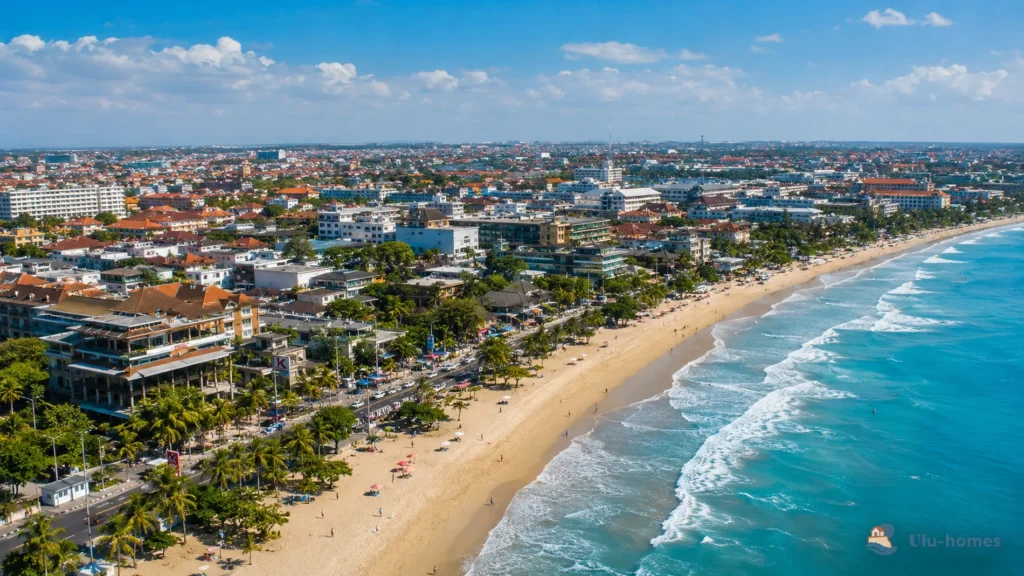
Kuta in Bali has long been one of the island’s most established tourist areas. It has been part of Bali’s tourism landscape for several decades, with dense development, mature infrastructure, and visitor activity throughout the year. This is precisely why evaluating Kuta as a real estate location requires a more nuanced perspective: the market is already mature, so opportunities differ from those available in emerging areas, but there is an established tourism market, mature infrastructure, and a clearly defined rental audience. For some buyers, these factors represent a major advantage; for others, they may be a limitation.
This guide examines Kuta from the perspective of a property buyer: where to buy, what types of real estate are available, how prices differ by location, what rental models work, and what legal factors should be checked before purchasing property in Kuta, Bali.
It explores the district’s exact location, internal structure, differences between its micro-areas, property prices, tenant profiles and rental demand, the real investment case behind the market, and the key factors that should be verified before moving forward with a purchase.
Kuta on the Map of Bali
Kuta is located on the western coast of southern Bali, approximately a 5–10-minute drive from Ngurah Rai International Airport. To the north, the area borders Legian, which gradually transitions into Seminyak. To the south lies Tuban, an area administratively closer to the airport with its own established hotel infrastructure. This entire coastal strip belongs to Badung Regency — one of the most developed and economically active tourism regions in Indonesia.
Administratively, Kuta District includes several villages (kelurahan), and it is important not to confuse different geographical definitions. Kuta as a tourist area and Kuta District as an administrative unit are not the same thing. South Kuta (Kuta Selatan) is a separate subdistrict located further south, covering areas such as Jimbaran, Bukit, and Uluwatu. When real estate materials refer to “South Kuta,” they may be describing an entirely different property market with different price levels and a different buyer profile.
For buyers and investors, geography plays a crucial role for several reasons. Proximity to the airport means minimal transfer times — a major advantage for short-term rental properties, where guests frequently arrive and depart. The western coastline offers spectacular ocean sunsets. The relatively flat terrain in central Kuta allows easy walking access to beaches, restaurants, and shops without significant elevation changes. At the same time, this same flat landscape and high-density development contribute to the area’s main drawbacks: noise, congestion, and heavy traffic during peak hours.
Comparative Table of Kuta Micro-Locations
| Location | Character | Main Audience | Property Types | Suitable Strategy |
|---|---|---|---|---|
| Central Kuta | Dense, busy, highly tourist-oriented, pedestrian-friendly | Young travelers, backpackers, surfers | Apartments, budget guesthouses, hotels | Short-term rentals, high-volume tourist demand |
| Tuban | Quieter than central Kuta, closer to the airport | Families, transit travelers, mid-range hotel guests | Hotels, apartments, serviced residences | Mixed rental strategy, family segment |
| Border with Legian | Transitional area, less dense, more restaurants and lifestyle venues | Returning visitors, tourists aged 25–40 | Villas, apartments, boutique hotels | Short-term rentals, higher ADR potential |
| Legian (context) | Quieter than Kuta, with a more Seminyak-like atmosphere | Travelers seeking a balance between price and quality | Villas, apartments | Rental income + potential capital appreciation |
How Kuta Is Structured
Kuta is not a uniform area. Even within just a few blocks, the character of the streets, building density, noise levels, and the profile of visitors can change dramatically. This directly affects the rental dynamics and determines which types of properties are likely to perform well — and which are unlikely to succeed.
Central Kuta
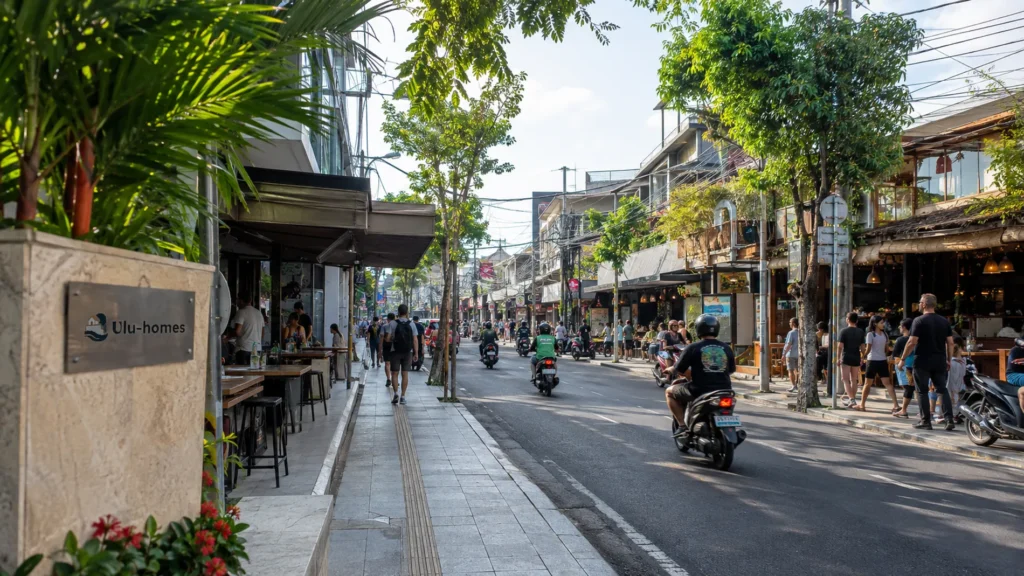
The central part of the area revolves around Jalan Pantai Kuta, the beachfront road, and the surrounding side streets: Poppies Lane I and II, Gang Beringin, as well as the lower section of Legian Street. This is where tourist activity reaches its highest concentration, with street vendors, sidewalk massage services, 24-hour cafés, surfboard rentals, and numerous surf schools. It is an environment designed entirely around short-term visitors who spend only a few days here and want to get the most out of every hour.
For property owners in central Kuta, this leads to a clear implication: a significant share of rental demand comes from short-term visitors who value walking distance to the beach, convenience, and accessibility. Stay duration varies depending on season, property type, and visitor profile, with many rentals focused on short-term tourism. Guests are usually less demanding when it comes to premium finishes or sophisticated design, but they are highly sensitive to pricing and convenience. This creates strong turnover potential, but also higher operating costs due to frequent cleaning, linen replacement, and faster wear and tear of the property.
Noise is a genuine factor, not just a minor consideration. Nightlife in central Kuta continues until the early morning hours, and this must be taken into account when choosing a specific location within the area. A property located 300 meters from the main nightlife venues and a property on a quiet side street within the same district are two completely different scenarios for long-term residents or families.
Tuban
Tuban is located south of central Kuta, closer to the airport. The area has a calmer atmosphere, with fewer nightlife venues and less street activity, while hosting several large international hotel chains. The typical visitor profile in Tuban consists of families with children and travelers who prioritize convenient airport access and a quieter stay.
For investors, Tuban represents a different rental model: its short transfer time from the airport makes the area especially attractive for guests with early flights, short stays, or limited time on the island. Competition remains high, but it is more concentrated within the hotel sector, which creates additional pressure on private properties to offer a strong balance between price and quality.
The Border with Legian
The area between Kuta and Legian represents a transitional market. Here, there is a noticeable increase in restaurants and venues aimed not at first-time street tourists, but at repeat visitors who already know the island. Nightlife remains present, but it is less intense and less disruptive. The beach is still within walking distance, although properties are no longer located within the first few hundred meters from the coastline. The audience is slightly older and generally less price-sensitive than in central Kuta, making this area more attractive for owners of mid-range and upper-mid-range properties.
Well-positioned apartments or smaller villas in this zone may achieve stronger rental performance depending on property quality, positioning, pricing strategy, and management.
Everyday Life in Kuta
Living in Kuta for a few days as a tourist and spending several months here as a resident are two very different experiences — and an honest guide should address both perspectives.
Kuta is among the most established tourist areas in Bali in terms of daily services, shopping, restaurants, and visitor infrastructure. The district is home to several major shopping centers, including Beachwalk Shopping Center directly by the beach, Discovery Shopping Mall in the Tuban area, and Lippo Mall Kuta. Grocery stores and supermarkets such as Coco Supermarket and Carrefour cover everyday needs, while pharmacies, banks, ATMs, and clinics are widely available throughout the central area. From a practical, day-to-day perspective, Kuta is significantly more convenient than, for example, the more remote parts of Ubud or the newer, less developed areas of the Bukit Peninsula.
The restaurant and café scene is exceptionally diverse and covers almost every type of cuisine. Traditional Indonesian street food stands alongside Italian pizzerias, burger restaurants, Japanese dining spots, and international coffee shops. Prices vary widely, from affordable local warungs to premium restaurants and beachfront venues. For everyday dining, Kuta is generally more affordable than Seminyak and comparable to Canggu in the mid-range segment.

Surfing remains one of the main reasons why Kuta has stayed popular for decades. Kuta Beach and Legian Beach offer waves that are well suited for beginners and intermediate surfers. There are dozens of surf schools in the area, and rental equipment is available almost everywhere along the coastline. For experienced surfers, areas such as Uluwatu and Padang-Padang offer more challenging conditions, but for learning, practicing regularly, or enjoying the sport without long drives, Kuta remains a very practical choice.
Transportation is one of the district’s main challenges. Traffic congestion in Kuta is not an occasional inconvenience — it is a constant part of everyday life, especially around the airport, along Jalan Sunset Road, and in the central areas during the evening hours. Getting around by scooter is usually much faster than traveling by car. Grab and Gojek services are widely used transport options in Kuta, but during peak hours waiting times can increase and routes may become significantly longer due to detours. A trip to Seminyak can take 10–15 minutes in normal conditions but may stretch to 30–40 minutes during busy periods. Reaching Canggu can take anywhere from 20 minutes to more than an hour depending on traffic.
Walkability is one of the genuine advantages of central Kuta. The beach, cafés, shops, restaurants, and ATMs are all accessible without transportation. This is a significant benefit both for tourists and for long-term renters who do not want to rely on a scooter every day. In Tuban and along the northern border with Legian, walkability is lower, and many destinations require some form of transport.
For long-term living, Kuta works best for people who value convenience, developed infrastructure, and a constant flow of activity. However, for those seeking peace, nature, privacy, or the more intimate feeling of having a quiet “home neighborhood,” Kuta’s intensity can become overwhelming. The tourist flow here continues throughout the year, even during the low season, and this is something residents need to accept as a permanent characteristic of the area rather than a temporary phase.
Who Kuta Is Best Suited For
Kuta is a conscious choice rather than a compromise. The area genuinely works well for a specific type of buyer, tenant, or resident. However, trying to prove that it is the right fit for everyone would be misleading.
Kuta is a good choice if:
- you value being within walking distance of the beach and having well-developed tourist infrastructure nearby;
- you are looking to purchase property for short-term rentals in a location with strong tourist demand;
- proximity to the airport is a key factor in your property usage model, for example, because of frequent arrivals and departures or a transit-oriented lifestyle;
- you are a beginner or intermediate surfer and want to live close to an accessible surf beach;
- you want the most convenient everyday lifestyle with minimal effort — restaurants, shops, clinics, and essential services are all within easy reach;
- you are considering affordable or mid-range short-term rental properties and are prepared to evaluate demand, operating costs, and management quality.
You may want to consider another area if:
- you are looking for peace, privacy, and a natural setting — in that case, Ubud, the northern parts of Canggu, or more secluded areas of Bukit may be a better match;
- you are interested in a premium wellness lifestyle and a slow-travel audience — Seminyak or Uluwatu may offer stronger positioning;
- you are counting on property appreciation driven by the development of an emerging location — Kuta may offer different growth dynamics compared with emerging areas where future development is a larger part of the investment case., as the area is already mature and fully established;
- you are looking for a calm family environment with more space — Sanur is likely to meet these needs to a greater extent;
- you are targeting long-term rentals for professionals and digital nomads — Canggu has a significantly larger community of this type.
Real Estate in Kuta
Kuta’s real estate market developed significantly earlier than that of most other tourist areas in Bali, and this maturity is clearly reflected in the structure of available properties.
Apartments and serviced residences are among the property formats available to foreign buyers in Kuta. These typically include studios and one- or two-bedroom units within managed complexes offering reception services, swimming pools, and professional property management. This format is convenient for short-term rentals: the property is ready for occupancy, service infrastructure is already in place, and operations are often organized from the start. The main challenge, however, is standardization. In Kuta’s highly competitive market, it is difficult to stand out among hundreds of similar apartments without clear positioning, strong guest reviews, and an effective pricing strategy.
Villas do exist in Kuta, but their character differs from villas in areas such as Seminyak or the Bukit Peninsula. Here, villas are generally more compact and located within dense urban surroundings rather than on large plots of land with open views. This is an important distinction: a villa in Kuta is primarily about privacy and having your own pool, rather than space, tranquility, or panoramic scenery. These properties are typically aimed at couples, small groups, or families looking for a private home with a swimming pool close to the beach at a more accessible price point.


 Bali,Melasti
 from 142,7м²
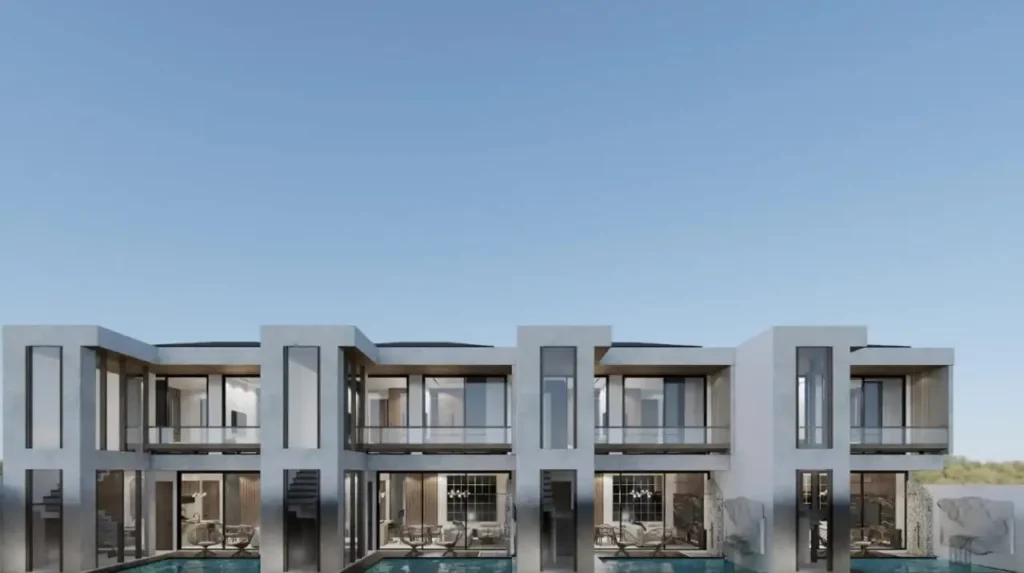 Bali,Canggufrom 102м²
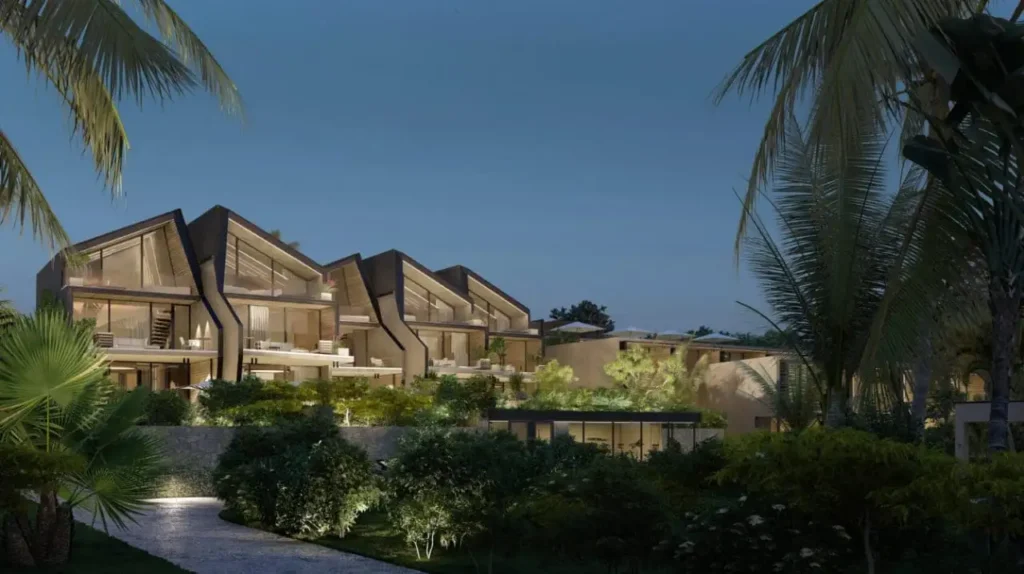 Bali,Balanganfrom 95.2м²
Off-plan properties are available, although their share of the market is smaller than in rapidly developing areas such as Canggu or the Bukit Peninsula. New projects continue to appear, but finding available land in central Kuta with suitable zoning for a high-quality development is becoming increasingly difficult. Buying during the construction phase involves the usual risks: delays, project changes, developer reputation, and the need for thorough legal due diligence. Kuta is a mature and densely developed area, meaning its market dynamics differ from emerging Bali locations, where the investment case is often built around new developments and future land appreciation.
Ready-made income-generating properties with an established rental history represent another important segment. For buyers, these assets are attractive because they allow them to evaluate real performance indicators: occupancy rates, ADR (average daily rate), guest reviews, and operating expenses. A seller who can provide transparent rental records is generally more trustworthy than one relying solely on projections and forecasts. Verifying the actual operating history is one of the most important elements of due diligence when considering such properties.
Can Foreigners Buy Property in Kuta Bali?
Foreign buyers can invest in Bali real estate through legally permitted ownership structures, including leasehold agreements and other options available under Indonesian law. The correct structure depends on the buyer’s goals, property type, and individual circumstances. Before signing any agreement, buyers should verify ownership documents, land status, permitted use, and contract conditions with an independent legal professional.
Property Prices
All price ranges below are based on an analysis of current market offerings rather than an official transaction index. Indonesia does not publish a unified database of completed property transactions, so all figures should be considered market indicators that require verification against specific properties.
Property prices in Kuta Bali vary significantly depending on lease duration, distance to the beach, development quality, and rental potential. Based on current market offerings, buyers can find entry-level apartments, mid-range residences, and private villas across different investment categories.
| Property Type | Approximate Range (Leasehold, USD) | Key Price Factors | Typical Use Case |
|---|---|---|---|
| Studio / small unit | $60,000 – $120,000 | Leasehold duration, distance to the beach, condition | Short-term rental, budget segment |
| 1–2 bedroom apartment | $100,000 – $220,000 | Development quality, management, finishing, zoning | Mid-range rentals, personal use |
| Compact villa | $180,000 – $350,000 | Location, land size, pool, remaining lease term | Rentals for small groups and families |
| Villa with 3+ bedrooms | $300,000 – $600,000+ | Beach proximity, quality, construction year | Premium rentals, personal use |
| Beachfront property / Legian area | Significant location premium | Uniqueness of position | Higher ADR, competitive advantage |
The remaining leasehold term has a major impact on value: a property with only 5–10 years remaining and one with a 25–30 year lease are fundamentally different investments and should be priced accordingly. Buyers should evaluate not only the price per square meter but also the effective annual cost of the remaining lease period.
The main factors influencing property prices in Kuta include:
- Distance to the beach — distance from the beach is one of the factors that can influence market value and rental potential.
- Micro-location — central Kuta, Tuban, and the border area with Legian have different levels of demand and pricing dynamics.
- Remaining leasehold term — a critical factor that inexperienced buyers often underestimate.
- Property condition and construction year — older properties require careful consideration of future renovation costs.
- Management model — the presence of a professional management company with a proven track record can increase the value of an income-producing asset.
- Complex infrastructure — pools, reception areas, security, and parking facilities improve both market value and rental attractiveness.
- Zoning and permitted use — not every property can automatically be used for short-term commercial rental, as permitted use depends on zoning, permits, and applicable regulations.
- Property completion status — off-plan projects are usually offered at a discount compared with completed properties but carry additional risks.
- Project quality and developer reputation.
- Commercial potential and rental history for ready income-generating properties.
Rental Market
High tourist traffic does not automatically translate into high returns for every property. In a mature market like Kuta, the supply of accommodation is also substantial, and the actual performance of a property depends heavily on its positioning and management quality.
According to Badan Pusat Statistik (BPS), Bali welcomed approximately 6.95 million international tourists in 2025, representing a 9.72% increase compared with the previous year. Australia remained the largest source market for visitors. As one of the closest major tourist areas to the airport, Kuta benefits from its convenient location and remains popular among visitors who value easy access and short transfers.

Short-term rentals (through platforms such as Airbnb, Booking.com, Agoda, and direct booking channels) remain the primary investment model for property owners in Kuta. Long-term rentals exist but are considerably less common, as the area is not a major hub for digital nomads or long-term expatriate residents. The main tenant base consists largely of tourists looking for short-term stays, although actual rental duration varies by season and property type.
Seasonality is present but relatively manageable. The high season typically falls in July–August and December–January, when occupancy rates and ADR increase significantly. The low season (February–March and October–November) produces more moderate results, although Kuta, unlike some other Bali areas, rarely becomes completely quiet due to its consistently high tourist turnover.
Competition from the hotel sector is one of the main structural challenges for private property owners in Kuta. The area has a dense concentration of hotels across all categories, from hostels to five-star international brands. Hotels benefit from stronger brand recognition, established infrastructure, and guest loyalty programs. Private properties compete through privacy, private pools, kitchens, and a more personalized experience. However, without clear positioning and professional management, an apartment in Kuta can easily become trapped in price competition with budget hotels, reducing both occupancy and ADR.
The factors that most strongly influence rental performance in Kuta include:
- Walking distance to the beach (proximity to the coastline is one of the key filters on OTA platforms).
- Rating and number of reviews on Airbnb and Booking.com — properties without a rental history often struggle against established competitors.
- Quality of photography and listing presentation.
- Professional management and response speed to guest inquiries.
- Property condition and regular maintenance.
- Availability of a swimming pool — essential for villas and highly desirable for apartments.
- Pricing strategy adapted to seasonality and dynamic market conditions.
When evaluating profitability, it is essential to clearly distinguish between gross revenue and the owner’s net result. Gross rental income must be reduced by management fees, which may vary depending on the operator, service package, and agreement terms, taxes, cleaning costs, utilities, maintenance, repairs, marketing expenses, and insurance. The actual net return is often significantly lower than the gross figures highlighted in developer marketing materials.
Investment Potential of Kuta
Kuta’s investment thesis is fundamentally different from that of Canggu in 2018 or today’s emerging areas of the Bukit Peninsula. Kuta is an investment in an already established tourism market, not a bet on an unknown location becoming the next hotspot. Understanding this distinction is essential before making a decision, because it determines the entire approach to selecting a property, choosing the right format, and building an investment strategy.
Strengths
Kuta’s global recognition is a genuine advantage. Kuta remains one of Bali’s internationally recognized tourist areas, which supports ongoing visitor awareness and demand. This creates a natural flow of potential tenants without requiring excessive additional marketing efforts.
Its proximity to the airport reduces friction for visitors with limited time on the island and makes the area a logical choice for a first or last night in Bali before departure. This creates a relatively stable source of demand compared with emerging areas where market performance depends more heavily on future development.
A well-developed infrastructure is another major benefit. Tenants do not need to travel far to find restaurants, shops, entertainment venues, or transport options — everything is already within reach. This reduces guest complaints and often improves location ratings on OTA platforms such as Airbnb and Booking.com.
The market also offers a wide range of price points, from around $60,000 to $600,000+, allowing different categories of buyers to participate. This range of property formats allows different categories of buyers to consider Kuta depending on their budget, goals, and preferred investment strategy.
Limitations
A mature market also means the absence of an early-entry advantage. An investor buying an apartment in Kuta today should not expect the same capital appreciation that an early buyer in this area might have achieved 15 years ago, or that early investors in Canggu experienced 7–8 years ago. The primary investment scenario in Kuta is typically based on rental income rather than significant capital appreciation.
The high density of supply creates constant competitive pressure. New residential projects continue to appear, existing properties require upgrades, and hotels regularly reposition their offerings. Maintaining strong visibility and performance on OTA platforms requires active management, regular maintenance, and ongoing investment into the property.
Operating costs in a high-turnover tourist destination are generally higher than in quieter residential areas. Faster wear and tear, frequent cleaning, utility consumption, and guest-related maintenance expenses all need to be included in a realistic financial model.
High ROI projections from developers and agents should also be approached carefully. Forecasts of double-digit annual returns based on optimistic occupancy assumptions should be treated as projections rather than guarantees., but rather marketing scenarios. The actual net performance depends on the specific property, quality of management, operating costs, and market conditions in a particular year.
Investment Strategy Comparison
| Strategy | Potential Advantage | Main Risk | Best Suited For |
|---|---|---|---|
| Ready income-generating property | Clear rental history and immediate cash flow | Overpriced asset or hidden documentation issues | Investors prioritising predictability and existing performance data |
| Off-plan apartments | Lower entry price at launch and potential appreciation before completion | Construction delays, project changes, developer risk | Investors with a 2–3 year horizon and strong due diligence experience |
| Compact villa | Higher ADR potential and privacy as a competitive advantage | Higher operating costs and more complex management | Investors with larger budgets and access to reliable property management |
| Personal-use apartment + rental model | Combines private use with partial cost recovery through rentals | Potential conflict between personal preferences and income optimisation | Buyers looking for a second home in Bali |
| Small rental unit | Lower entry threshold and broad tenant appeal | High competition and downward pricing pressure | First-time investors with limited budgets |
Kuta or Other Areas of Bali

Choosing a location is not about finding the “best” or “worst” area — it is about finding the right match between the character of a neighborhood and the purpose of the purchase. The same budget can provide a completely different experience depending on where the property is located.
| Area | Lifestyle | Tourist Demand | Property Types | Main Advantage | Main Trade-off |
|---|---|---|---|---|---|
| Kuta | Lively, tourist-oriented, walkable | High, mass-market, consistent | Apartments, compact villas | Airport access, infrastructure, constant visitor flow | Noise, density, strong competition |
| Seminyak | More premium, restaurant-focused, boutique atmosphere | High, mid-to-upper segment | Villas, boutique hotels | Strong positioning, higher ADR potential | Higher entry prices, traffic |
| Canggu | Young, digital nomad, café and coworking culture | High, rapidly growing | Villas, apartments, coliving spaces | Market growth, long-term rental demand | Traffic congestion, potential price overheating |
| Uluwatu | Surf-focused, cliff-top, lower density | Moderate, targeted, growing | View villas, boutique hotels | Ocean views, privacy, premium niche | Distance, limited walkable infrastructure |
| Sanur | Relaxed, family-friendly, expat-oriented | Moderate, stable | Villas, apartments, houses | Long-term living, residential comfort | Less active for short-term rentals |
If an investor is looking for maximum tourist demand and established infrastructure with a budget of up to $150,000, Kuta can be a logical choice.
If the goal is premium positioning and higher ADR potential with a willingness to invest $250,000–$400,000+, Seminyak or Legian may be more suitable options.
If the priority is market growth and a strong digital nomad audience, Canggu deserves attention.
If the focus is ocean views, privacy, and a high-quality surfing lifestyle, Uluwatu is likely to be a better fit.
Kuta vs Seminyak vs Canggu vs Uluwatu
| Area | Best For | Investment Profile |
|---|---|---|
| Kuta | Airport access, short-term rentals | Mature tourism market |
| Seminyak | Premium lifestyle | Higher-end rentals |
| Canggu | Digital nomads, growth | Growth-oriented market |
| Uluwatu | Luxury villas, ocean views | Premium positioning |
What to Check Before Buying
A foreign buyer cannot purchase property in Indonesia in the same way they would acquire real estate in Europe. There is no standard freehold ownership transaction available to non-residents, and this distinction needs to be understood before signing any agreement, not after.

The main legal structures available to foreign buyers are:
Hak Sewa (leasehold) — the most common ownership structure used by foreigners. The buyer receives the right to use a property for a fixed period, typically 25–30 years, with the possibility of extension. The land itself remains owned by an Indonesian landholder. It is essential to verify who has the right to extend the agreement and under what conditions. The value of a leasehold property should always be assessed together with the remaining lease term.
Hak Pakai — a right of use available to foreign individuals, established under Government Regulation No. 18 of 2021 (ATR/BPN). This structure allows foreigners to hold residential property under a more clearly regulated legal framework, but it does not apply to every type of property and requires verification based on the specific circumstances of the transaction.
Official document — ATR/BPN
PT PMA — a foreign-owned investment company registered in Indonesia. This structure can allow property ownership through a corporate entity, including the use of HGB (Hak Guna Bangunan — Right to Build), which grants rights related to constructing and owning buildings on land. It is a more complex solution that requires establishing a legal entity, complying with corporate regulations, and receiving professional legal support. Its applicability depends on the specific property, zoning regulations, and intended use.
Nominee structures — where a property is registered in the name of an Indonesian citizen based on informal agreements — are not a reliable or recommended method of purchasing real estate. Such arrangements create significant legal risks and potential vulnerabilities for the foreign buyer.
Zoning is another critical factor that is often overlooked during negotiations. Not every property in Kuta is legally approved for commercial tourist rentals. Using a residential property for short-term accommodation without the required permissions may create legal risks. Always verify the zoning status before purchasing, not after.
Practical Checklist Before Buying Property in Kuta Bali
Buying property in Kuta requires more than comparing prices and locations. The same property can have very different investment potential depending on the legal structure, remaining lease period, permitted use, operating costs, and management quality.
Before making a decision, buyers should review the following key factors.
1. Check the Lease Duration and Contract Terms
For many foreign buyers in Bali, leasehold structures are one of the main ways to access property. However, the remaining lease period has a direct impact on the value of the property.
A property with 25 years remaining on the lease and a similar property with only 5 years remaining represent completely different investment scenarios.
Before signing any agreement, review:
- total lease duration;
- remaining lease period;
- extension conditions;
- renewal costs;
- responsibilities of each party;
- transfer or resale conditions.
The price should always be evaluated together with the remaining lease term, not separately.
2. Verify Land Status and Ownership Documents
Before purchasing, buyers should confirm the legal status of the land and property documents.
Important points to review include:
- ownership and land documentation;
- identity of the legal owner;
- existing agreements connected with the property;
- possible restrictions or obligations;
- consistency between documents and the actual property.
Independent legal due diligence is strongly recommended before signing any binding agreement.
3. Confirm Zoning and Permitted Use
Not every property in Bali can automatically be used for commercial short-term rentals.
Buyers should verify:
- permitted land use;
- zoning regulations;
- whether rental activity is allowed;
- required permits or operational requirements;
- compliance of the existing property with local regulations.
A property with strong tourist demand may still face limitations if its permitted use does not match the intended investment strategy.
4. Review Existing Rental Performance
If the property is already operating as a rental asset, buyers should analyze real operating data rather than rely only on forecasts.
Important indicators include:
- historical occupancy rates;
- average daily rate (ADR);
- booking history;
- guest reviews;
- seasonal changes;
- management reports;
- actual income and expenses.
A property with proven rental history can provide a clearer picture of performance than a projection based only on future assumptions.
5. Calculate Operating Costs and Net Returns
Gross rental income does not represent the final investment result.
Before buying, calculate ongoing expenses such as:
- property management fees;
- cleaning costs;
- utilities;
- maintenance and repairs;
- insurance;
- taxes and applicable charges;
- marketing expenses.
The realistic investment calculation should focus on net income after all operating costs.
6. Check Developer or Management Company Reputation
For apartments, serviced residences, and managed rental projects, the quality of the developer and operator can significantly affect long-term performance.
Review:
- previous completed projects;
- construction quality;
- reputation among owners;
- transparency of rental reporting;
- management experience;
- service standards.
A well-designed property can still underperform if management quality is weak.
7. Review Your Exit Strategy
Before buying, consider not only how the property will generate income but also how it can be sold or transferred in the future.
Evaluate:
- potential buyer demand;
- remaining lease period at the time of resale;
- property condition;
- market positioning;
- expected competition from new projects.
A strong investment strategy considers both the income period and the possible exit scenario.
In Kuta, location alone does not determine investment success. Two properties located only a few minutes apart can have very different results depending on legal structure, lease conditions, rental positioning, management quality, and operating costs.
A careful review before purchase helps buyers choose properties with realistic expectations and avoid unnecessary risks.
Pros and Cons of Kuta
| Advantages | Compromises |
|---|---|
| 5–15 minutes from the international airport | Heavy traffic and congestion |
| Well-developed tourism infrastructure | High density of development |
| Consistent tourist demand | Strong competition from hotels and resorts |
| Walkable access to the beach in central areas | Noise, especially during evening and night hours |
| Wide range of property options and price points | Less opportunity for “early-stage market entry” growth |
| Globally recognised destination among travellers | Less suitable for some long-term residential scenarios |
| Strong OTA visibility and organic tourist demand | Higher operating costs due to high turnover |
| Convenient everyday logistics for living | Less suitable for those seeking nature, privacy, and a slower pace |
In short, Kuta offers predictability where other Bali areas may offer higher growth potential. Neither approach is inherently better — they simply represent different investment strategies.
For buyers who value an established location, strong tourism demand, airport accessibility, and a proven rental market, Kuta remains one of Bali’s most recognisable destinations. For those seeking a quieter lifestyle or a bet on future development, other areas of the island may be a better fit.
Is Kuta the Right Choice?
Kuta remains one of Bali’s most established tourism destinations. This does not make it the “best” area on the island, but it does make it a more transparent and predictable market — something that cannot always be said about emerging areas where investment promises often move faster than actual market development.
Kuta’s investment case is not based on the potential transformation of the location, but on the stability of existing tourism demand. The airport is nearby. The beach is accessible on foot. Infrastructure is already in place. Tourist traffic remains strong throughout the year. This creates a solid foundation for rental-focused properties — provided the asset itself is selected carefully: the right micro-location, a reasonable remaining lease term, legally permitted commercial use, and professional property management.
The biggest mistakes in Kuta usually happen not because the area itself is unsuitable, but because buyers underestimate competition, overestimate developers’ gross income projections, and overlook operating expenses. Two properties located only a few minutes apart can have completely different financial performance due to differences in beach accessibility, noise levels, remaining lease duration, and the quality of the management company.
Kuta is a conscious choice for a specific buyer with a specific strategy. If you are seriously considering this area, it makes sense to compare it with at least two or three alternatives — such as Seminyak, Legian, Canggu, or Sanur — depending on your goals, budget, and investment horizon.
Foreign tourist arrival statistics for Bali are based on data from BPS Bali, February 2026. The administrative structure of Kuta District is based on materials from BPS Badung, Kuta District in Figures 2025. Legal structures available to foreign buyers are based on Government Regulation No. 18 of 2021, ATR/BPN. Property price references represent market asking ranges and are not an official index of completed transactions.
 Real estate in Georgia
 Real estate in Cyprus
 Real estate in the UAE
 Real estate in Montenegro
 Real estate in Thailand
 Real estate in Spain
 Real estate in Saudi Arabia
 Real estate in Turkey
 Real estate in Zanzibar
 +62 895 001 924 667
 hello@ulu-homes.id
 Tibubeneng, Canggu, Kuta Utara, Badung Regency, Bali 80361, Indonesia



 Get catalogue of TOP-7 objects